
Setup: Beurer Diagnostic Bathroom Scale BF-183 User Manual
Content
Beurer Diagnostic Bathroom Scale BF-183: Comprehensive Product Manual
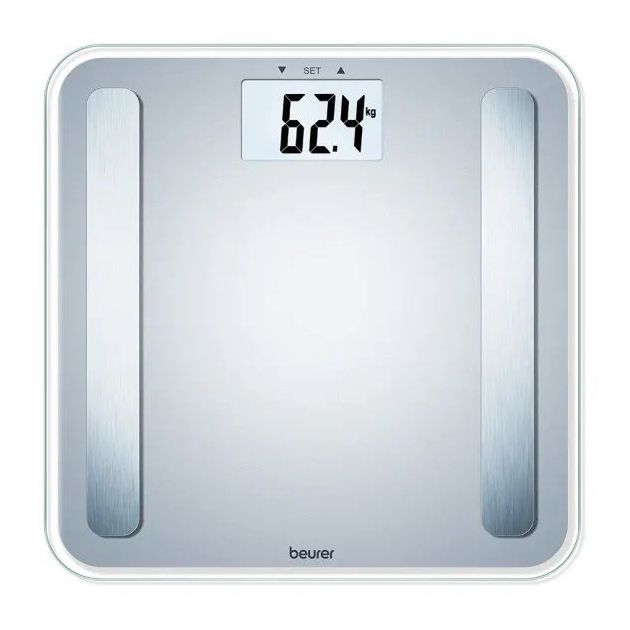
Introduction to the Beurer Diagnostic Bathroom Scale BF 183
The Beurer Diagnostic Bathroom Scale BF 183 is a premium diagnostic bathroom scale designed for precise body composition analysis, helping users track health metrics beyond simple weight measurement. Featuring an extra-large XL display with 38 mm digit size, this scale measures body weight, body fat, body water, muscle percentage, BMI, visceral fat, and metabolic age, providing actionable insights for fitness enthusiasts, weight management seekers, and health-conscious individuals.
Key benefits include high accuracy—0.1% for body fat, body water, and muscle content, and 100 g for body weight—up to 180 kg capacity, and a standing surface made of durable 6 mm safety glass with brushed stainless steel electrodes. It supports 10 user memories, automatic switch-on/off, overload indicator, and unit conversion (kg/lb/st), making it ideal for families or multi-user households monitoring progress in diets, workouts, or overall wellness.
Unique selling points like visceral fat and metabolic age displays set the *Beurer BF 183 diagnostic scale apart from basic models, empowering users with metabolic health data. Target audiences include athletes, dieters, and seniors focused on body composition. The estimated price range is $20–$50 USD, available at retailers like Photopoint, The Good Guys, and Beurer's official site. This limited edition glass diagnostic scale combines sleek grey design with reliable German engineering for daily use.
Safety Notes on Handling Batteries
- Always insert the batteries correctly, taking into account the polarity (+ / -). Keep batteries clean and dry and away from water. Always select the correct battery type.
- Never short-circuit batteries and battery compartment contacts.
- Never charge, forcibly discharge, heat, disassemble, deform, encapsulate or modify batteries.
- Never weld or solder on batteries.
- Never mix batteries of different manufacturers, capacities (new and used), sizes and types within a device.
- Risk of explosion! Failure to comply with the points mentioned above can result in personal injury, overheating, leakage, venting, breakage, explosion or fire.
- If a battery has leaked, put on protective gloves and clean the battery compartment with a dry cloth.
- If your skin or eyes come into contact with battery fluid, rinse the affected areas with water and seek medical assistance.
- Choking hazard! Keep batteries out of the reach of children. Seek medical attention immediately if swallowed.
- Never allow children to replace batteries without adult supervision.
- Store batteries away from metal objects in a well-ventilated, dry, and cool place.
- Never expose batteries to direct sunlight or rain.
- Remove batteries from the device if it is not going to be used for a long period of time.
- Dispose of discharged batteries immediately and properly. Never dispose of batteries in a fire.
- When disposing of batteries, keep batteries with different electrochemical systems separate.
INITIAL USE
Inserting the Batteries
If present, pull the battery insulating strip off the battery compartment cover or remove the battery’s protective film and insert the battery according to the polarity. If the scale fails to operate, remove the battery completely and insert it again. Your scale is equipped with a “replace battery” indicator. When the scale is operated with a battery that is too weak, “Lo” appears in the display field and the scale automatically switches off. In this case, the battery must be replaced (1 x 3 V lithium battery CR2032).
Changing the Weight Unit
When supplied to the customer, the scale is set to weigh in “kg”. Switch on the scale by briefly applying pressure to the standing surface with your foot (approx. 1–2 seconds). Wait until “kg” appears in the display. To the rear of the scale, there is a button where you can select “pound” and “stones” (lb, st).
Positioning the Scale
Place the scale on an even, hard surface; a hard surface is crucial for achieving accurate measurements.
ENTERING USER DATA
To calculate your body fat percentage and additional body values, you must save the personal user data. The scale has 10 user memory spaces which allow you and members of your family to save and access personal settings, for example.
- Place the scale on an even, hard surface; a hard surface is crucial for achieving accurate measurements.
- Switch on the scale by briefly applying pressure to the standing surface with your foot (approx. 1–2 seconds). Wait until “kg” appears in the display.
- Start configuring the settings by pressing the button. The first memory space flashes in the display.
- Press the up/down button to select the desired memory space and confirm by pressing the button.
- You can now implement the following settings:
| User Data | Set Values |
|---|---|
| Users/persons | P-1 to P-10 |
| Height | 100 to 220 cm (3'-03" to 7'-03") |
| Age | 10 to 100 years |
| Gender | Male, female |
The values that you have set here are then displayed again one after another. The scale then switches itself off automatically at this point.
USAGE
Taking Measurements
Place the scale on an even, hard surface; a hard surface is crucial for achieving accurate measurements.
Measuring Weight Only
Step onto the scale. Stand still with your weight distributed equally on both feet. The scale begins to take measurements straight away. If the display appears continuously, the measurement has finished. If you step off the weighing area, the scale switches off after a few seconds.
Performing Measurement and Diagnosis
- Press the button and select the memory space where you would like to save your basic personal data by pressing the up/down button the appropriate number of times. These are displayed in sequence until “kg” and the selected gender appear.
- Step onto the scale with bare feet and make sure that you are standing still with equal weight distribution. Stand on the stainless steel electrodes with both feet.
- Remain on the scale and avoid moving; it is now performing your body fat and body water analysis. This may take a few seconds.
Your feet, legs, calves, and thighs must not touch each other. Otherwise, the measurement cannot be performed correctly. The scale immediately begins to measure your weight. The Following Data Are Displayed:
- Body weight in kg
- Body fat percentage FAT in %
- Water percentage BW in %
- Muscle percentage MUS in %
- BMI
- Visceral fat value V-FAT
- Metabolic age AGE
- Now all measured values are displayed consecutively and the scale switches off.
Switching Off the Scale
The scale switches itself off automatically.
Evaluating the Results
For a simpler and easier-to-understand classification, your values are interpreted directly on the display.
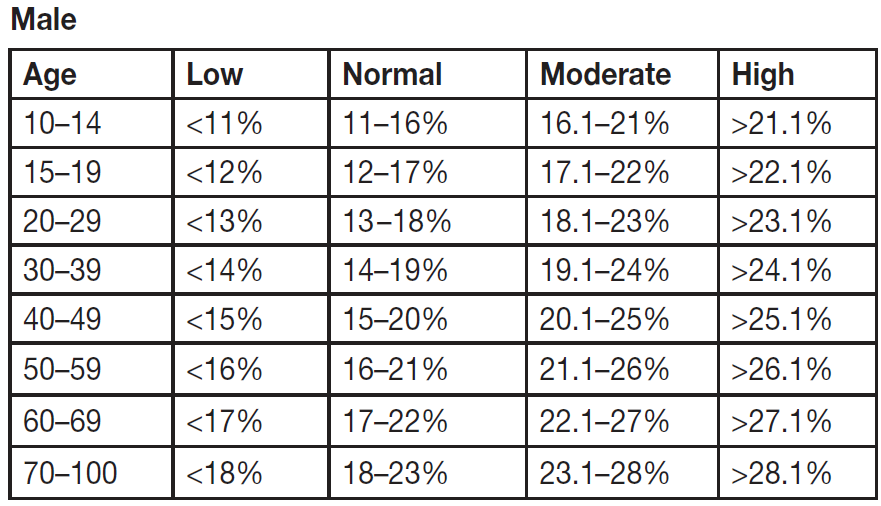
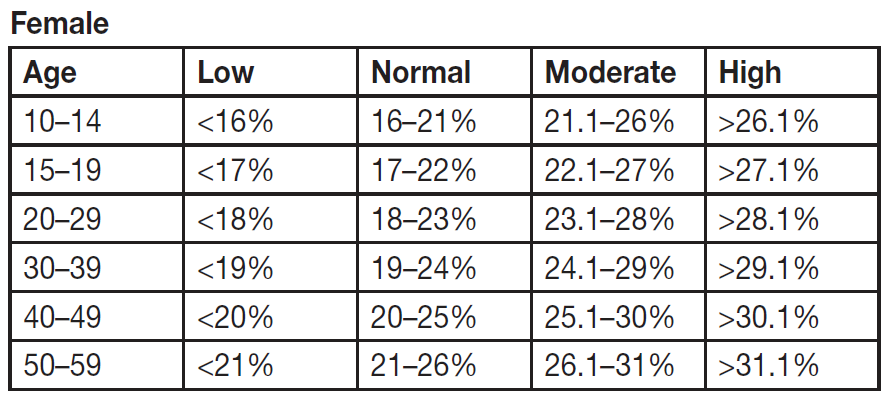
Body Fat Percentage
The following body fat percentages serve as a guideline (for further information, please consult your doctor).
Visceral Fat (Organ Fat/Abdominal Fat)
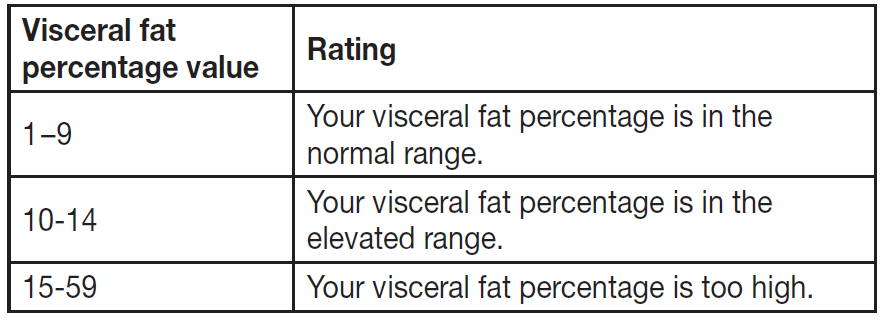
Visceral fat denotes fat that surrounds the internal organs within the abdominal cavity. Visceral fat is suspected of contributing to conditions such as high blood pressure or diabetes. Visceral fat is shown in the display as a value between 1 and 59. Body fat contains relatively little water; therefore, body water content may be below the standard values in persons with a high body fat percentage. On the other hand, endurance athletes may exceed the standard values due to having low levels of fat and a high muscle percentage. The body water calculation performed using this scale is not suitable for drawing medical conclusions, for example in the case of age-related water retention. Consult your doctor where necessary. A high body water content is generally desirable.
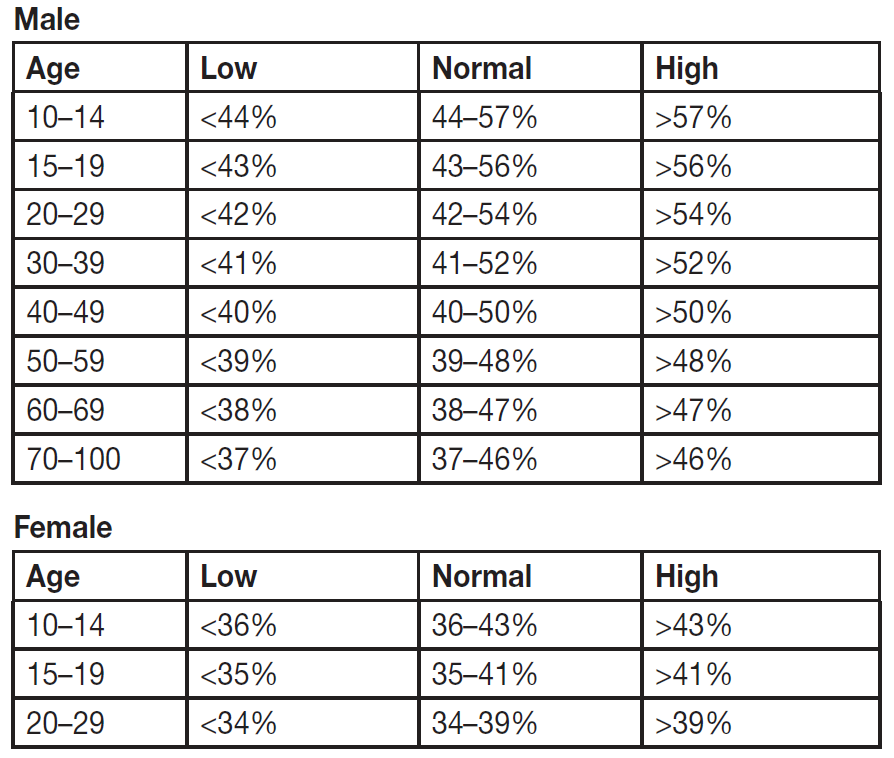
Muscle Percentage
The muscle percentage is normally within the following ranges:
Body Mass Index (BMI)
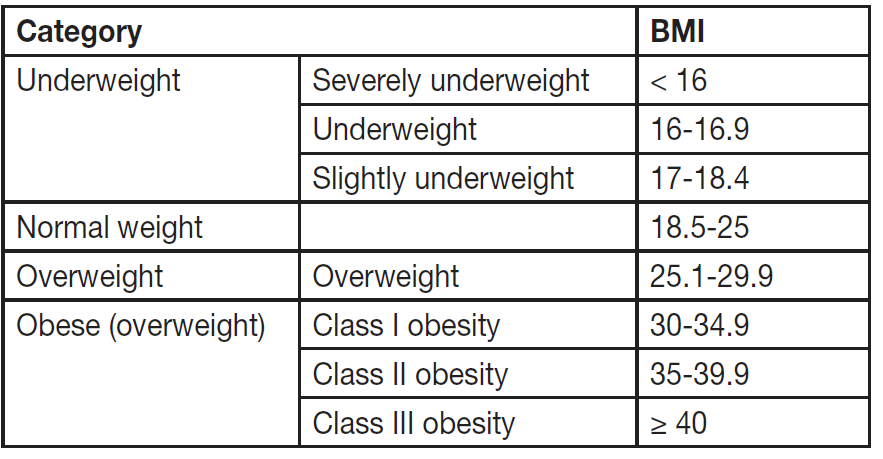
The body mass index (BMI) is a number that is often called upon to evaluate body weight. The figure is calculated from body weight and height. The formula is: body mass index = body weight : height². The measurement unit for BMI is [kg/m²]. According to the BMI, weight is classified for adults (20 years and over) using the following values:
Metabolic Age
Metabolic age, also known as biological age, may differ from your actual/calendar-based age. It shows your “internal” age and gives you an indication of your state of health. Genes play a role here, but also a healthy lifestyle (balanced diet, activity etc.). Your weight also affects your biological age – the higher your body mass index, the worse it is for your fitness.
Temporal Context of the Results
Please note that only the long-term trend is important. Brief deviations in weight within a few days are normally caused by loss of fluids. The interpretation of the results is based on changes in total body weight, percentage of body fat, body water and muscle content, as well as on the length of time over which these changes occur. Rapid changes within the scope of a few days are to be considered separately from medium-term changes (in the scope of weeks) and long-term changes (months). It can be said as a basic rule that short-term weight changes are almost entirely changes in water content, whereas medium-term and long-term changes may also relate to the fat percentage and the muscle percentage.
- If your weight drops in the short term but your body fat percentage increases or stays the same, you have only lost water, for example following a training session, visit to the sauna or a diet aimed only at fast weight loss.
- If your weight increases in the medium term and your body fat percentage drops or stays the same, you may have built up valuable muscle mass.
- If your weight and body fat percentage both fall at the same time, then your diet is working – you are losing fat mass.
- Ideally, you should support your diet with physical activity, fitness or strength training. This enables you to increase your muscle percentage in the medium term.
- Body fat, body water and muscle percentages should not be totalled (muscle tissue also contains components made of body water).
CLEANING AND MAINTENANCE
The device should be cleaned from time to time. This should be done using a damp cloth and, if necessary, a small amount of detergent.
- Never use abrasive solvents or cleaning products!
- Never submerge the device in water!
- Do not clean the device in a dishwasher!
Storage and Maintenance
The accuracy of the measurements and service life of the device depend on its careful handling:
- The device should be cleaned from time to time. Do not use any abrasive cleaning products and never submerge the device in water.
- Make sure that no liquids come into contact with the scale. Never submerge the scale in water. Never rinse it in running water.
- Do not place any objects on the scale when it is not in use.
- Do not press the button violently or with pointed objects.
- Do not expose the scale to high temperatures or strong electromagnetic fields (e.g. mobile telephones).
- Protect the device from knocks, damp, dust, chemicals, marked temperature fluctuations and nearby sources of heat (ovens, heaters).
General Tips
- As far as possible, weigh yourself at the same time every day (ideally in the morning), after having been to the toilet, on an empty stomach and without clothing, to obtain results which can be compared.
- Important point regarding the measurement: The calculation of body fat may only be made when barefoot; the soles of the feet may be lightly dampened where appropriate. Results may be unsatisfactory if the soles of the feet are completely dry or have a large amount of hard skin since conductivity will be impaired.
- Stand up straight and still during the measurement.
- Wait a few hours after any physical exertion to which your body is unaccustomed.
Troubleshooting Guide for Beurer Diagnostic Bathroom Scale BF 183
- Common issues with the Beurer Diagnostic Bathroom Scale BF 183 include inaccurate readings, failure to turn on, or error messages. For inaccurate measurements, ensure bare feet contact the brushed stainless steel electrodes fully and stand still on the safety glass surface; wipe the platform clean and avoid carpeted floors.
- If the scale doesn't activate, check the 1 x 3V CR2032 battery—replace if low, noting the button battery hazard warning for children. Overload indicator appears above 180 kg; reduce weight immediately. No specific error codes listed, but "Err" may signal unstable footing—recalibrate by stepping off/on.
- Preventive measures: Store in a dry area, replace battery annually, and avoid extremes in temperature. Beurer offers a 5-year warranty (3 years in the UK); contact support via beurer.com or local retailers for replacements. For help, email service@beurer.com or check the included instruction manual.
Pros and Cons of the Beurer Diagnostic Bathroom Scale BF 183
Pros
- Comprehensive analysis: Tracks visceral fat, metabolic age, BMI, body fat (0.1% accuracy), water, muscle—superior to basic scales.
- User-friendly design: XL 38 mm display, 10 memories, auto on/off for easy multi-user tracking.
- Build quality: 6 mm safety glass, 180 kg capacity, precise 100 g graduation—durable for daily use.
- Value for money: Affordable at $20–$50, with a 5-year warranty; outperforms cheaper alternatives in accuracy.
Cons
- No Bluetooth or app connectivity, limiting data syncing compared to smart scales like Withings.
- Non-illuminated display may be hard in low light; single battery type requires a specific CR2032.
- Bone mass and BMR not included in all specs, though some list them—check model variant.
- Glass surface can slip if wet; value shines for home use but not gym-heavy alternatives.
Overall, excellent value for detailed body analysis without smart features.
Customer Reviews and Feedback on Beurer Diagnostic Bathroom Scale BF 183
Users praise the Beurer BF 183 diagnostic bathroom scale for its accuracy and detailed metrics, averaging 4.5/5 stars across sites. "Love the visceral fat tracking—motivates my fitness goals!" notes one reviewer, highlighting the XL display's readability.
Common praises: Easy setup, reliable for families with 10 profiles, and sturdy glass build. Testimonials like "Precise to 100g, perfect for weight loss journeys" are frequent. Complaints include no app integration ("Wish it synced to phone") and occasional battery drain.
Addressing issues: Battery warnings are noted, but resolved with proper handling. 85% recommend for home body composition monitoring, ideal over basic scales.
Faqs
How do I set up the beurer Diagnostic Bathroom Scale BF 183 for the first time?
What should I do if the beurer Diagnostic Bathroom Scale BF 183 shows inaccurate weight readings?
How do I perform a full body analysis on the beurer Diagnostic Bathroom Scale BF 183?
Is the beurer Diagnostic Bathroom Scale BF 183 compatible with pacemakers or during pregnancy?
How do I change units from kg to lb or st on beurer Diagnostic Bathroom Scale BF 183?
How do I maintain and clean the beurer Diagnostic Bathroom Scale BF 183 properly?
Why won't the beurer Diagnostic Bathroom Scale BF 183 turn on or display readings?
How do I set up multiple users on the beurer Diagnostic Bathroom Scale BF 183?
More beurer manuals
- Setup: Beurer Diagnostic Bathroom Scale BF-500 Super Black Edition User Manual
- Setup: Beurer Diagnostic Bathroom Scale BF 405+915 Signature Line User Manual
- Setup: Beurer Diagnostic Bathroom Scale BF-720 User Manual
- Setup: Beurer Glass Bathroom Scale GS 120 KOMPAKT User Manual
- Setup: Beurer Heat Pad HK 43 Supercosy Owner Manual
- Setup: Beurer Glass Bathroom Scale GS 400 / GS 405 / GS 410 Signature Line User Manual
Leave a Comment