
Qsc CP-Series 2-way loudspeaker System CP8 User Manual
Content
QSC CP-Series 2-way Loudspeaker System CP8 Overview
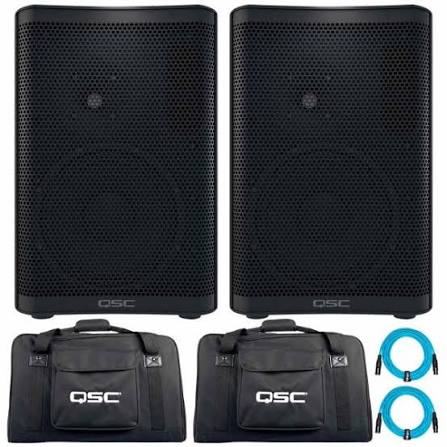
The qsc CP-Series 2-way loudspeaker System CP8 is a compact powered PA speaker designed for portable sound reinforcement, live music, speeches, DJ setups, and rehearsal spaces. It combines an 8-inch woofer with a 1.4-inch compression driver, a Class D amplifier section rated at 800W for low frequencies and 200W for high frequencies, and a 90-degree axisymmetric coverage pattern for clear, even sound dispersion. With a frequency response of 56 Hz to 20 kHz and a maximum SPL of 124 dB, the CP8 delivers surprisingly strong output for its size and is well suited for small to mid-sized venues, solo performers, mobile DJs, and churches.
One of the biggest advantages of the qsc CP-Series 2-way loudspeaker System CP8 is its balance of portability and performance. At about 21 lb, it is easy to carry, mount on a pole, or use as a floor monitor. It also includes dual combo XLR/1/4-inch inputs, a 3.5 mm auxiliary input, and an XLR mix output, making it flexible for simple or expanded setups. The six-position contour voicing and mic boost options make it easy to adapt to speech, live vocals, or music playback without complicated processing. Typical pricing has historically landed around the mid-range compact powered speaker category, often roughly in the $399 to $499 range depending on the seller, region, and sales availability. The CP8 remains widely available through pro audio dealers and online retailers, though stock can vary by market.
Specifications at a Glance
- Configuration: Two-way active loudspeaker
- LF driver: 8-inch cone woofer
- HF driver: 1.4-inch compression driver
- Amplifier: Class D, 800W LF / 200W HF peak
- Frequency response: 56 Hz to 20 kHz
- Frequency range: 53 Hz to 20 kHz
- Maximum SPL: 124 dB
- Coverage: 90-degree axisymmetric
- Inputs: 2 combo XLR/1/4-inch, 1 auxiliary 3.5 mm
- Output: 1 XLR mix out
- Weight: Approximately 21 lb
Troubleshooting the QSC CP8 Powered Speaker
If the speaker does not power on, first check the IEC power cable, wall outlet, and rear power switch. A common cause is an unplugged or faulty AC source rather than a speaker failure. If there is no sound, confirm that the input channel gain is raised, the source device is outputting signal, and the correct input type is selected. Low volume or distorted sound often comes from clipping at the source or excessive gain on the CP8, so reduce input level and raise volume gradually. If you hear hum or noise, try balanced cabling, separate audio and power lines, and test with a different source device.
The CP8 does not typically use numeric error codes like consumer electronics, so problems are usually indicated by LED status and audio behavior rather than code messages. If thermal protection activates, allow the unit to cool, reduce output level, and improve ventilation. Preventive care includes keeping the cabinet clean, avoiding continuous peak operation, and not blocking the rear amplifier section. For warranty service or technical support, contact QSC through its official support channels or an authorized dealer. Keep your proof of purchase and serial number ready when requesting help.
Pros and Cons of the QSC CP-Series 2-way Loudspeaker System CP8
Pros
- Compact and lightweight design makes transport and setup easy for mobile users.
- Strong output for its size, with 124 dB maximum SPL and clean vocal projection.
- Flexible connectivity supports microphones, line sources, and portable playback devices.
- Useful contour presets help tailor sound for speech, live music, or DJ playback.
- Good value for money in the compact powered loudspeaker category, especially for performers who need a dependable all-in-one speaker.
Cons
- 8-inch low-frequency response is solid for small rooms but limited for deep bass-heavy music without a subwoofer.
- Best performance is in small to medium venues rather than larger events.
- Users wanting built-in Bluetooth or advanced digital DSP may prefer newer alternatives.
- Compared with larger models such as the CP12 or full-range rival speakers from JBL and Yamaha, the CP8 trades low-end output for portability.
Overall, the qsc CP-Series 2-way loudspeaker System CP8 offers excellent portability and professional-grade sound for its class, making it a smart choice for users who prioritize reliability and clarity over thunderous bass.
Customer Reviews and User Feedback
Customer feedback for the CP8 is generally positive, with many users praising its clean highs, easy setup, and portable form factor. Typical ratings average around 4.5 out of 5 stars from review collections, with buyers frequently highlighting its usefulness for vocals, speeches, and compact DJ rigs. A common testimonial theme is that the speaker sounds bigger than expected for an 8-inch cabinet and remains clear at moderate to high volumes.
Common complaints focus on limited bass without a subwoofer and the fact that it is not intended for very large venues. One frequent recommendation is to pair it with a sub for dance music or low-end-heavy playback. Many owners describe it as a dependable purchase for anyone needing a compact powered speaker that is easy to carry and consistent in performance.
Buying Advice for the QSC CP8
If you need a portable powered speaker for vocals, acoustic music, presentations, or small event sound reinforcement, the qsc CP-Series 2-way loudspeaker System CP8 is a strong choice. It is especially useful for users who want professional sound quality in a lightweight cabinet with simple controls and fast setup.
- Best for solo performers, mobile DJs, churches, schools, and AV rental kits.
- Consider adding a subwoofer for fuller low-end performance.
- Choose the CP8 if portability matters more than maximum bass output.
- Look at larger alternatives if you need more coverage for bigger events.
Faqs
How do I set up the qsc CP-Series 2-way loudspeaker System CP8 for the first time?
What input connections does the qsc CP-Series 2-way loudspeaker System CP8 support, and which one should I use?
Why is my qsc CP-Series 2-way loudspeaker System CP8 distorting or sounding too loud too quickly?
What are the best settings on the qsc CP-Series 2-way loudspeaker System CP8 for speech, DJ, and live music?
Can I use the qsc CP-Series 2-way loudspeaker System CP8 with a mixer, microphone, or laptop?
How can I connect multiple qsc CP-Series 2-way loudspeaker System CP8 units together?
What should I check if the qsc CP-Series 2-way loudspeaker System CP8 has no sound?
How should I maintain and care for the qsc CP-Series 2-way loudspeaker System CP8 for long-term reliability?
Tags
Leave a Comment