
Setup: Rain Bird ESP-Smte Controller User Manual
Content
Rain Bird ESP-SMTe Controller Review and Product Manual Overview
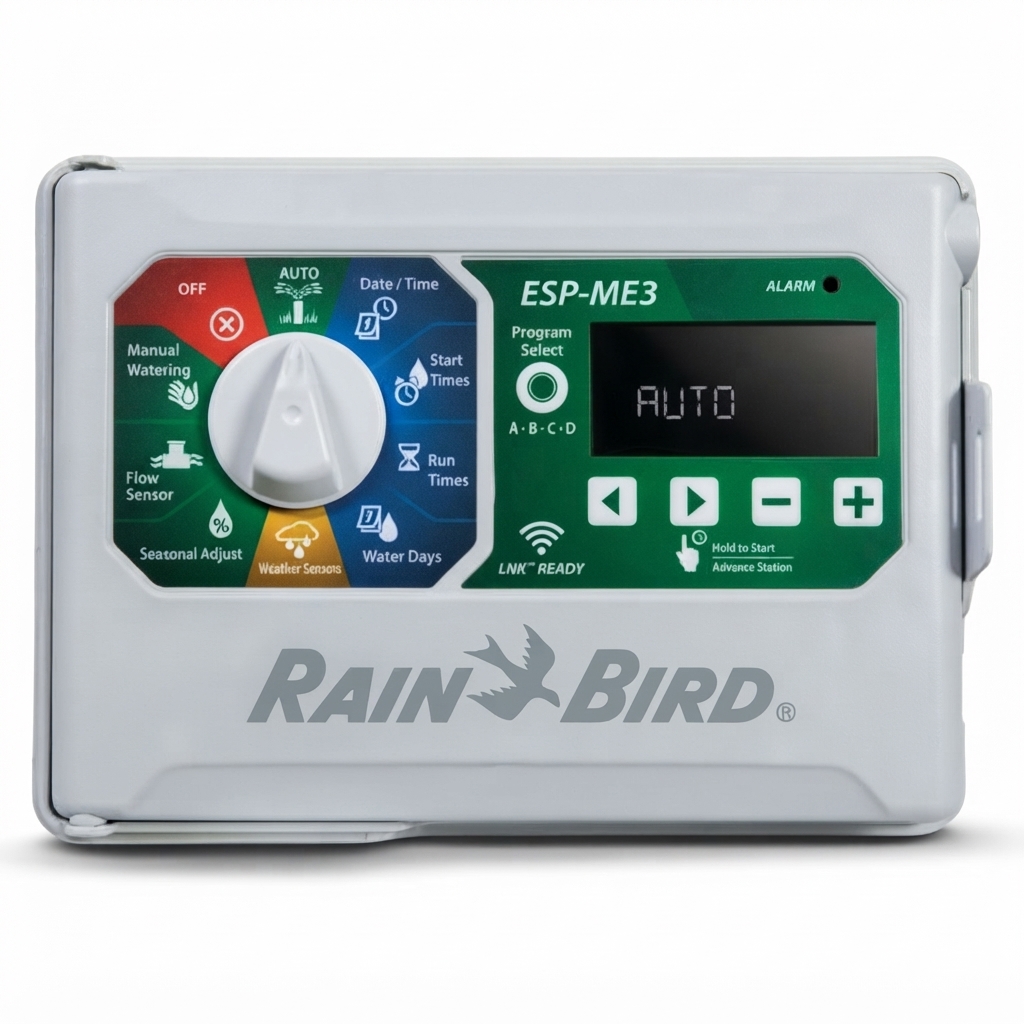
The Rain Bird ESP-Smte Controller is a smart modular irrigation controller designed for residential and light commercial sprinkler systems that need flexible zone expansion and weather-based watering control. It combines simple setup with advanced evapotranspiration-based irrigation logic, helping users reduce water waste while keeping landscapes healthy. This makes it a strong fit for homeowners, property managers, and irrigation pros who want a dependable controller that can grow with the system.
One of the biggest advantages of the Rain Bird ESP-Smte Controller is its modular design. The base unit supports four zones and can be expanded up to 22 stations with expansion modules, making it ideal for small yards as well as larger multi-zone properties. It also includes an SMTe weather sensor, which helps the controller automatically adjust watering schedules based on local conditions. That combination of automation, scalability, and straightforward programming gives it an edge over many basic sprinkler timers.
In practical use, this controller works well for users who want more intelligence than a standard timer without moving into a fully connected smart-home ecosystem. It is especially useful for landscaping with varied sun exposure, turf types, or seasonal watering demands. Estimated market pricing typically falls in the mid-range for professional-grade irrigation controllers, with the base outdoor model often found around the low-to-mid hundreds of dollars, while additional expansion modules cost extra. Availability remains good through irrigation suppliers, hardware retailers, and online marketplaces.
Specifications for the Rain Bird ESP-Smte Controller
- Model type: Smart modular irrigation controller for indoor or outdoor installation
- Standard zones: 4 zones with expansion capability up to 22 stations
- Power input: 120VAC ± 10%, 60Hz for standard U.S. models
- Power output: 25.5VAC, 1A
- Backup memory: Nonvolatile memory retains programming during outages
- Battery support: 10-year lithium battery maintains time and date
- Protection: Built-in surge protection with MOV components
- Compatibility: Supports master valve or pump start relay
- Dimensions: Approximately 10.7 in wide, 7.7 in high, and 4.4 in deep
- Installation options: Indoor and outdoor versions available
The Rain Bird ESP-Smte Controller stands out for combining weather-based watering logic with modular expansion, while many basic controllers only offer fixed-zone scheduling. Compared with simpler timers, it offers better water management and more flexibility. Compared with newer Wi-Fi irrigation controllers, it may lack app-based remote access, but it remains a dependable choice for users who prefer a proven, standalone controller with professional irrigation features.
Pros and Cons of the Rain Bird ESP-Smte Controller
Pros
- Highly expandable: Starts at 4 zones and grows to 22 stations, which is excellent for properties that may need future expansion.
- Weather-based watering: The included sensor helps reduce overwatering and improves seasonal efficiency.
- Reliable memory retention: Programming stays saved even after power loss, which is useful for maintenance and outages.
- Professional-grade build: Suitable for residential and light commercial irrigation systems.
- Good value for modular systems: Offers strong long-term flexibility compared with replacing a smaller fixed controller later.
Cons
- No modern app control: Users who want Wi-Fi and mobile watering adjustments may prefer a newer smart controller.
- Expansion modules add cost: Larger systems require additional purchases, which increases total price.
- Learning curve for beginners: The controller is simpler than some commercial systems, but still more technical than entry-level timers.
- Best for specific use cases: If remote access is essential, alternatives such as Wi-Fi-enabled Rain Bird models may be a better fit.
Overall, the Rain Bird ESP-Smte Controller delivers strong value for users who need dependable irrigation management without paying for features they may never use. For buyers comparing it with simpler controllers, the modular growth path is a major advantage. For those comparing it with app-connected alternatives, the tradeoff is clear: less connectivity, but solid mechanical reliability and weather-aware scheduling.
Customer Reviews and User Feedback on the Rain Bird ESP-Smte Controller
User feedback is generally positive, with many buyers rating it around 4 to 4.5 out of 5 stars for reliability, easy expansion, and water-saving performance. A common praise is the controller’s ability to handle multiple zones without becoming complicated. One typical comment is that it is “easy to expand and dependable for long-term use,” especially for homeowners upgrading from older sprinkler timers.
Frequent complaints usually focus on the lack of Wi-Fi connectivity and the added expense of expansion modules. Some users also mention that first-time setup takes longer than expected if they are unfamiliar with irrigation wiring. Despite that, most reviews highlight consistent scheduling, solid construction, and good overall value for a modular controller. The Rain Bird ESP-Smte Controller is a strong purchase recommendation for buyers who want a proven sprinkler control system with weather-based watering and future expansion in mind.
Faqs
How do I set up the rain bird ESP-Smte Controller for the first time?
Why is my rain bird ESP-Smte Controller not watering when it should?
What makes the rain bird ESP-Smte Controller different from a standard sprinkler controller?
How many zones can the rain bird ESP-Smte Controller support?
Is the rain bird ESP-Smte Controller compatible with an outdoor weather sensor?
How do I use Cycle and Soak on the rain bird ESP-Smte Controller to reduce runoff?
What should I check if the rain bird ESP-Smte Controller display is blank or unresponsive?
How often should I maintain the rain bird ESP-Smte Controller and weather sensor?
More rain bird manuals
Leave a Comment