
Waring Commercial WDH10 10-Tray Food Dehydrator User Manual
Content
Waring Commercial WDH10 10-Tray Food Dehydrator Review and Product Manual
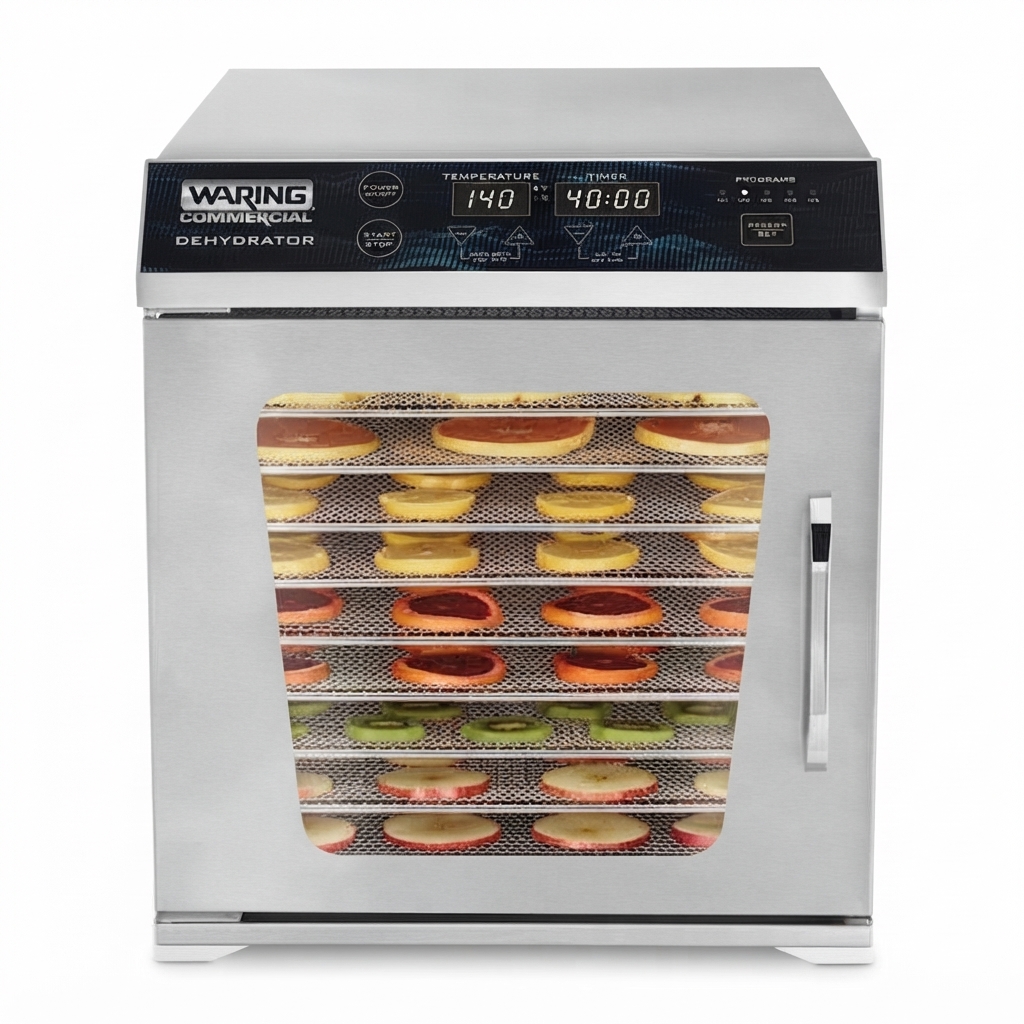
The Waring Commercial WDH10 10-Tray Food Dehydrator is a high-capacity countertop dehydrator built for restaurants, specialty food producers, and serious home users who need consistent drying performance. With ten stainless steel mesh racks and a total dehydrating surface of about 14 square feet, this commercial food dehydrator is designed to handle large batches of jerky, fruit, herbs, vegetables, and snack ingredients with efficient airflow and dependable temperature control.
Its stainless steel housing, glass viewing door, and digital touch controls give it a professional feel, while the adjustable temperature range from 90°F to 180°F supports a wide variety of recipes. The rear-mounted airflow system helps promote even dehydration across multiple trays, reducing the need for constant tray rotation. For kitchens that value productivity, the Waring Commercial WDH10 10-Tray Food Dehydrator offers a practical balance of capacity, durability, and ease of use.
This model is best suited for commercial kitchens, catering operations, farmers market vendors, and food entrepreneurs making dried fruit, jerky, vegetable chips, spice blends, and other shelf-stable products. It is also a strong option for advanced home cooks who want a commercial-grade dehydrator with a compact footprint. Typical market pricing usually falls in the mid-to-premium commercial appliance range, often around the lower four-figure mark depending on the seller, stock levels, and shipping. Availability is generally through restaurant equipment suppliers, commercial kitchen dealers, and online marketplaces.
Specifications for Waring Commercial WDH10 10-Tray Food Dehydrator
- Model: Waring Commercial WDH10
- Tray count: 10 stainless steel mesh racks
- Drying surface: 14 square feet total
- Tray size: 15 in. x 13.5 in.
- Temperature range: 90°F to 180°F
- Power: 800 watts
- Electrical: 120V, 60Hz, 1 phase
- Amperage: 6 amps
- Plug type: NEMA 5-15P
- Cord length: 5 feet
- Dimensions: 14.5 in. W x 20 in. D x 16.3 in. H
- Weight: approximately 35 to 45 lb. depending on listing
- Construction: stainless steel body with glass door
- Controls: digital LED display with touch controls
- Airflow: rear-mounted circulation system
In real-world use, this commercial food dehydrator stands out for its large tray count and sturdy build. Compared with smaller countertop dehydrators, it offers far more usable drying space and better batch efficiency. Against larger high-output models, it is easier to fit into a standard kitchen footprint while still delivering commercial-grade performance.
Troubleshooting the Waring Commercial WDH10 10-Tray Food Dehydrator
If the dehydrator will not turn on, first confirm the outlet is working, the plug is fully inserted, and the unit is connected to a 120V circuit. If the display is active but the unit is not heating, check the temperature setting, make sure the door is fully closed, and allow time for the heating element to cycle. Uneven drying is usually caused by overcrowded trays, overloaded racks, or inconsistent food slicing. Rotate trays when needed and keep food pieces uniform in thickness.
If airflow seems weak, inspect the rear screen and tray alignment for blockages or debris. Clean the stainless steel mesh trays after each session to prevent residue buildup, which can reduce airflow and impact performance. Common error codes are not prominently documented for this model, so most issues are handled through basic operational checks rather than code-based diagnostics.
Preventive maintenance includes regular cleaning, avoiding moisture buildup around the control panel, and not overloading the cabinet. For warranty support, many commercial sellers advertise a limited one-year warranty. For service help, contact the retailer or Waring commercial support through the manufacturer’s customer service channels listed in the product documentation. Keep your model number, purchase date, and serial information ready for faster assistance.
Pros and Cons of the Waring WDH10 10-Tray Commercial Dehydrator
Pros
- Large 10-tray capacity makes it ideal for batch drying and commercial prep.
- 14 square feet of drying space supports high-volume food production.
- Stainless steel construction improves durability and cleanup.
- Digital touch controls offer straightforward temperature adjustment.
- Glass door makes it easy to monitor progress without opening the cabinet.
- Strong value for users who need a compact commercial dehydrator with serious output.
Cons
- Higher purchase price than basic home dehydrators.
- Heavy countertop footprint may be too large for small kitchens.
- No widely documented advanced preset programs compared with premium competitor models.
- Commercial build quality adds weight, which can make repositioning difficult.
For buyers comparing alternatives, the Waring Commercial WDH10 10-Tray Food Dehydrator is a stronger pick than entry-level home units but less feature-rich than some larger specialty dehydrators with more automation. It delivers solid value for food businesses that need reliability over extra bells and whistles.
Customer Reviews of the Waring Commercial WDH10 10-Tray Food Dehydrator
Overall customer feedback is generally positive, with many users praising the roomy tray layout, sturdy stainless steel design, and reliable drying performance. A common rating pattern is around 4 to 4.5 stars out of 5, especially among restaurant operators and serious batch processors.
Typical praise includes comments like, “It handles large jerky batches with consistent results,” and “The glass door and digital controls make it easy to monitor drying without interrupting the process.” Common complaints usually focus on the premium price, weight, and size. Some users note that learning the best temperature and timing for different foods takes a few test runs.
Purchase is recommended for buyers who need a commercial dehydrator for regular production rather than occasional home use. Those seeking a compact, budget-friendly dehydrator may prefer a smaller model, while users needing dependable bulk drying will likely find this unit a strong match.
Final Buying Advice
The Waring Commercial WDH10 10-Tray Food Dehydrator is a practical choice for anyone who needs a durable, high-capacity food dehydrator with commercial performance. Its large drying area, stainless steel build, and adjustable temperature range make it especially useful for jerky, fruit, herbs, and prepared snack products. If your priority is dependable batch processing and long-term kitchen use, this model is worth serious consideration.
Faqs
How do I set up the waring commercial WDH10 10-Tray Food Dehydrator for the first time?
What foods work best in the waring commercial WDH10 10-Tray Food Dehydrator for consistent results?
Why is my waring commercial WDH10 10-Tray Food Dehydrator drying food unevenly?
How can I fix a waring commercial WDH10 10-Tray Food Dehydrator that seems too noisy or vibrating?
How long does it take the waring commercial WDH10 10-Tray Food Dehydrator to dry fruit, herbs, and jerky?
What maintenance does the waring commercial WDH10 10-Tray Food Dehydrator need after regular use?
Can I use the waring commercial WDH10 10-Tray Food Dehydrator for commercial batch prep or large food volumes?
How do I optimize airflow and energy efficiency in the waring commercial WDH10 10-Tray Food Dehydrator?
More waring commercial manuals
- Waring Commercial WWCM180 Single Waffle Cone Maker User Manual
- Waring Commercial WCT708CND Four-Slice Toaster User Manual
- Setup & Features: Waring Commercial Heavy-Duty Citrus Juicer User Manual
- Setup & Features : Waring Commercial 7.0 Quart Stand Mixer WSM7Q User Manual
- Setup & Features: Waring Commercial Heavy-Duty Deep Fryers User Manual
Leave a Comment