
Startup: Nikon D5500 Webcam Digital Camera N1405 User Guide
Content
Nikon D5500 Webcam Digital Camera N1405
Introduction
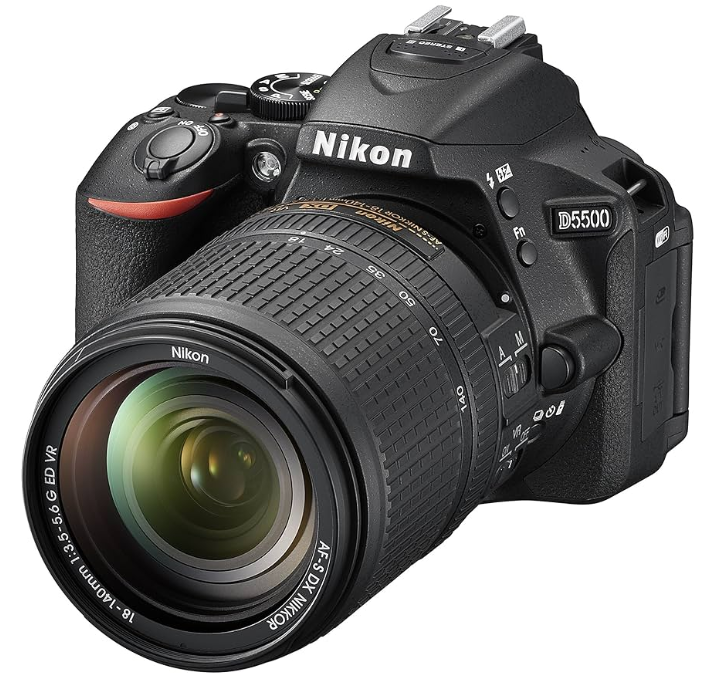
The Nikon D5500 is a versatile and powerful DSLR camera that, when paired with the appropriate accessories, can also serve as a high-quality webcam. Launched in January 2015, the D5500 is part of Nikon's DX-format lineup and is known for its excellent image quality, robust feature set, and user-friendly interface.
This camera is ideal for photographers and videographers who need a reliable device for various purposes, including live streaming, video conferencing, and content creation. The estimated price of the Nikon D5500 body only is around $500-$700, although prices can vary depending on the region and any bundles or kits available.
When used as a webcam, the D5500 offers superior video quality compared to standard webcams, making it a popular choice among professionals and enthusiasts alike.
Package Contents
Confirm that the package contains the following items:
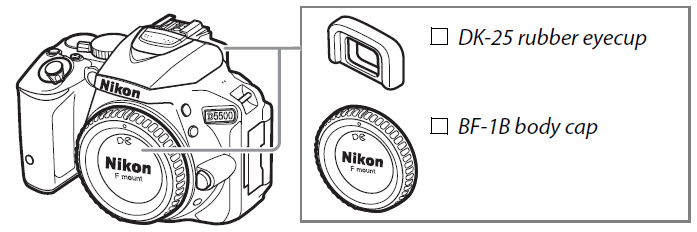
D5500 camera
- EN-EL14a rechargeable Li-ion battery (with terminal cover)
- MH-24 battery charger (plug adapter supplied in countries or regions where required; shape depends on country of sale)
- AN-DC3 strap
- UC-E23 USB cable
- EG-CP16 audio/video cable
- User’s Manual (this booklet)
- Warranty
Specifications
Nikon D5500 Digital Camera
Type
- Type: Single-lens reflex digital camera
- Lens mount: Nikon F mount (with AF contacts)
- Effective angle of view: Nikon DX format; focal length equivalent to approx. 1.5× that of lenses with FX format angle of view
Effective pixels
- Effective pixels: 24.2 million
Image sensor
- Image sensor: 23.5 × 15.6 mm CMOS sensor
- Total pixels: 24.78 million
- Dust-reduction System: Image sensor cleaning, Image Dust Off reference data (Capture NX-D software required)
Storage
- Image size (pixels)
- 6000 × 4000 (Large)
- 4496 × 3000 (Medium)
- 2992 × 2000 (Small)
- File format
- NEF (RAW): 12- or 14-bit, compressed
- JPEG: JPEG-Baseline compliant with fine (approx. 1 : 4), normal (approx. 1 : 8), or basic (approx. 1 : 16) compression
- NEF (RAW)+JPEG: Single photograph recorded in both NEF (RAW) and JPEG formats
- Picture Control System
- Standard, Neutral, Vivid, Monochrome, Portrait, Landscape, Flat; selected Picture Control can be modified; storage for custom Picture Controls
- Media
- SD (Secure Digital) and UHS-I compliant SDHC and SDXC memory cards
- File system
- DCF 2.0, DPOF, Exif 2.3, PictBridge
Viewfinder
- Viewfinder
- Eye-level pentamirror single-lens reflex viewfinder
- Frame coverage
- Approx. 95% horizontal and 95% vertical
- Magnification
- Approx. 0.82× (50 mm f/1.4 lens at infinity, –1.0 m–1)
- Eyepoint
- 17 mm (–1.0 m–1; from center surface of viewfinder eyepiece lens)
- Diopter adjustment
- –1.7–+0.5 m–1
- Focusing screen
- Type B BriteView Clear Matte Mark VII screen
- Reflex mirror
- Quick return
- Lens aperture
- Instant return, electronically controlled
Lens
- Compatible lenses
- Autofocus is available on AF-S, AF-P, and AF-I lenses. Autofocus is not available with other type G and D lenses, AF lenses (IX NIKKOR and lenses for the F3AF are not supported), and AI-P lenses.
- Non-CPU lenses can be used in mode M, but the camera's exposure meter will not function.
- The electronic rangefinder can be used with lenses that have a maximum aperture of f/5.6 or faster.
Shutter
- Type
- Electronically-controlled vertical-travel focal-plane shutter
- Speed
- 1/4000 – 30 s in steps of 1/3 or 1/2 EV; Bulb; Time
- Flash sync speed
- X=1/200 s; synchronizes with shutter at 1/200 s or slower
Wireless
This product, which contains encryption software developed in the United States, is controlled by the United States Export Administration Regulations and may not be exported or re-exported to any country to which the United States embargo on goods. The following countries are currently subject to embargo: Cuba, Iran, North Korea, Sudan, and Syria.
The use of wireless devices may be prohibited in some countries or regions. Contact a Nikon-authorized service representative before using the wireless features of this product outside the country of purchase.
Setup Guide
To use the Nikon D5500 as a webcam, you will need a few additional items, such as the Nikon Webcam Utility software, a USB cable, and possibly an HDMI capture card if you want to stream video directly from the camera's HDMI output.
- Download and install the Nikon Webcam Utility software from the official Nikon website.
- Connect your D5500 to your computer using a USB cable.
- Launch the Nikon Webcam Utility and follow the on-screen instructions to configure the camera as a webcam.
- If using an HDMI capture card, connect the camera's HDMI output to the capture card and then connect the capture card to your computer.
Other Accessories
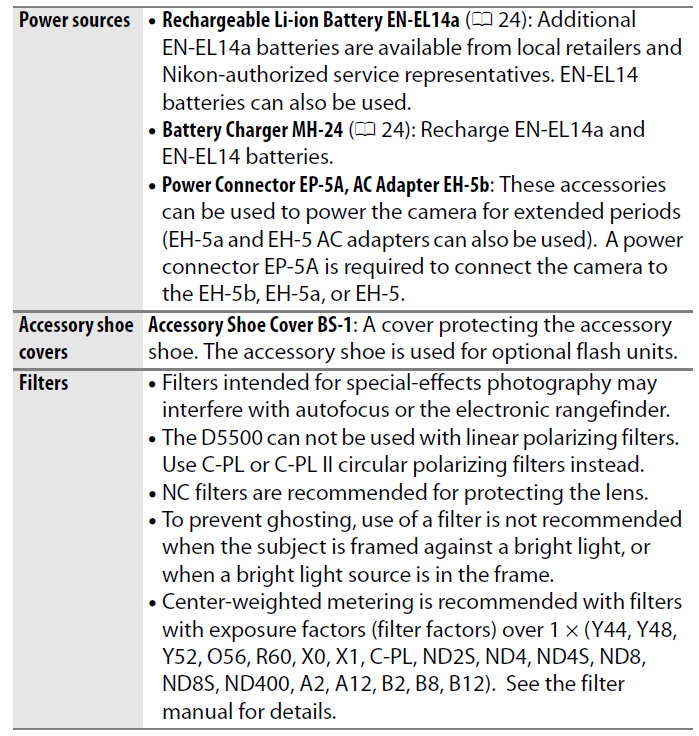
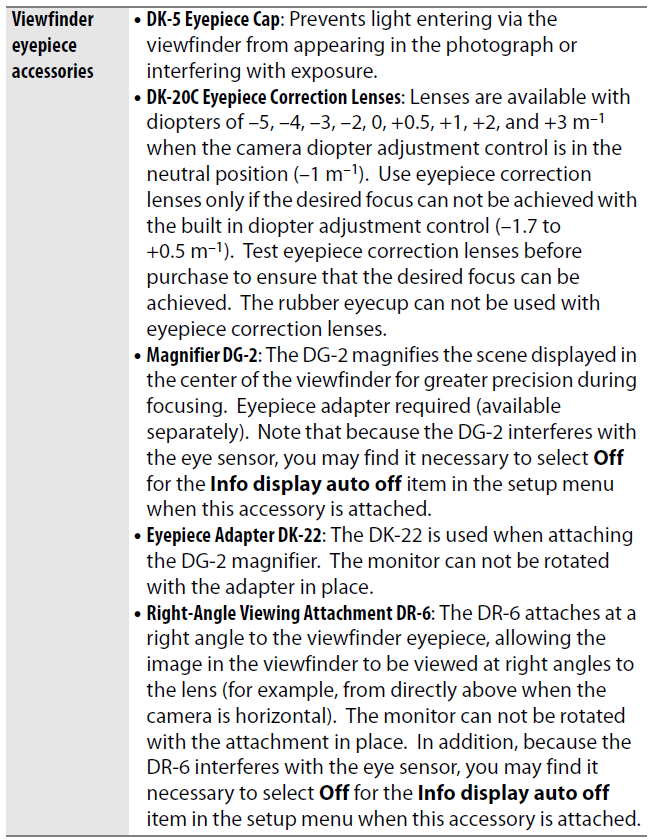
At the time of writing, the following accessories were available for the D5500.
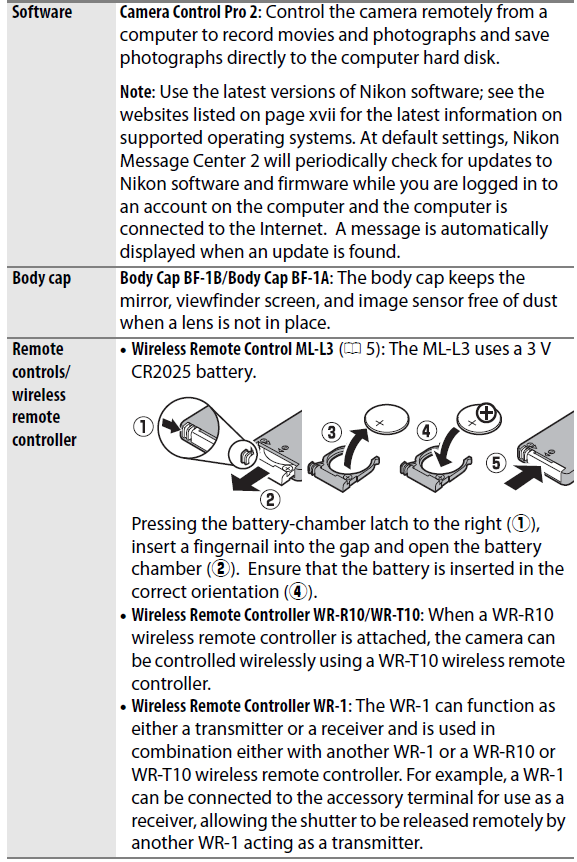
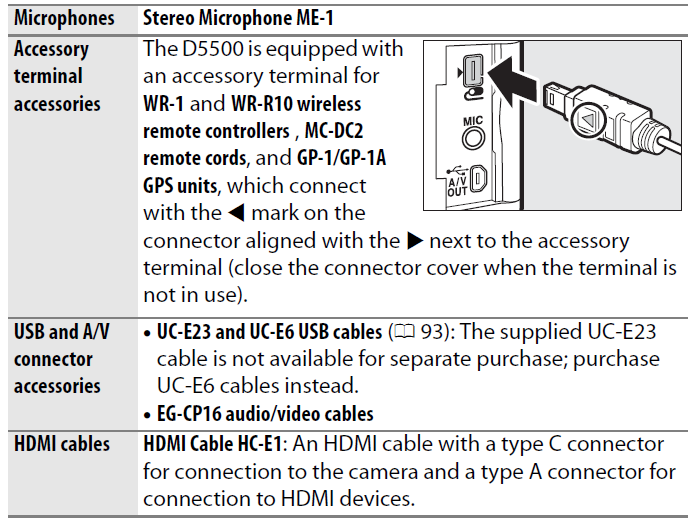
Approved Memory Cards
The following SD memory cards have been tested and approved for use in the camera. Cards with class 6 or faster write speeds are recommended for movie recording. Recording may end unexpectedly when cards with slower write speeds are used.
- Check that any card readers or other devices with which the card will be used support 2 GB cards.
- Check that any card readers or other devices with which the card will be used are SDHC-compliant. The camera supports UHS-I.
- Check that any card readers or other devices with which the card will be used are SDXC-compliant. The camera supports UHS-I.
Other cards have not been tested. For more details on the above cards, please contact the manufacturer.
Caring for the Camera
Storage
When the camera will not be used for an extended period, remove the battery and store it in a cool, dry area with the terminal cover in place. To prevent mold or mildew, store the camera in a dry, well-ventilated area. Do not store your camera with naphtha or camphor moth balls, or in locations that:
- are poorly ventilated or subject to humidities of over 60%
- are next to equipment that produces strong electromagnetic fields, such as televisions or radios
- are exposed to temperatures above 50 °C (122 °F) or below – 10 °C (14 °F)
Battery Life
The movie footage or number of shots that can be recorded with fully-charged batteries varies with the condition of the battery, temperature, the interval between shots, and the length of time menus are displayed. Sample figures for EN-EL14a (1230 mAh) batteries are given below.
- Photographs, single-frame release mode (CIPA standard 1): Approximately 820 shots
- Photographs, continuous release mode (Nikon standard 2): Approximately 3110 shots
- Movies: Approximately 65 minutes at 1080/60p and 1080/50p 3
- Measured at 23 °C/73.4 °F (±2 °C/3.6 °F) with an AF-S DX NIKKOR 18–55mm f/3.5–5.6G VR II lens under the following test conditions: lens cycled from infinity to minimum range and one photograph taken at default settings once every 30 s; after photograph is taken, monitor is turned on; tester waits for monitor to turn off; flash fired at full power once every other shot. Live view not used.
- Measured at 20 °C/68 °F with an AF-S DX NIKKOR 18–55mm f/3.5–5.6G VR II lens under the following test conditions: vibration reduction off, continuous high-speed release mode, focus mode set to AF-C, image quality set to JPEG basic, image size set to M (medium), white balance set to Auto, ISO sensitivity set to ISO 100, shutter speed 1/250 s, focus cycled from infinity to minimum range three times after shutter-release button has been pressed halfway for 3 s; six shots are then taken in succession and monitor turned on; cycle repeated once monitor has turned off.
- Measured at 23°C/73.4°F (±2 °C/3.6 °F) with the camera at default settings and an AF-S DX NIKKOR 18–55mm f/3.5–5.6G VR II lens under conditions specified by the Camera and Imaging Products Association (CIPA). Individual movies can be up to 20 minutes in length or 4 GB in size; recording may end before these limits are reached if the camera temperature rises.
The following can reduce battery life:
- Using the monitor
- Keeping the shutter-release button pressed halfway
- Repeated autofocus operations
- Taking NEF (RAW) photographs
- Slow shutter speeds
- Using the built-in Wi-Fi function or using an optional GP-1 or GP-1A GPS unit or WR-R10/WR-1 wireless remote controller
- Using an Eye-Fi card
- Using VR (vibration reduction) mode with VR lenses
- Repeatedly zooming in and out with an AF-P lens.
To ensure that you get the most from rechargeable Nikon EN-EL14a batteries:
- Keep the battery contacts clean. Soiled contacts can reduce battery performance.
- Use batteries immediately after charging. Batteries will lose their charge if left unused.
No reproduction in any form of this manual, in whole or in part (except for brief quotation in critical articles or reviews), may be made without written authorization from NIKON CORPORATION.
Troubleshooting
If you encounter issues while setting up or using the D5500 as a webcam, here are some common problems and solutions:
- No Video Signal: Ensure that the camera is properly connected to the computer and that the Nikon Webcam Utility is configured correctly.
- Check that the camera settings are optimized for video recording (e.g., correct ISO, white balance).
Always refer to the user manual or Nikon's support website for detailed troubleshooting guides.
Pros & Cons
Pros:
- High-Quality Video: Delivers superior video quality compared to standard webcams. Icannn be used for photography, videography, and as a webcam.
Cons:
- Requires additional software and possibly hardware (HDMI capture card) to function as a webcam.
Customer Reviews
Customers praise the Nikon D5500 for its excellent image quality, robust feature set, and ease of use. Many users appreciate its versatility in serving both as a high-quality DSLR camera and a superior webcam. However, some users find the setup process for using it as a webcam to be somewhat complex.
Common complaints include the need for additional hardware and software, which can add to the overall cost and complexity of using the camera as a webcam.
Faqs
How do I set up the Nikon D5500 as a webcam?
Do I need any additional hardware to use the Nikon D5500 as a webcam?
What is the best way to ensure high-quality video when using the Nikon D5500 as a webcam?
Can I use the Nikon D5500 with any computer or device?
How do I update the Nikon Webcam Utility software?
What are some common issues when using the Nikon D5500 as a webcam?
Is the Nikon D5500 suitable for live streaming?
Can I use external microphones with the Nikon D5500 when using it as a webcam?
How long does the battery last when using the Nikon D5500 as a webcam?
Is there a specific setting or mode I should use for optimal webcam performance?
More nikon manuals
- Specifications: Nikon Digital Camera Coolpix S33 User Manual
- Nikon Coolplix Digital Camera P1000 Usage Guide
- How to Use: Nikon coolscan 35mm Film Scanner Guide | Features
- Nikon Coolpix B500 Compact Digital Camera User Manual | Specifications
- Nikon AF-S DX 35mm Autofocus Lens User Manual | Specifications
Leave a Comment