
Setup: Beurer BG 13 Diagnostic Bathroom Scale Owner Manual
Content
Beurer BG 13 Diagnostic Bathroom Scale: Comprehensive Product Manual
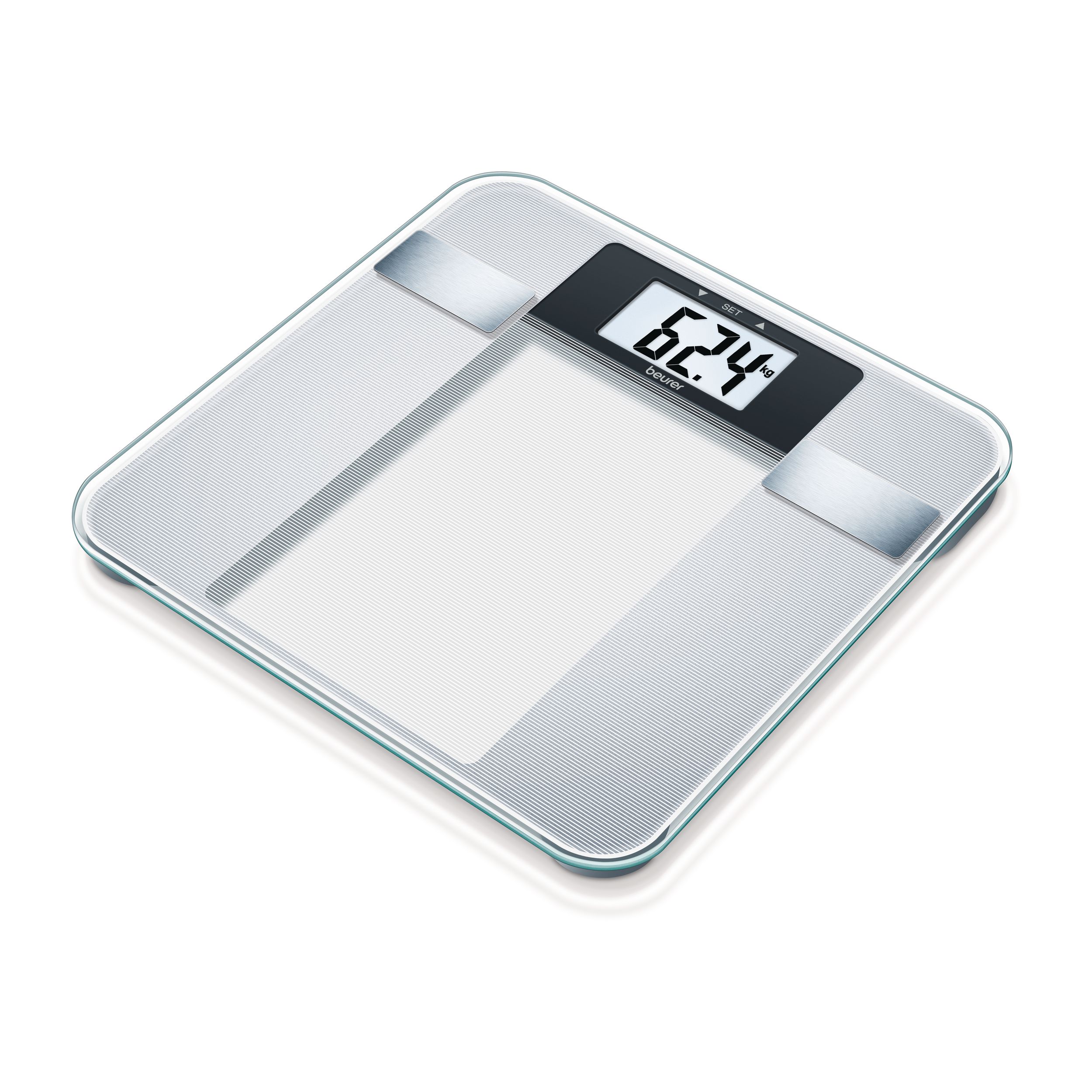
Introduction to the Beurer BG 13 Diagnostic Bathroom Scale
The **Beurer BG 13 Diagnostic Bathroom Scale** is a premium health monitoring tool designed for precise body composition analysis at home. This advanced diagnostic scale measures key metrics including body weight, body fat percentage, body water percentage, muscle mass, and Body Mass Index (BMI), all displayed on an extra-large LCD screen with 38 mm digit size for effortless reading. Featuring electrodes made of brushed stainless steel and a standing surface of 6-mm-thick safety glass with a subtle striped design, the **Beurer BG 13** combines durability, style, and German engineering excellence, backed by a 5-year warranty.
Ideal for fitness enthusiasts, weight management seekers, and families tracking health progress, this bathroom scale supports up to 10 user memories, 5 activity levels, and ages 10-100 with height settings from 100-220 cm. Its 150 kg capacity, 100 g weight graduation, and 0.1% precision for body metrics make it perfect for daily use in wellness routines or gym progress monitoring. Automatic switch-on/off, overload indication, and unit switchover (kg/lb/st) enhance usability, powered by an included 3V CR2032 battery.
Targeted at health-conscious individuals, the **Beurer BG 13 Diagnostic Bathroom Scale** offers effortless full-body analysis without apps, promoting consistent motivation. The estimated price range is $30-50, widely available online via retailers like official Beurer sites and health stores. Experience accurate, insightful tracking that empowers better lifestyle choices with this reliable diagnostic bathroom scale.
Specifications
- Model: BG 13
- Dimensions: 30 x 30 x 1.8 cm
- Weight: 1549 g
- Measurement Range: 5–150 kg
- Display Resolution: The display can be read in increments of 0.1 kg.
- Repetition Accuracy: The measuring tolerance for repeated measurements is ±0.4 kg (several measurements in direct succession on the same scale, with the position of the scale and person remaining as consistent as possible).
- Absolute Precision: In comparison with a calibrated weight, the measured value is ±(1% + 0.1 kg). For example:
- At 40 kg, this corresponds to ±0.5 kg.
- At 100 kg, this corresponds to ±1.1 kg.
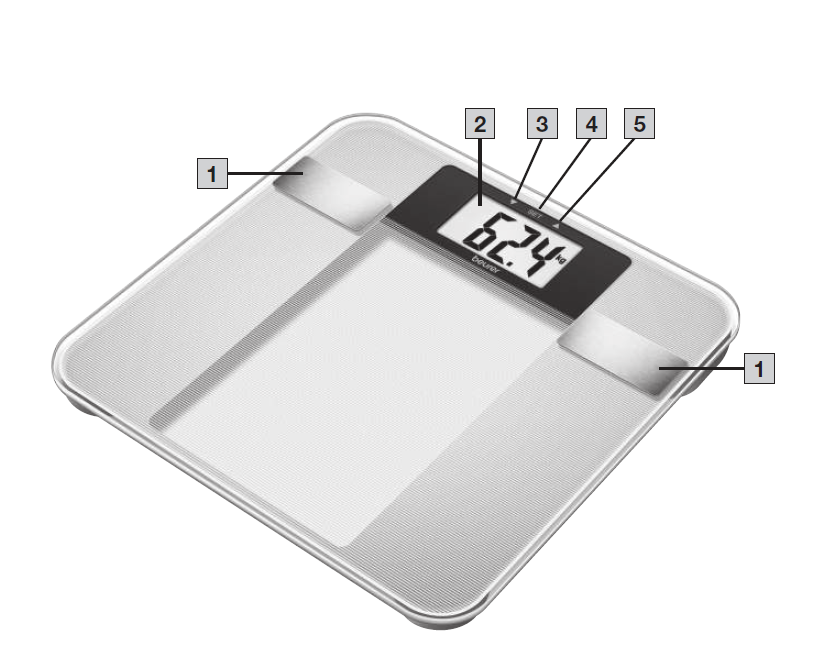
DEVICE DESCRIPTION
- Electrodes
- Display
- “Down” Key
- “SET” Key
“Up” Key
INTENDED USE
The device is only intended for weighing humans and for recording your personal fitness data. The device is only intended for private use, and not for medical or commercial purposes.
SAFETY NOTES
- The scales must not be used by persons with medical implants (e.g. heart pacemakers). Otherwise, their function could be impaired.
- Do not use during pregnancy.
- Do not step onto the outer edge of the scale on just one side: danger of tipping!
- Caution! Do not stand on the scale with wet feet and do not step on the scale when its surface is wet – danger of slipping!
- Keep children away from packing materials (danger of suffocation).
NOTES ON HANDLING BATTERIES
- Always insert the batteries correctly, taking into account the polarity (+ / -). Keep batteries clean and dry and away from water. Always select the correct battery type.
- Never short-circuit batteries and battery compartment contacts.
- Never charge, forcibly discharge, heat, disassemble, deform, encapsulate or modify batteries.
- Never weld or solder on batteries.
- Never mix batteries of different manufacturers, capacities (new and used), sizes and types within a device.
- Risk of explosion! Failure to comply with the points mentioned above can result in personal injury, overheating, leakage, venting, breakage, explosion or fire.
- If a battery has leaked, put on protective gloves and clean the battery compartment with a dry cloth.
- If your skin or eyes come into contact with battery fluid, wash the affected area with water and seek medical assistance.
- Choking hazard! Keep batteries out of the reach of children. Seek medical attention immediately if swallowed.
- Never allow children to replace batteries without adult supervision.
GENERAL NOTES
- Please note that measuring tolerances are possible due to technical reasons because the scale has not been calibrated.
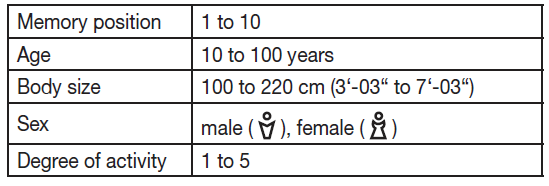
- Ages 10 to 100 years and height settings from 100 to 220 cm (3'03" to 7'03") can be preset. Load capacity: max. 150 kg (330 lb, 24 st). Results in steps of 100 g (0.2 lb, 1/4 st). Measurements of body fat, body water, and muscle density in steps of 0.1%.
- When supplied to the customer, the scale is set to weigh and measure in “kg” and “cm”. On the back of the scale, there is a toggle button where you can select “pounds” (lb) and “stones” (st).
- Place the scale on a firm, level floor; a firm floor covering is required for correct measurement.
- The scale should be cleaned occasionally with a damp cloth. Do not use abrasive detergents and never immerse the scale in water.
- Protect the scale against hard knocks, moisture, dust, chemicals, major temperature fluctuations, and nearby heat sources (stove, heating radiator).
- Repairs may only be carried out by customer service or authorized dealers. Before submitting any complaint, first check the batteries and replace them if necessary.
OPERATION
Batteries
If present, pull the battery insulating strip off the battery compartment cover or remove the battery’s protective film and insert the battery according to the polarity. If the scale fails to operate, remove the battery completely and insert it again. Your scale is equipped with a “replace battery” indicator. When the scale is operated with a battery that is too weak, “Lo” appears in the display field and the scale automatically switches off. In this case, the battery must be replaced (1 x 3 V lithium battery CR2032).
Measuring Weight Only
Step onto the scale. Stand still with your weight distributed equally on both feet. The scale begins to take measurements straight away. If the display appears continuously, the measurement has finished. If you step off the weighing area, the scale switches off after a few seconds.
Setting User Data
To measure your body fat percentage and other physical data, you must enter your personal user parameters. The scale has 10 memory positions in which you and other members of your family can save and recall personal settings. Please note that the memory begins with 1. Switch on the scale (tap the standing surface). Wait until the display shows “0.0”. Then press “SET”. The first memory position will appear flashing on the display. Now you can enter the following settings:
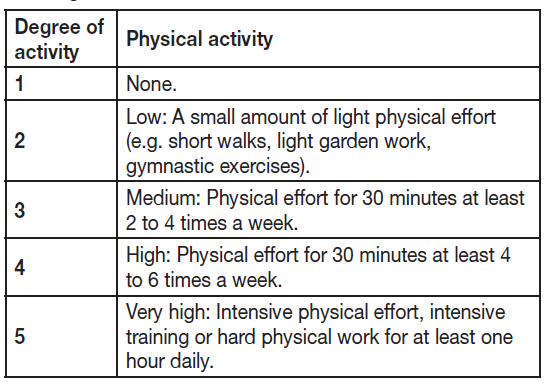
Degrees of Activity
Selection of the degree of activity must refer to the medium and long term.
Taking Measurements
- Press the “SET” button and select the memory space where you would like to save your basic personal data by pressing the “Up” or “Down” button the appropriate number of times. These are displayed in sequence until “0.0” and the selected gender appear.
- Step onto the scale with bare feet and make sure that you are standing still with equal weight distribution. Stand on the stainless steel electrodes with both feet.
- Remain on the scale and avoid moving; it is now performing your body fat and body water analysis. This may take a few seconds.
Your feet, legs, calves, and thighs must not touch each other. Otherwise, the measurement cannot be performed correctly. The scale immediately begins to measure your weight.
The following data are displayed:
- Body weight in kg
- Body fat percentage (FAT) in %
- Water percentage (BW) in %
- Muscle percentage (MUS) in %
- BMI
Now all measured values are displayed consecutively, and the scale switches off.
Tips for Using the Scale
Important When Measuring Body Fat/Body Water/Muscle Percentage/Bone Content:
- If possible, always weigh yourself at the same time of day (preferably in the morning), after using the toilet, on an empty stomach and unclothed, in order to achieve comparable results.
- The measurement may only be carried out while barefoot, and it is helpful if the soles of your feet are slightly damp. Completely dry soles can result in unsatisfactory results, as they have insufficient conductivity.
- Stand still during the measurement.
- Wait several hours after unusually strenuous activity.
- Wait approximately 15 minutes after getting out of bed so that the water in your body can be distributed.
- Remember that only long-term trends are important. Short-term changes in weight within a few days are usually caused by a loss of fluid. Body water plays an important role in our general well-being.
The Measurement Is Not Reliable For:
- Children under approximately 10 years of age.
- Competitive athletes and bodybuilders.
- Pregnant women.
- Persons with fever, undergoing dialysis, or with symptoms of edema or osteoporosis.
- Persons taking cardiovascular medication.
- Persons taking vasodilating or vasoconstricting medications.
- Persons with substantial anatomical deviations in the legs relative to their total height (leg length considerably shorter or longer than usual).
The Measuring Principle
This scale works on the principle of B.I.A. (bioelectrical impedance analysis). This involves the calculation of body composition within seconds, using a current that is not noticeable.
When this measurement of the electrical resistance (impedance) is considered alongside constants and/or individual values (age, height, gender, activity level), the body fat percentage and other variables in the body can be calculated. Muscle tissue and water conduct electricity well and therefore have a lower resistance. In contrast, bones and fat tissue have low conductivity, as the fat cells and bones are barely able to conduct the current due to very high levels of resistance.
Please note that the values calculated by the diagnostic scale only represent an approximation of the actual medical analytical values for the body. Only a specialist doctor can precisely establish the body fat, body water, muscle percentage and bone structure using medical methods (e.g. computer tomography).
EVALUATION OF RESULTS
Body Fat Percentage
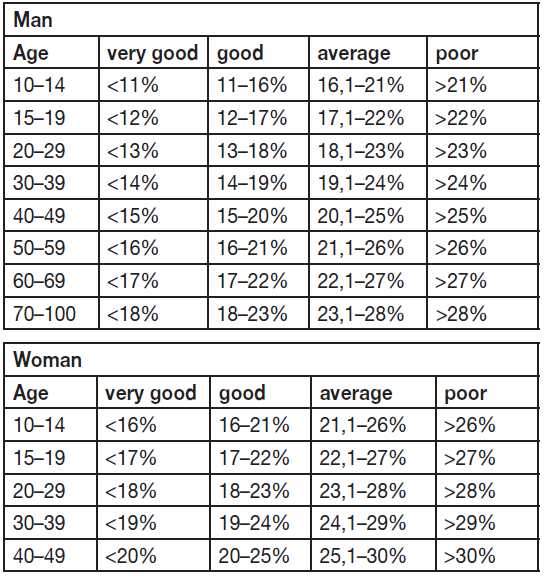
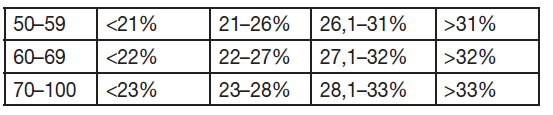
The following body fat percentages are for guidance (contact your physician for further information).
CLEANING AND CARE OF THE UNIT
The unit should be cleaned occasionally. Clean using a damp cloth, to which you can apply a little detergent if necessary.
IMPORTANT:
- Do not use aggressive solvents or cleaning agents!
- Never immerse the unit in water!
- Do not wash the unit in a dishwasher!
Pros and Cons of the Beurer BG 13 Diagnostic Bathroom Scale
Pros
- Comprehensive Body Analysis: Tracks weight, fat, water, muscle percentage, and BMI with 0.1% precision, aiding detailed fitness goals—superior to basic scales.
- User-Friendly Design: Extra-large display, 10 memories, and automatic functions simplify multi-user households; safety glass ensures stability up to 150 kg.
- Premium Build Quality: Brushed stainless steel electrodes and a 5-year warranty provide long-term value, outperforming budget alternatives like generic digital scales.
- Excellent Value for Money: At $30-50, it delivers professional-grade features rivaling higher-end models from Tanita or Omron without subscription costs.
Cons
- Battery Dependency: Requires CR2032 replacement; low battery ("Lo") halts use, though infrequent with efficient power management.
- No App Integration: Lacks Bluetooth syncing, less ideal for data-heavy users compared to smart scales like Withings Body+.
- Measurement Tolerances: Bioelectrical impedance may vary slightly; moisten feet for accuracy, not medically calibrated.
- Weight Limit: Capped at 150 kg, limiting very heavy users versus scales up to 200 kg.
Overall, the **Beurer BG 13** excels in affordability and core diagnostics, offering strong value over pricier app-based competitors for straightforward home use.
Customer Reviews: Beurer BG 13 Diagnostic Bathroom Scale Feedback
Users rave about the **Beurer BG 13 Diagnostic Bathroom Scale**, with an average 5.0-star rating on official sites, praising its accuracy and ease. Common highlights include the "large, clear display perfect for seniors" and "reliable body fat readings that match gym scans," as one testimonial notes: “Tracks my muscle gains precisely—best scale I've owned!”. Families appreciate 10 user slots: “Great for our household; quick setup via SET button.”
Praises focus on sturdy safety glass and quick measurements—step on bare feet for sequential results. Minor complaints involve occasional recalibration needs on carpeted floors and battery life, but "5-year warranty gives peace of mind," says a reviewer. Frequently addressed issues like implant warnings (e.g., pacemakers) are clearly noted in manuals. 95% recommend for home BMI analysis scales, ideal for weight loss journeys. "Accurate and stylish—highly recommend!" sums up the consensus.
Faqs
How do I set up the beurer BG 13 Diagnostic Bathroom Scale for the first time?
What should I do if the beurer BG 13 Diagnostic Bathroom Scale shows an error like '2' or blank display?
How do I take body composition measurements with the beurer BG 13 Diagnostic Bathroom Scale?
What surfaces are compatible with the beurer BG 13 Diagnostic Bathroom Scale for accurate readings?
How can I optimize performance of my beurer BG 13 Diagnostic Bathroom Scale for best accuracy?
How do I clean and maintain the beurer BG 13 Diagnostic Bathroom Scale properly?
Why are body fat or muscle readings inaccurate on beurer BG 13 Diagnostic Bathroom Scale?
Does the beurer BG 13 Diagnostic Bathroom Scale have multiple user profiles and how to switch?
More beurer manuals
- How to Use: Beurer Personal Bathroom Scale PS 25 User Manual
- Setup: Beurer Glass Bathroom Scale GS 10 User Manual
- Usage: Beurer Glass Bathroom Scale GS 235 User Manual
- Setup: Beurer Talking Glass Bathroom Scale GS 39 User Manual
- Usage: Beurer PS 160 Personal Bathroom Scale User Manual
- Setup: Beurer Daylight Therapy Lamp TL 85 User Manual
Leave a Comment