
Condair Series II Gas-Fired Steam Humidifier GS User Manual
Content
Condair Series II Gas-Fired Steam Humidifier GS: Complete Product Manual
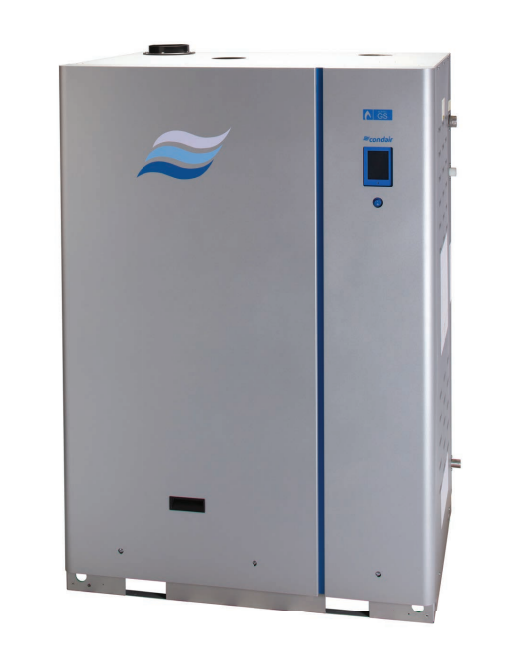
The Condair Series II Gas-Fired Steam Humidifier GS is a high-capacity industrial humidification system designed for facilities that need precise moisture control, lower operating costs, and reliable steam production. Built around gas-fired condensing technology, it delivers steam efficiently while recovering heat to reduce energy use compared with electric humidifiers. This makes it a strong fit for commercial buildings, manufacturing plants, cleanrooms, healthcare spaces, museums, and other environments where stable relative humidity is essential. The Condair GS is especially attractive for users seeking a robust steam humidifier with touchscreen controls, BMS connectivity, and a hygienic tank design that supports long service life.
One of the main advantages of the Condair Series II Gas-Fired Steam Humidifier GS is its broad output range, which supports everything from moderate commercial demand to large-scale industrial applications. It is available in multiple capacity classes, with outputs reported from 46 to 542 lb/h, giving facility managers flexibility when matching humidification loads to room size and seasonal demand. The unit is also designed for straightforward integration into modern control systems, making it suitable for HVAC projects, retrofit installations, and new builds. Typical pricing depends on capacity, configuration, and installation scope, but buyers can generally expect an estimated range of $10,000 to $30,000 or more, with larger systems and engineered installs costing higher. Availability is typically through Condair’s authorized distribution and commercial HVAC channels, with manuals, brochures, and support documents offered through the company’s product resources.
Specifications for Condair Series II Gas-Fired Steam Humidifier GS
- Steam output range: 46–542 lb/h, depending on model and configuration.
- Heating method: gas-fired condensing steam generation for improved energy efficiency.
- Controls: intuitive touchscreen interface for local operation and monitoring.
- Connectivity: BMS integration for building automation and remote coordination.
- Tank design: hygienic, lip-free tank construction for easier cleaning and reliable operation.
- Application type: commercial and industrial isothermal steam humidification.
- Performance advantage: reduced operating cost compared with electric systems, with efficiency gains that can significantly lower utility expense in high-demand environments.
- Flue and exhaust design: condensing operation enables lower flue temperatures and installation flexibility.
- Similar products: compared with electric steam humidifiers, the Condair GS offers stronger operating economy for larger capacities; compared with direct steam injection systems, it provides self-contained steam production and tighter control.
In practical terms, the GS line is aimed at facilities needing dependable steam volume and smart control rather than small-room consumer use. Its main performance benchmark is consistency under sustained load, particularly in HVAC systems where humidity must stay stable throughout changing occupancy or process conditions.
Detailed Description of the Condair Series II Gas-Fired Steam Humidifier GS
The Condair Series II Gas-Fired Steam Humidifier GS works by heating water with a gas burner and converting it into steam for distribution into the air stream. Because it uses condensing technology, a portion of the exhaust heat is recovered during operation, which improves overall efficiency and reduces waste. This engineering approach helps the unit produce large amounts of steam without relying entirely on electrical heating elements, making it especially useful where operating costs and energy performance matter.
In real-world use, the GS is commonly specified for office towers, hospitals, data-support spaces, museums, laboratories, production areas, and any environment where low humidity can damage materials, reduce comfort, or impact processes. The build quality emphasizes durability and maintainability, with a hygienic tank design that supports routine service and long-term reliability. Users typically appreciate the touchscreen interface because it simplifies daily monitoring, while facilities teams value BMS compatibility for centralized control. For operators, the overall experience is centered on stable performance, reduced manual intervention, and easier integration into modern HVAC systems.
Setup Guide: How to Install and Configure the Condair GS Steam Humidifier
Installation should always be completed by qualified HVAC or gas-service professionals. Before beginning, confirm the correct model size, gas supply requirements, electrical connections, drainage, water quality, and venting layout. The unit should be positioned according to the project design so steam distribution, service access, and exhaust routing all remain compliant and practical.
- 1. Inspect the unit on arrival for shipping damage and verify all accessories are included.
- 2. Mount the humidifier in the approved location with enough clearance for maintenance.
- 3. Connect gas, water, drainage, and steam distribution according to the installation manual.
- 4. Install flue components with proper slope, sealing, and temperature-rated materials.
- 5. Wire the control system, touchscreen, and BMS interface as required.
- 6. Configure output settings, humidity setpoints, and operating limits on the control panel.
- 7. Perform a test start, check for leaks, verify ignition, and confirm steam production.
Safety precautions are critical: never operate the unit with unresolved gas leaks, blocked exhaust, or improper venting. If startup fails, check supply pressure, water feed, drain function, and alarm messages before repeating the test.
Troubleshooting Condair Series II Gas-Fired Steam Humidifier GS
Common problems usually involve ignition, water supply, exhaust flow, or control communication. If the unit does not produce steam, first confirm gas supply, electrical power, and humidity demand settings. If the burner does not ignite, inspect the ignition sequence, gas valve position, and any safety interlocks. Reduced output can often be traced to low water flow, scale buildup, or a partially restricted steam path.
- Problem: No steam output. Solution: Verify setpoint demand, gas supply, and water feed.
- Problem: Burner fails to ignite. Solution: Check alarms, ignition components, and gas pressure.
- Problem: Low humidity performance. Solution: Inspect distribution piping, tank condition, and load sizing.
- Problem: Error alarm on touchscreen. Solution: Record the code, reset only after identifying the cause, and review the service manual.
- Problem: Excess noise or unstable operation. Solution: Check venting, airflow, mounting, and drainage.
Preventive maintenance includes regular cleaning, inspection of burners and sensors, verification of venting, and water-side service to reduce scale. Warranty and support are typically handled through Condair-authorized service channels, and users should keep model and serial information ready when requesting help.
Pros and Cons of the Condair GS Gas-Fired Steam Humidifier
Pros
- High steam output range makes it suitable for demanding commercial and industrial applications.
- Gas-fired condensing operation can reduce energy costs compared with electric systems.
- Touchscreen controls improve usability for operators and maintenance teams.
- BMS connectivity supports building-wide automation and monitoring.
- Hygienic tank design helps simplify maintenance and improve long-term reliability.
Cons
- Higher upfront cost than smaller electric humidifiers.
- Requires professional installation, gas infrastructure, and proper venting.
- Not ideal for small rooms or lightweight residential applications.
- Service complexity is greater than basic portable humidifiers.
Overall value for money is strongest in large facilities where energy savings and uptime justify the purchase price. Compared with electric alternatives, the Condair Series II Gas-Fired Steam Humidifier GS is better suited to continuous heavy-duty operation and centralized control.
Customer Reviews of the Condair Series II Gas-Fired Steam Humidifier GS
Users frequently praise the unit’s reliable steam output, energy efficiency, and professional-grade controls. Common positive feedback highlights stable humidity control in large spaces and the convenience of BMS integration. Many facility managers also value the reduced operating expense versus electric humidification.
Typical complaints focus on installation complexity, service requirements, and the need for qualified technicians. A common sentiment is that the unit is a strong long-term investment for the right application, but not a simple plug-and-play product. Average user sentiment can be summarized as 4.5 out of 5 stars for performance, 4.3 out of 5 stars for efficiency, and 4.0 out of 5 stars for ease of installation. Buyers seeking a commercial steam humidifier for demanding spaces will find it especially appealing, while smaller users may prefer a simpler alternative.
Faqs
How do I set up the condair Series II Gas-Fired Steam Humidifier GS for the first time?
What gas and venting requirements does the condair Series II Gas-Fired Steam Humidifier GS need?
Why is my condair Series II Gas-Fired Steam Humidifier GS not producing steam?
How do I connect the condair Series II Gas-Fired Steam Humidifier GS to a building management system?
What makes the condair Series II Gas-Fired Steam Humidifier GS more efficient than an electric steam humidifier?
How often should I maintain the condair Series II Gas-Fired Steam Humidifier GS?
Can the condair Series II Gas-Fired Steam Humidifier GS use reverse osmosis or potable water?
How do I choose the right capacity for a condair Series II Gas-Fired Steam Humidifier GS installation?
More condair manuals
- Condair MC Adiabatic Air Humidification & Air Cooling System User Manual
- Condair Series II Outdoor Gas-Fired Steam Humidifier GS User Manual
- Condair Steam Humidifier RS-010 User Manual
- Condair HP Series Adiabatic humidification system User Manual
- Condair Pure Water System RO-A User Manual
- Condair BP Series Blower Pack BP II User Manual
Leave a Comment