
Condair MC Adiabatic Air Humidification & Air Cooling System User Manual
Content
Condair MC Adiabatic Air Humidification & Air Cooling System: Overview
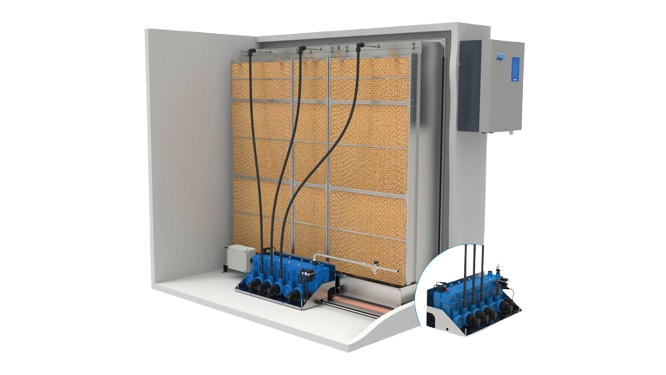
The Condair MC adiabatic air humidification & air cooling system is a high-efficiency in-duct evaporative solution designed to add precise humidity while also delivering free cooling to air handling systems. It combines an evaporative module and a hydraulic unit inside the AHU, with a separate control panel mounted outside for easier operation and maintenance. This makes it a strong choice for commercial buildings, data centers, manufacturing spaces, healthcare facilities, and any environment where indoor air quality, static control, or process stability matters.
One of the main advantages of the Condair MC is its ability to provide both humidification and adiabatic cooling from a single unit. A properly sized system can deliver up to 360 kg/h of humidification and approximately 245 kW of cooling while using very little electricity. That efficiency helps reduce operating costs compared with traditional mechanical cooling and steam humidification systems. The unit is especially useful in dry climates or seasonal environments where humidity levels fluctuate throughout the year.
Estimated pricing typically falls in the premium commercial HVAC category, with final cost depending on AHU size, configuration, media type, controls, and installation requirements. In most projects, the full installed system is custom-quoted rather than sold as a simple off-the-shelf product. Availability is generally through Condair distributors, HVAC contractors, and commercial engineering partners.
Technical Specifications and Key Features
- Type: In-duct adiabatic humidifier and evaporative air cooler
- Maximum humidification output: Up to 360 kg/h
- Cooling capacity: Approximately 245 kW of adiabatic cooling
- Power consumption: Less than 0.15 kW in typical operation
- Water supply: Compatible with mains water or reverse osmosis water
- Water staging: Up to three stages for accurate humidity control
- Automatic drainage: Designed to drain when not operating to reduce stagnation risk
- Media construction: Glass-fiber evaporative media with stainless-steel framing
- Typical sizes: Width from 600 mm to 3000 mm; height from 750 mm to 3000 mm
- Maximum face velocity: 3.5 m/s without droplet separator, 4.5 m/s with droplet separator
- Control signals: 0–10 V, 2–10 V, 4–20 mA, and on/off contact options
- Protection ratings: Control unit IP21; hydraulic module IP42
Compared with steam humidifiers, the Condair MC offers lower energy use and built-in cooling benefits. Compared with larger Condair evaporative systems, it is more compact and suited to smaller-to-mid-size AHU applications while still delivering strong output.
Detailed Product Description
The Condair MC adiabatic air humidification & air cooling system works by pumping water to the top of the evaporative module, where it wets the glass-fiber media. As air passes through the media, moisture evaporates into the airstream, increasing relative humidity and lowering air temperature through the natural evaporative process. Because the system follows the wet-bulb line, it provides efficient free cooling without the energy draw of compressor-based systems.
In real-world use, the unit is well suited to office towers, hospitals, printing facilities, museums, clean rooms, and industrial production areas where controlled humidity helps protect materials, improve comfort, or support process quality. The stainless-steel framing and fiber media support durability in demanding HVAC environments, while the external control panel improves service access.
User experience is typically defined by stable control, low operating cost, and flexible integration with existing building automation systems. The compact in-duct format also helps preserve AHU layout efficiency.
Setup Guide: Installation, Configuration, and Safety
Installation should be completed by qualified HVAC professionals because the system integrates directly into an air handling unit. First, verify AHU dimensions, airflow direction, and available space for the evaporative module, hydraulic unit, and external control panel. Next, mount the module inside the AHU and install the control panel outside in an accessible service area.
Connect the water supply, confirm appropriate pressure and flow, and choose whether the system will run on mains water or RO water. Then configure the control interface to match the building management system, using the supported analog or contact-based control signals. Set humidity targets based on seasonal needs and verify staging response for accurate output control.
Troubleshooting during setup often involves checking airflow direction, drain routing, water pressure, and sensor placement. Safety precautions include isolating power before servicing, preventing water leakage into electrical compartments, and ensuring access panels remain secure during operation.
Troubleshooting Common Problems
- Low humidity output: Check water supply pressure, staging settings, and evaporative media condition.
- Excessive carryover or droplet migration: Confirm face velocity limits and inspect droplet separator installation.
- Unit not starting: Verify control signal, power supply, and interlocks in the AHU.
- Poor cooling performance: Check airflow rate, water distribution, and media saturation.
- Water stagnation concerns: Confirm automatic drain function and maintenance intervals.
If an alarm or fault appears, inspect the controller display, wiring, pumps, and water circuit first. Typical issues are often related to blocked water lines, incorrect setpoints, or sensor misalignment rather than major component failure. Preventive maintenance should include media inspection, cleaning, and regular water quality checks.
Warranty and support are generally handled through Condair’s commercial service network and local distributors. For help, contact the installing contractor or the regional Condair support team listed in the system documentation.
Pros & Cons
Pros
- Very low energy consumption compared with steam or compressor-based alternatives
- Dual-purpose operation for humidification and air cooling
- High output for commercial AHU applications
- Automatic drainage helps reduce stagnation risk
- Flexible control options for building integration
Cons
- Requires professional installation inside an AHU
- Performance depends on airflow, water quality, and correct sizing
- Installed cost can be higher than basic humidification systems
- Best suited to commercial and industrial projects rather than small standalone spaces
For buyers comparing adiabatic systems, the Condair MC offers excellent value where both humidity control and cooling benefits are needed. It is often more efficient than traditional humidification equipment, but smaller applications may find simpler alternatives more cost-effective.
Customer Reviews and User Feedback
Typical user feedback is strongly positive, with many operators rating the system around 4.6 out of 5 stars for efficiency, control quality, and lower operating costs. Facility teams often praise the compact design and the way it improves summer cooling performance without adding major electrical demand.
Common complaints usually involve installation complexity, the need for correct AHU sizing, and maintenance planning for water quality and media care. Users also note that the system performs best when integrated properly with controls and airflow management. Many buyers recommend it for buildings that need precise humidity control and year-round HVAC efficiency.
Final Verdict
The Condair MC adiabatic air humidification & air cooling system is a premium commercial HVAC solution that delivers efficient humidification, free cooling, and reliable control in one integrated platform. For facilities that need precise environmental management with lower energy use, it is a highly practical choice.
Faqs
How do I set up the Condair MC Adiabatic Air Humidification & Air Cooling System for the first time in an AHU?
What should I do if the Condair MC Adiabatic Air Humidification & Air Cooling System is not producing enough humidity?
Why is my Condair MC Adiabatic Air Humidification & Air Cooling System showing a fault or alarm?
Can the Condair MC Adiabatic Air Humidification & Air Cooling System work with mains water or reverse osmosis water?
How does the Condair MC Adiabatic Air Humidification & Air Cooling System control humidity so accurately?
What airflow and installation requirements affect performance of the Condair MC Adiabatic Air Humidification & Air Cooling System?
How often should I maintain the Condair MC Adiabatic Air Humidification & Air Cooling System?
What are the best ways to improve efficiency and hygiene in the Condair MC Adiabatic Air Humidification & Air Cooling System?
More condair manuals
- Condair Steam Humidifier RS-010 User Manual
- Condair Series II Gas-Fired Steam Humidifier GS User Manual
- Condair Pure Water System RO-A User Manual
- Condair Series II Outdoor Gas-Fired Steam Humidifier GS User Manual
- Condair RS-II Steam Humidifier User Manual
- Condair HP Series Adiabatic humidification system User Manual
Leave a Comment