
Set-up & Operations: Hp Pavilion PC User Guide
Content
HP Pavilion PC
Introduction
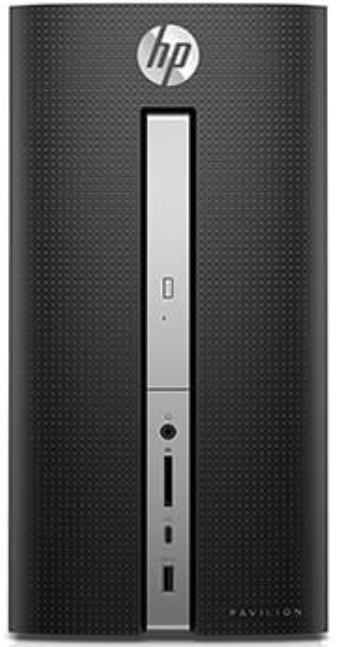
The HP Pavilion PC is a powerful and versatile desktop computer designed for both work and entertainment purposes. With its sleek design and advanced features, it offers a seamless computing experience.
Specifications
- Processor: Intel Core i7-9700K
- Graphics: NVIDIA GeForce RTX 2070 Super
- Memory: 16GB DDR4 RAM
- Storage: 1TB SSD
- Operating System: Windows 10
- Connectivity: Wi-Fi 6, Bluetooth 5.0
- Ports: USB 3.1, HDMI, DisplayPort, Ethernet
- Dimensions: 13.28 x 6.12 x 11.97 inches
- Weight: 13.12 pounds
Instructions
- Unbox the HP Pavilion PC and remove all packaging materials.
- Connect the power cable to the PC and plug it into a power outlet.
- Connect a monitor to the PC using an HDMI or DisplayPort cable.
- Turn on the PC by pressing the power button located on the front panel.
- Follow the on-screen instructions to set up Windows 10.
- Install any necessary drivers and software for optimal performance.
- Connect to the internet using Wi-Fi or Ethernet.
- You're now ready to use your HP Pavilion PC for work or entertainment!
Setting Up Your System
Thank you for choosing a Hewlett-Packard Pavilion PC. To maximize your comfort and productivity, it is important that you set up and use your system properly.
Finding a Place for Your Computer
Keep these recommendations in mind when you choose a place for your computer:
- Choose a room that is dry, clean, and well-ventilated.
- Place the computer on a strong, flat surface with enough space to move the mouse around.
- Provide access to the back of the computer and the display during setup.
- Use grounded, three-prong electrical outlets for the computer and display. HP recommends that you also use a power strip with surge protection.
- Place the computer near a phone jack so that you can connect the modem. The modem is needed to send and receive faxes and e-mail, and to log on to the Internet.
- Consider the location of the windows in the room—if the display reflects direct sunlight, viewing the display may be uncomfortable.
Putting Your Computer Together
For step-by-step instructions on putting your computer together, refer to the Welcome Poster that came with your computer box. You’ll notice that the colors of the cable plugs match the colors
of the connector labels on the back of your computer. When in doubt, match the colors.
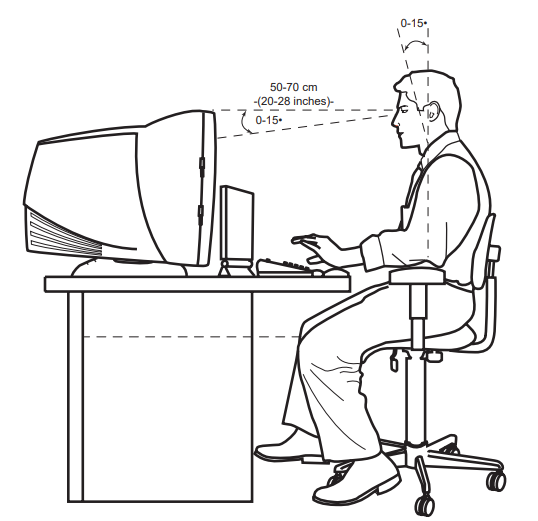
Getting Comfortable
Refer to the manual Working in Comfort With Your HP Computer Equipment, which was provided with your HP Pavilion PC, for important ergonomic information.
Note: You should take frequent, short breaks while using the computer; we suggest you take a break after 15 to 20 minutes on the computer. Stretch each time you take a break. If you experience physical discomfort, it may be alleviated by ergonomically designed accessories such as adjustable chairs, footrests, keyboard trays, wrist rests, and glare screens.
Your System is Working
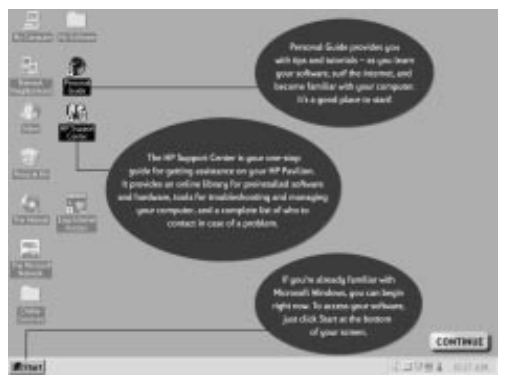
- When you first turn on your computer, a series of startup screens, including a mouse tutorial, appears, and then you see the Microsoft® Windows® 95 desktop. Your computer is now set up.
- Double-click the Free Game icon on the desktop. In addition to giving you a free game, this procedure will guide you through the steps necessary to register. It is important to register with HP, so that you can be notified of changes and updates for your HP Pavilion PC.
- After you register online, a roadmap points out and describes several important icons on your desktop. For further information on Personal Guide and HP Support Center, see the next chapter.
If Your System is Not Working
If one or more of your system components are not working properly,
Starting Out with HP
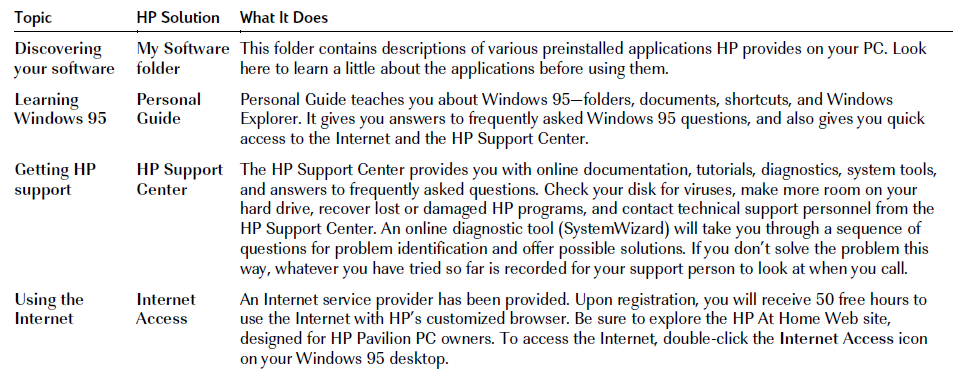
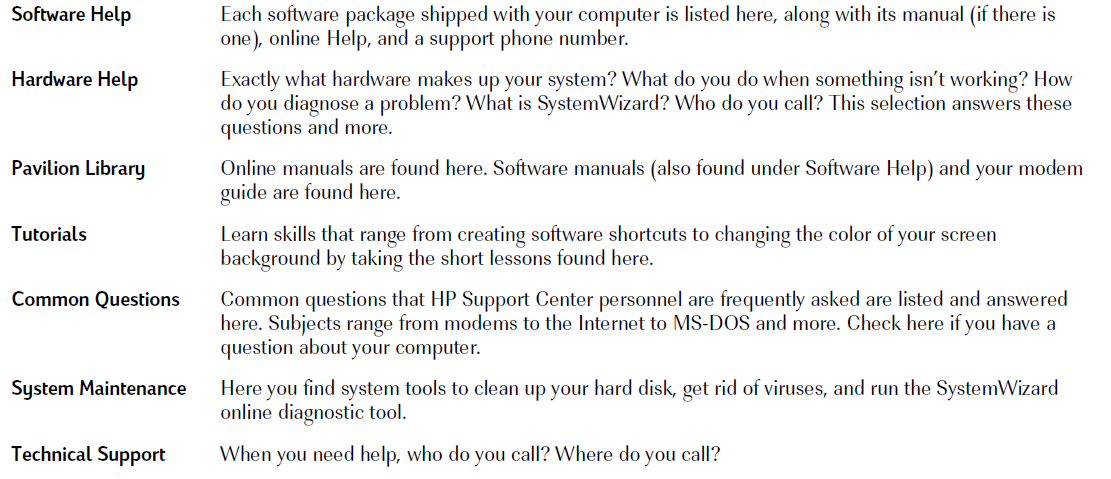
To help you get started, HP provides simple solutions for discovering your software, learning Windows 95, getting support, and using the Internet. The following table describes these solutions.
Note: Your computer is shipped with Windows 95. Hewlett-Packard does not support Windows NT on the Pavilion.
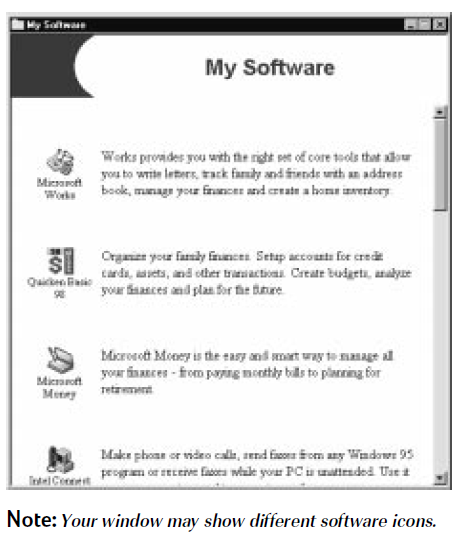
My Software Folder
Your HP Pavilion PC comes with a number of preinstalled software programs. The programs vary, depending on which system you purchased. To see what programs you have and run them:
- Double-click the My Software folder on your Windows 95 desktop.
- To run a program, double-click the program’s icon in the My Software window.
Note: You can also run all of these preinstalled programs (plus any new ones you install) from the Windows 95 Programs list. To see this list, click Start on the Windows 95 taskbar and then choose Programs.
Personal Guide
For those who are new to Windows 95, the Personal Guide provides an easy way to start using your HP Pavilion PC. It offers easy access to a variety of on-screen tutorials and multimedia demos that will help you get up and running quickly with your new computer.
Start the Personal Guide by double-clicking its icon on the Windows 95 desktop.
To explore a Personal Guide category, click its button in the Personal Guide window.
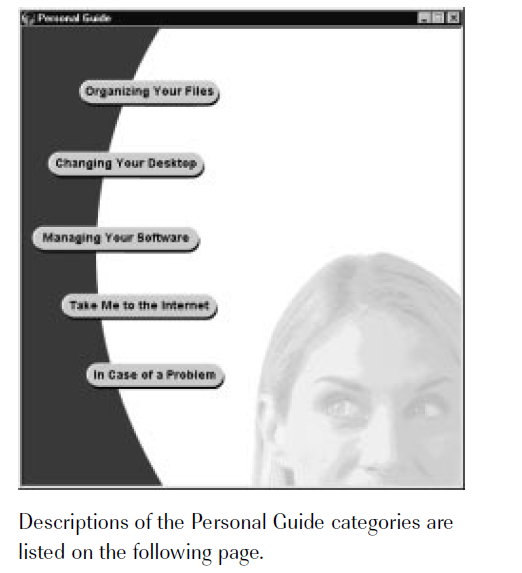
Personal Guide Categories
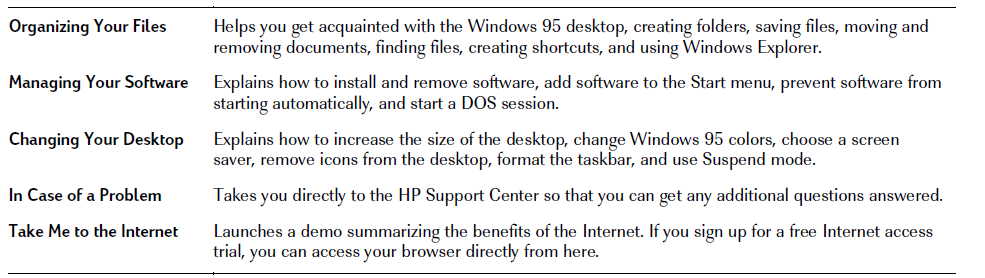
Several of the categories (Organizing Your Files, Managing Your Software, and Changing Your Desktop) contain several topics for which you can run tutorials. Just click a topic, read the helpful information presented on the screen, and then click Show Me a Step-by-Step Demo to see and hear the multimedia tutorial.
Easy Internet Access
HP has made it easy for you to explore the world of the Internet by providing:
- A customized Internet browser that points you to some of the most interesting sites on the Web.
- Free Internet access for up to 50 hours. E-mail is included, and no credit card is needed!
- To launch the custom browser, press the Internet button on the keyboard or double-click the Internet Access icon on your desktop.
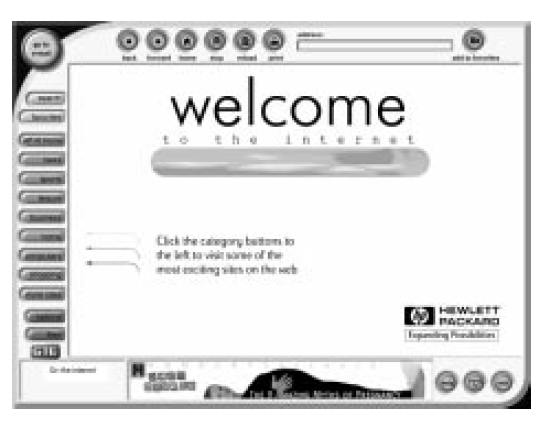
You can then watch an interactive demo that will acquaint you with the Web and show you how to use e-mail. When you’re ready, click Sign Up to register for your free Internet access trial.
After you sign up, you will see the HP At Home website, which was created especially for HP Pavilion PC owners. It’s filled with questions and answers, tips, tricks, and activities for fun with your HP Pavilion PC. The custom browser provides direct links to popular sites on the Web, helps you search the Web for specific topics, lets you send and receive e-mail, and more. Even if you already have an Internet service provider and an e-mail address, you can still use the browser provided. Simply select this option during the sign-up process.
HP Support Center
If you are having trouble learning a new software program or diagnosing a hardware problem, the HP Support Center is the place to go. Your support options, online documentation, tutorials, and system maintenance tools have been grouped in this one convenient location. To go to the Support Center, choose HP Support Center in the Start menu or double-click the icon on the desktop.
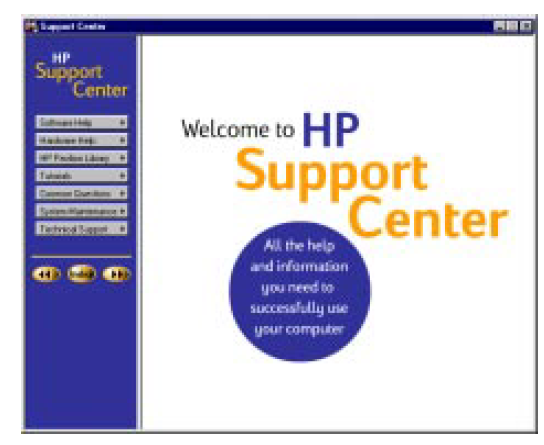
HP Support Center Options
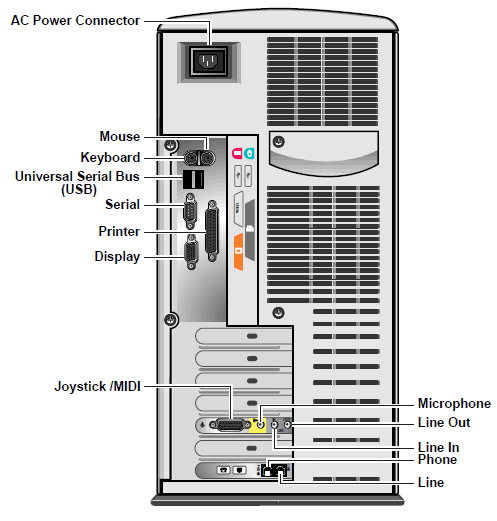
Connecting Components to Your PC
This illustration points out all the connections on the back of your computer. You may need to refer to this drawing in case you ever move your computer and need to reconnect the components, or if you purchase new accessories.
Using Headphones
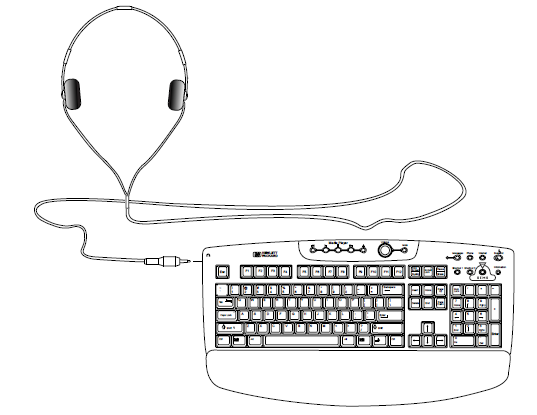
The HP Pavilion one-touch multimedia keyboard is equipped with a standard mini (3.5mm) headphone jack. This jack supports most portable headphones. If you would like to use headphones equipped with the larger .25-inch phone jack, inexpensive adapters are available at most consumer electronics stores.
To use the headphones, plug them into the outlet located on the side of the keyboard.
Note that when the headphones are plugged in, the speakers will be muted. (The system’s line output, however, will continue to work.) When you unplug the headphones, the speakers will go back to normal operation.
Using Your Computer with Your Stereo System
- Sending Output to a Stereo System
- Your computer can be connected to your stereo system for games or multimedia applications. Connect the line output from the audio card to any unused line-level input connector on the stereo system. Use a cable that has a 3.5mm stereo plug on one end and two RCA plugs on the other end. (You can buy such a cable at most consumer electronics stores.)
- When your computer and your stereo system are connected, the volume levels can be adjusted with either the computer keyboard Volume knob or the stereo volume control.
Making Audio Recordings to a File
- You can make recordings on your computer using either the Microsoft Sound Recorder Applet or the Media Rack Wave Recorder. In either case:
- Select the sound source. For computer-generated sounds, select Line Out as the source. For stereo-generated sounds, connect the Line Out of the stereo system to the Line In of the computer and select Line In as
the source. - Set recording properties for the desired recording quality. Be aware that the higher the recording quality, the larger the resulting file will be. A CD-quality recording requires approximately 11 MB per minute of recorded material.
- Start the recorder by clicking the red button on the recorder.
- Start the material to be recorded. The audio is now being saved on the hard drive as a .WAV file.
- After the material has been recorded, stop the recorder and save the file.
- Select the sound source. For computer-generated sounds, select Line Out as the source. For stereo-generated sounds, connect the Line Out of the stereo system to the Line In of the computer and select Line In as
Replacing the Battery
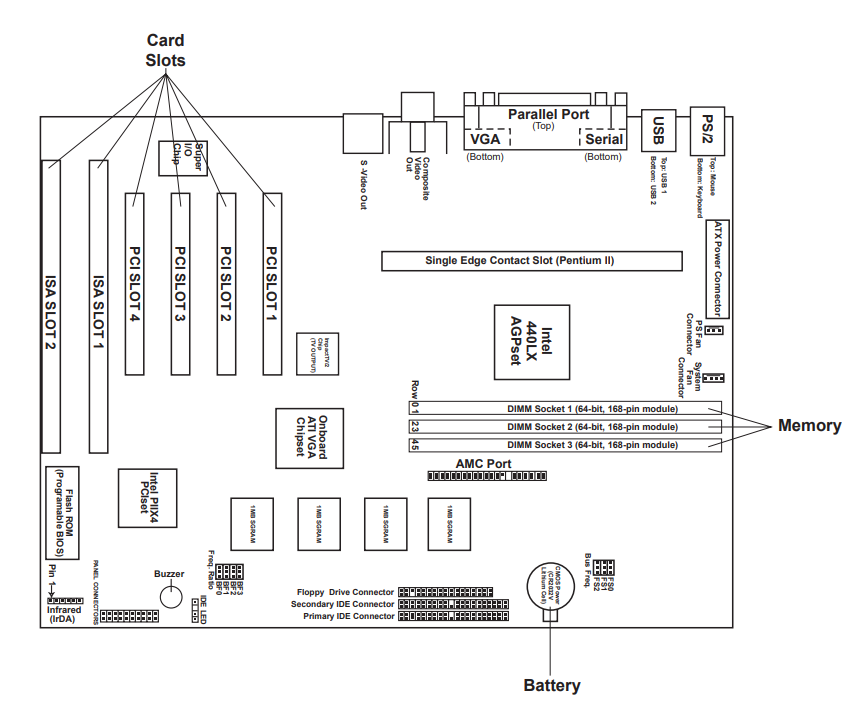
- A lithium battery on the motherboard provides backup power for the computer’s timekeeping capability. The battery has an estimated life expectancy of seven years.
- When the battery starts to weaken, the date and time may be incorrect. If the battery fails, replace it with a CR2032 lithium battery (3 volt, 220mAh rating) or an equivalent battery.
- Warning: There is a danger of explosion if the battery is incorrectly replaced. Replace only with the same or equivalent type of battery. Discard used batteries according to the manufacturer’s instructions.
- Attention : Il y a danger d’explosion s’il y a remplacement incorrect batterie. Remplacer uniquement avec une batterie du meme type ou d’un type equivalent recommandé par le constructeur. Mettre au rebut les batteries usagees conformement aux instructions du fabricant.
Replacing the battery
To replace the battery:
- Turn off the computer and all peripherals.
- Disconnect the power cord and modem cable.
- Remove the computer cover according to the directions in the booklet Removing the Computer Covers.
- If necessary, remove any full-length add-in cards to gain access to the socket. (See the next page for battery location.)
- Remove any components that are blocking access to the battery.
- Gently pry the battery free from its socket, taking care to note the positive (+) and negative (-) orientation of the battery.
- Install the new battery in the socket, observing the correct polarity.
- Replace any components that were removed.
- Replace any add-in cards that were removed,, and then replace the computer cover.
- Run the BIOS (Basic Input Output System) Setup program to reset the date and time.
Troubleshooting
This chapter discusses your options for resolving problems you may have with your HP Pavilion PC:
- Fixing common problems
- Solving software issues
- Using system tools
- Using SystemWizard
- Calling HP support
- Using the HP Pavilion Recovery CD(s)
Fixing Common Problems
This section lists problems you might experience when using your computer. The problem is listed first, followed by the solution. Check to see whether your problem is listed. The list is in alphabetical order. For example, if your Windows 95 taskbar has disappeared, check under W for Windows and then find the problem . My taskbar disappeared. General problems are listed at the end of this section.
Answering machine: he answering machine never answers the phone.
Make sure that the software is running. (The screen with the phone should be in an open window.) If the software is running, make the following adjustments from the Intel Connect™ main window:
- Click Setup.
- Click Answering.
- Choose either Answer as a voice mail system or Answer as an answering machine.
Answering machine : The answering machine grabs calls before I can answer the phone.
- Increase the number of rings before Intel
- Connect™ automatically answers:
- From the Intel Connect™ main window, click Setup.
- Click Ringing.
- Enter a higher number in the Auto-answer ring count box.
- Make sure that the DND (Do Not Disturb) button is not lit on the Intel Connect™ main window. Click the DND button to disable the Do Not Disturb feature.
- Answering machine,, I can't hear messages as they are left.
Check the following:
- Make sure that the Screen button is lit on the Intel Connect™ main window.
- Make sure that the mute feature is not on.
- Press the keyboard Mute button repeatedly until Mute Off flashes on your screen.
- Adjust the Volume knob on the keyboard or use the Multimedia Sound Mixer to increase just the answering machine sound level:
- Double-click the Volume icon (located in the lower-right corner of your screen).
- Adjust the slide control. Make sure that the Volume Controls are set at least halfway.
- Answering machine,,e I can't hear messages as they are played back.
- Make the following adjustments:
- Make sure that the mute feature is not on.
- Press the keyboard Mute button until Mute Off appears on the screen.
- Turn up the Volume knob on the keyboard.
- Adjust the Sound Mixer volume:
- Double-click the Volume icon (located in the lower-right corner of your screen).
- Make sure that the Volume Controls are not muted and are set at least halfway.
- Answering machine, I, Ican'tt record an outgoing message.
- Use the phone you connected to your computer, rather than the microphone in the display, to record the message. If you haven’t set up a phone on the computer, directions are on your Welcome Poster.
- CD The message System Error: Unable to read drive appears when running a CD program.
- Make sure that the CD is placed into the drive with the label side up.
- Wait 5 to 10 seconds after closing the CD drawer to give the computer time to recognize the CD.
- Are you trying to play a DVD in a CD player?
- A DVD will not play in a CD player. To play a DVD, you must have a special DVD player.
- Display My display doesn't work, even though the computer appears to work.
- Make sure that the power cord is securely plugged into the display.
- Make sure that the display is turned on—it has its own power switch.
- Make sure that your power cord is plugged into a grounded three-prong outlet. Check to see whether the outlet works by plugging another item (such as a lamp) into the outlet. (If the light on the front of the display is lit, it is getting power. Try the next item on this list.)
- Check the cable connection between the display and the computer. The cable connectors must be pushed in all the way.
- Adjust the brightness and contrast controls on the display. (The information may be there, but you just can’t see it.)
- Fax and pho, can't dial out.
- Check to make sure that a phone cable connects from the back of the computer to the wall. The cable must be plugged into the rightmost socket on the computer. The left socket is there to plug in a phone if you want to.
- Fax and phone, I can't correct typing mistakes when dialing a phone number.
- No, you can’t. The Backspace key doesn’t do anything here. If you misdial a number, you must hang up and start over.
- Fax and phone T..he message Invalid phone number appears when using the Address Book.
- You need to include the area code in the Properties Description in the Address Book Manager window.
- Fax and phone. The message Check error log appears in the status window. Make the following adjustments, starting at the Intel Connect™ main window:
- Click Setup.
- Click Error Log.
- Read the error message.
- Click Delete.
- Fax and phone: Incoming faxes are not picked up automatically.
- Click Setup on the Intel Connect™ main window.
- Click Answering.
- Choose either Answer as a voice mail system or Answer as an answering machine.
- Fax and ph,, one I can't enter a name or a phone number in the To: box when composing a fax.
- In the Message Manager window:
- Click To:
- Choose a name from the Address Book,; or click Unlisted, and then enter a name and phone number.
- Fax and phone,, The Address Book dials the person's business phone instead of the home phone (and vice versa).
- In the Address Book window:
- Click Other Number.
- Choose Home Phone or Business Phone.
- Keyboard: My keyboard doesn't work, even though the computer and display seem to work.
- Make sure that the keyboard is connected to the keyboard port, not the mouse port. The colors of the cable plugs and the colors of the connector labels should match.
- Press the Caps Lock key on the keyboard.
Does a light appear on the key?
- Mouse: My mouse doesn't work, even though everything else does.
- Make sure that the mouse is connected to the mouse port, not the keyboard port. The colors of the cable plugs and the colors of the connector labels should match. If you need to reconnect these two cables, you must turn the computer off, reconnect the cables, and then turn the computer back on.
- Make sure that you are in Windows 95, not MS-DOS. (The MS-DOS interface is a plain screen with a prompt that looks like this: C>) If you are in MS-DOS, type EXIT and press the Enter key.
Does the pointer move on the screen when you move your mouse?
- If not, try this:
- Remove the mouse ball by unscrewing the bottom of the mouse.
- Clean the mouse ball with a damp cloth (not paper).
- Use your finger to move the rollers in the mouse ball housing.
- Replace the mouse ball and screw on the cover
- Sound, my computer doesn't make any sound.
- Check the headphone and microphone cables at the back of the computer to be sure they are not switched. The colors should match. Be sure the blue sound plug is pressed firmly into the jack.
- Locate the Volume knob on the keyboard. The knob is at the top of the keyboard, near the center. Turn up the volume by turning the knob clockwise. As you do this, you’ll see the volume indicator increase on your screen.
- Make sure that you have the speakers connected properly.
- The Volume knob affects all sound on your computer, but each input can be turned up or down individually by adjusting the sound/mixer settings. To adjust the setting, double-click this icon and increase the sound for a single input.
- Your audio system may be muted. Press the Mute button on the keyboard. If the message Mute Off appears, you just turned off the mute feature; your system should now produce sound. If the message Mute On appears, you just muted your system; press the Mute button again to turn it off.
- The subwoofer (optional third speaker) has its own volume control on the back; turn it clockwise to increase the volume.
Make sure that headphones are not plugged into the keyboard. If they are, sound goes to the headphones.
Speakerphone, I'm getting a squealing noise from the speakers or the microphone.
- During a phone call, turn the Volume knob on the keyboard counterclockwise to decrease the volume.
- Click the Volume icon and drag the volume bar downward.
- If your display is against a wall or other object, pull it out a few inches.
- If your display is underneath a shelf or large object, pull the display out.
Speakerphone:: The volume is either too loud or too soft.
- Turn the Volume knob on the keyboard.
- To set the sound on the phone only, double-click the Volume icon (located in the lower-right corner of your screen), choose the phone, and drag the volume bar upward or downward. Speakerphone,, can't hear the other person clearly or at all.
- Turn the Volume knob on the keyboard clockwise.
- Adjust the Sound Mixer volume:
- Double-click the Volume icon (located in the lower-right corner of your screen).
- Make sure that Mute is not checked.. Windows ,95,, I'm having trouble understanding Windows 95.
- You have Windows 95 tutorials on your computer.
To access them:
- Double-click the HP Support
Centthe er the icon on the desktop. - Click Tutorials.
You also have an online book called the ABCs of
Windows 95. To read it:
- Double-click the HP Support Center icon on the desktop.
- Click HP Pavilion Library.
- Click Online Books.
- Click the ABCs of Windows 95.
The printed Microsoft book Introducing Microsoft Windows 95 is included with your computer.
Windows 95:My program window disappeared.
Sometimes, when operating a program, you accidentally click outside the program’s work surface and switch to another program. Your program isn’t gone; it’s just underneath something else. Hold down the Alt key and press the Tab key to see all open programs, one at a time. When you see the one you want, release the two keys, and your program will reappear. (You can also see the program button for your open program on the Windows 95 taskbar—click on the button.) Windows 95: My taskbar disappeared.
You may have accidentally removed your taskbar.
To get it back:
- Point the cursor at the bottom of the screen.
- When the cursor changes to a double arrow, click and hold down the left mouse button.
- Drag the double arrows up and release the mouse button.
General problem
- I can't turn on my computer at all.
- Make sure that the power cord and all cables are securely plugged into the computer.
- Make sure that the power cord is plugged into a grounded, three-prong outlet. Check to see whether the outlet works by plugging another item (such as a lamp) into the outlet.
- Check cables for damage and replace any bad ones.
- If there is no response, press the computer’s power button again.
- Check to see whether the keyboard lights flash when you turn on the computer. The light next to the 3.5" disk drive should flash.
- You should hear the hard disk spin or the diskette drive make a noise.
You should hear one beep; one beep indicates that your computer is operating properly.
- Make sure your display is plugged in, connected to your computer, and turned on.
- Follow any instructions that appear on the screen.
General problem
- My computer (or part of it) doesn't seem to be working. If the system is “frozen” (no response to mouse or keyboard actions), you may have had too many application windows open at one time. Avoid this overload in the future by closing applications when you don’t need them. For now, reset the system (see below).
- Also, a voltage spike, power outage, or brownout may have occurred. Symptoms of voltage spikes include a flickering video display, unexpected system startups, and the system not responding to your commands. Try resetting the system first (see below). If the problem persists, reload the software. (For HP software, use the Recovery CD(s) discussed on page 49.) A voltage spike can occasionally corrupt or destroy files, so it is a good idea to consistently make backup copies of your data files.
- Prevent voltage spikes by installing a surge suppressor between the power outlet and the system power cord.
- If you can use your mouse and Start menu, reset your system by clicking Start and then Shut Down
- Down (see note). Your computer will do a disk check to make sure that no files were damaged by the reset.
- Note: The power button can be used in two ways to reset and recover the system. First, press the button and release. This procedure should reset the system. Using the power button to reset the system is not a recommended practice and should be used only as a last resort.
General problem
A General Protection Fault error occurred.
This error usually occurs when a program has corrupted your random access memory (RAM) resources. To recover:
- Click Close on the message box announcing the error.
- Close the software program.
- Click Start on the Windows 95 taskbar.
- Click Shut Down.
- Wait a few seconds, and then restart your computer.
General problem
- A Non-System Disk error occurred. If you have a diskette in the disk drive, remove the diskette, and then press any key to continue. General problem:m: I need more space on my disk.
- Run a hard disk space check (DriveSpace) to find out exactly how much space you have. For more information, see page 48.
- You can defragment your disk. That is, you can rearrange your current files so that they are packed in together and any little storage spaces between them are removed to make empty space on the disk. Results will vary. For more information, see page 48
General problem: My computer is taking longer to start up than it did before.
- Before you turn on the computer, remove any CDs from the drive, so that the computer won’t have to spend time checking them.
- You don’t have to wait for the virus scan each time. Press the spacebar to skip the scan.
- (Don’t skip it all of the time; you should run a virus scan occasionally.)
- Your disk may need to be defragmented. See page 48.
- General problem I think my computer has a virus.
- A virus check is run automatically when you start the computer. However, you can run a more thorough check by using your System Tools.
- General problem: I installed a new printer or other device, and it won't work.
- Be sure that you installed the device drivers that came with the new device.
Solving Software Issues
If you have a question about a specific application, first check the program’s online Help on the top menu bar of the program ; the the Support Center also includes the Help for each application. To see this in Support Center:
- Double-click the HP Support Center icon on the desktop.
- Click Software Help.
- Select an application. A list of all software Help will be displayed.
You can also read the online manuals provided by HP. To find these manuals:
- Double-click the HP Support Center icon on the desktop.
- Click HP Pavilion Library
Using System Tools
Microsoft provides several utilities with Windows 95. HP took some of the commonly used utilities, grouped them, and added some additional utilities. The HP Support Center has links to these utilities and other diagnostic tools. To use the HP Support Center:
- Double-click the HP Support Center icon on the desktop.
- Click System Maintenance. The options listed on the next page appear.
Utilities Available in the HP Support Center
- SystemWizard Detect:, diagnose, and resolve problems with your computer hardware and software. Additional diagnostic databases can be downloaded toll-free by SystemWizard, if needed, to diagnose your problem. If it cannot identify the problem, SystemWizard calls HP (toll-free) and lets the HP support person know what you have tried to do so far. (The phone calls are for HP-supported products only.)
- Virus Protection: If it is infected with a virus, your system can display any of a number of symptoms. When in doubt, run this utility, especially if you download software from the Internet or use shareware. McAfee® VirusScan™ 95 is run from here.
- Hard Drive: Three utilities are found here—DriveSpace, ScanDisk, and Disk Defragmenter. DriveSpace:: When your hard disk fills up, it will refuse to take more files of a certain size or more. Instead of guessing how much more you can store on the hard disk, run this utility. ScanDi.sk As periodic maintenance, it’s good to scan your hard disk for data errors and to check the physical surface of the disk.
Disk Defragmenter: When you store and erase files extensively, your hard disk becomes fragmented. Bits and pieces of files can be scattered, instead of being stored in one place. The files are complete when you open them, but the computer takes longer to gather the fragments. Defragment your disk when your system seems to slow down or when you get memory errors. - HP Pavilion Recovery CD(s): Before you got your computer, HP did a backup of your entire system. The backup CD is included with your system in case you need to restore any software that was originally on your computer.
- Device Manager: Find out what kind of system processor you have, how much RAM you have, and your support ID number. Learn what kind of drives, controllers, ports, keyboard, modem, and display you have. Find out what resources these devices use.
Using SystemWizard
If you have a system component that isn’t working, and you tried the suggestions in this chapter, refer to SystemWizard. To locate SystemWizard:
- Double-click the HP Support Center icon on the desktop.
- Click System Maintenance.
- Click SystemWizard.
- Follow the directions given.
Calling HP Support
If you need further support, call the HP Customer Care Center (24 hours a day, 365 days a year). If you can, have your support ID number ready. To find your support ID number, either press Alt+Ctrl+S or:
- Double-click the HP Support Center icon on the desktop.
- Click Technical Support.
- Click My HP Pavilion’s Support Number.
If your computer is completely nonfunctional, call the HP Customer Care Center at 1-208-323-HOME (1-208-323-4663).
Using the HP Pavilion Recovery CD(s)
The HP Pavilion Recovery CD(s) are provided in case you accidentally lose system files or software that came with your computer. The CD(s) contain a copy of the software originally installed on your system and can be used only on an HP Pavilion..
- PC. There are two ways to use the CD(s):
- You can restore the software that came with your system without reformatting the hard disk.
- You can reformat the hard disk and then restore all the original software. Only reformat as a last resort because reformatting destroys system files and all your data. In addition, all programs you bought and installed will have to be reinstalled.
Warningg: Reformatting the hard disk removes all information on the hard disk. If you reformat, you lose all installed software and files created since you bought your computer. You must reinstall software not originally on the computer.
Running the HP Pavilion Recovery program
To run the HP Pavilion Recovery program:
- Insert the HP Pavilion Recovery CD in the CD-ROM drive.
- Shut down your computer.
- Wait 30 seconds and turn on your computer again.
- When the Recovery program screen appears, follow the instructions on the screen.
Faqs
Can I upgrade the RAM?
Does it come with a keyboard and mouse?
What is the warranty period?
Does it have a DVD drive?
Can I connect multiple monitors?
Is Wi-Fi 6 compatible with older Wi-Fi standards?
Can I upgrade the graphics card?
Are there any pre-installed software?
Does it have a built-in webcam?
What is the power supply wattage?
More hp manuals
- Specifications & Connection: Hp DeskJet 1110 Series User Guide
- Hp Procurve Switch 2124 Instruction Manual | Specifications
- Settings & Connections: Hp x2 Detachable 10-p0XXHP PC User Guide
- Hp 10B Business Calculator Owner Manual | Functions & Usage
- Set-up: Hp Scanjet Professional 3000 EN Scanner User Guide | Specifications
- Hp Sprocket Printer User Manual | Specs & Features
Leave a Comment