
Setup: Beurer Blood Pressure Monitor BC-44 User Manual
Content
Introduction — beurer Blood Pressure Monitor BC-44 Overview
The beurer Blood Pressure Monitor BC 44 is a compact, fully automatic wrist blood pressure monitor designed for easy home use and rapid self-monitoring of blood pressure and pulse. It features a large blue‑illuminated LCD for clear readings, automatic inflation/deflation, a WHO risk indicator (colour scale) to classify values, and arrhythmia detection to warn of possible irregular heart rhythms, making it suitable for adults who need routine checks or anyone tracking cardiovascular health at home. The device stores up to 60 measurements for one user and includes a storage box and printable/recordable log for documentation, plus a low-battery indicator for reliability in everyday use. beurer lists wrist circumference compatibility as 14.0–19.5 cm, and the unit is battery-operated and lightweight for travel use.
Key benefits and unique selling points include simple one‑button operation, an illuminated START/STOP button and display for low‑light readability, automatic pressure preselection and deflation for comfortable measurements, a coloured risk indicator for fast interpretation, and arrhythmia detection for extra safety. Target users are adults who need convenient home blood pressure monitoring, travellers wanting a pocketable monitor, and people who prefer wrist devices over upper-arm cuffs. Typical use cases include daily hypertension tracking, medication follow‑up, and screening for irregular pulse.
Estimated price range varies by retailer and region — commonly between approximately $50–$200 (examples: Best Buy listing and international retailers show prices near $100–$200, but promotions and regional pricing apply). Availability is broad in Europe and North America through official Beurer outlets, major retailers, and online marketplaces; check local sellers for current stock and price.
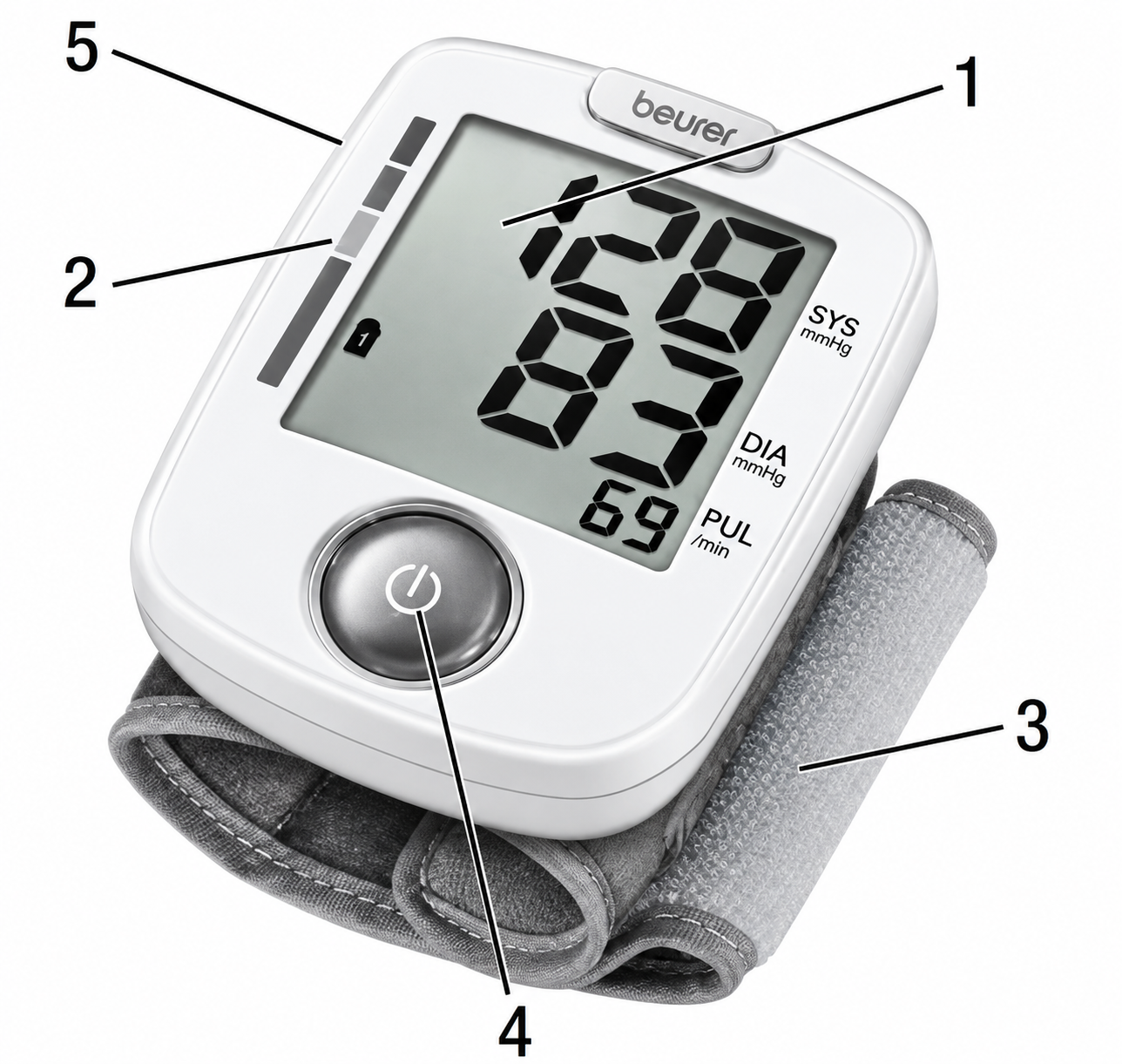
Unit description
- Display
- Risk indicator
- Wrist cuff
- START/STOP button
- Battery compartment lid
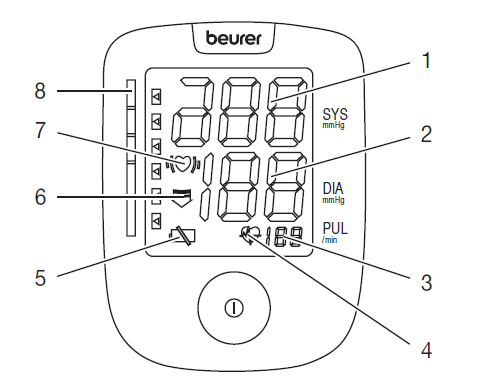
Icons in the Display:
- Systolic pressure
- Diastolic pressure
- Pulse
- Pulse symbol

- Battery replacement symbol

- Pump up, release air (arrow)
- Cardiac arrhythmia symbol

Risk indicator
Specifications
- Model No: BC 44
- Measurement Method: Oscillometric, non-invasive blood pressure measurement on the wrist.
- Measurement Range:
- Cuff Pressure: 0–300 mmHg
- Systolic Pressure: 60–260 mmHg
- Diastolic Pressure: 40–199 mmHg
- Pulse: 40–180 beats/minute
- Display Accuracy:
- Systolic: ±3 mmHg
- Diastolic: ±3 mmHg
- Pulse: ±5% of the displayed value
- Measurement Inaccuracy: Maximum permissible standard deviation according to clinical testing:
- Systolic: 8 mmHg
- Diastolic: 8 mmHg
- Dimensions: 8.8 cm (L) × 6.5 cm (W) × 6.8 cm (H)
- Weight: Approx. 98 g (without batteries, with cuff)
- Cuff Size: 140–195 mm
- Permissible Operating Conditions: +10°C to +40°C, ≤90% relative humidity (non-condensing)
- Permissible Storage Conditions: -20°C to +55°C, ≤90% relative humidity, 800–1050 hPa ambient pressure
- Power Supply: 2 × 1.5 V AAA batteries
- Battery Life: Approx. 300 measurements, depending on blood pressure level and/or pump pressure
- Classification: Internal power supply, continuous operation, Type BF applied part, IPX0, no AP or APG.
Prepare Measurement
Inserting Battery
- Remove the battery compartment lid on the lower left side of the device.
- Insert two 1.5 V micro batteries (alkaline, type LR03).
- Make sure that the batteries are inserted with the correct polarity, according to the label on the battery compartment lid. Do not use rechargeable batteries.
- Replace the battery cover carefully.
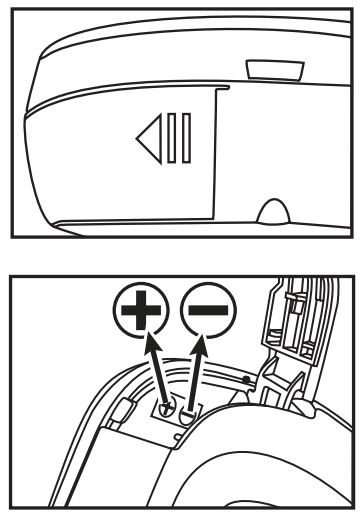
If the battery change symbol is continuously illuminated, measurement is no longer possible and you must replace all the batteries.
Measuring Blood Pressure
Ensure the device is at room temperature before measuring. The measurement can be performed on the left or right wrist.
Positioning Cuff
Expose your wrist. Ensure that the circulation of the arm is not hindered by tight clothing or similar.
- Place the cuff on the inside of your wrist.
- Fasten the cuff with the hook and loop fastener so that the upper edge of the monitor is positioned approx. 1 cm below the ball of your thumb.
- The cuff has to be fitted tightly around the wrist but should not constrict it.
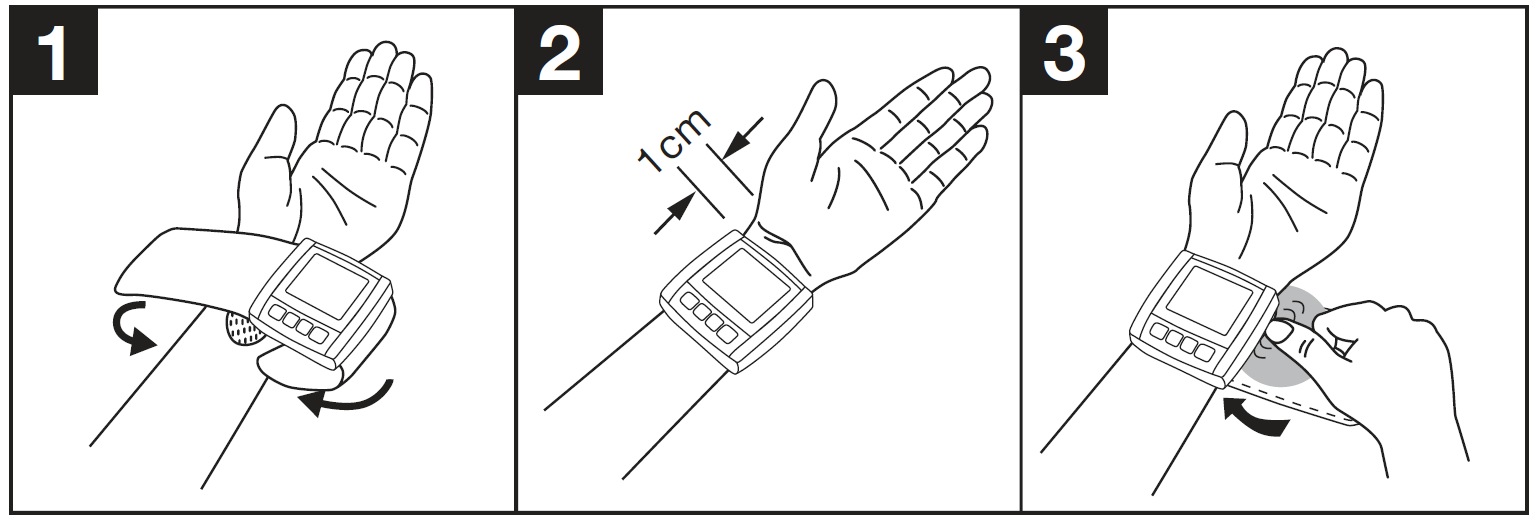
Important: The instrument should only be operated with the original cuff. Blood pressure may vary between the right and left wrists, which may mean that the measured blood pressure values are different. Always measure the same wrist. If the values between the two wrists are significantly different, please consult your doctor to determine which wrist should be used for the measurement.
Correct Posture
- Before the initial blood pressure measurement, make sure always to rest for about 5 minutes. Otherwise, there may be discrepancies.
- Furthermore, if you want to take several measurements in succession, make sure always to wait for at least 1 minute between the individual measurements.
- You can perform the measurement either sitting or lying down. To carry out a blood pressure measurement, make sure you are sitting comfortably with your arms and back leaning on something. Do not cross your legs. Place your feet flat on the ground. It is essential to support your arm and have it at an angle. Always make sure that the cuff is level with your heart. Otherwise, there may be serious inaccuracies. Relax your arm and the palms of your hands.
- In order not to distort the result, it is important to keep still during the measurement and not talk.

Measuring Blood Pressure
- Start the blood pressure monitor with the START/STOP button. A beep and a brief display of all the symbols confirm that the device is switched on.
- Before the measurement, the last saved test result is briefly displayed. If there is no measurement in the memory, the instrument displays an empty memory indication.
- The cuff automatically inflates. Cuff air pressure is released slowly.
- If a tendency towards high blood pressure is already detectable, the cuff is pumped up again and cuff pressure is increased further. The pulse symbol flashes as soon as a pulse is found.
- After the pressure has been completely reduced, the systolic pressure, diastolic pressure and pulse readings are displayed.
- Measuring can be cancelled at any time by pressing the START/STOP button.
- An error message appears if it has not been possible to perform the measurement properly. Observe the section in these instructions on error messages/troubleshooting and repeat the measurement.
- The test result is saved automatically.
Evaluating results
Cardiac arrhythmia:
This instrument can identify possible cardiac arrhythmia disorders during measurement and if necessary, indicates the measurement with the flashing icon . This may be an indicator for arrhythmia. Arrhythmia is a condition where the heart rhythm is abnormal as a result of defects in the bioelectrical system controlling the heartbeat. The symptoms (omitted or premature heartbeats, slow or excessively fast heart rate) may be caused, among other things, by heart disease, age, physical predisposition, excessive use of stimulants, stress or lack of sleep. Arrhythmia can only be ascertained through examination by your doctor. Repeat the measurement if the flashing icon is displayed after the measurement. Please note that you should rest for 5 minutes between measurements and not talk or move during the measurement. If the icon appears often, please contact your doctor. Any self-diagnosis and treatment based on the test results may be dangerous. It is vital to follow your doctor’s instructions.
Risk indicator:
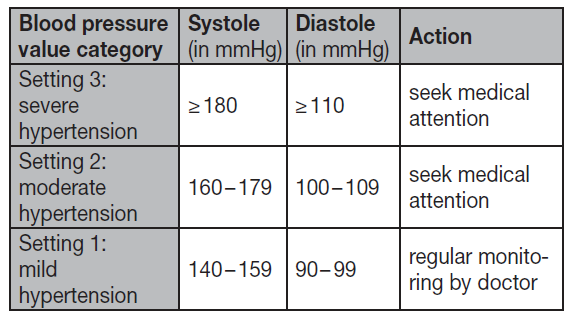
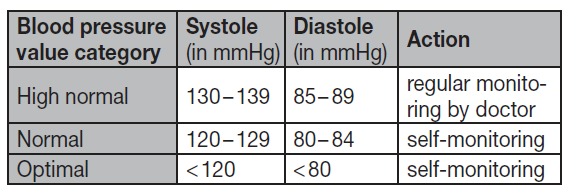
The measurements can be classified and evaluated in accordance with the following table. However, these standard values serve only as a general guideline, as the individual blood pressure varies in different people and different age groups etc. It is important to consult your doctor regularly for advice. Your doctor will tell you your individual values for normal blood pressure as well as the value above which your blood pressure is classified as dangerous. The classification on the display and the scale on the unit show which category the recorded blood pressure values fall into. If the values of systole and diastole fall into two different categories (e.g. systole in the ‚High normal‘ category and diastole in the ‚Normal‘ category), the graphical classification on the device always shows the higher category; for the example given this would be ‚High normal‘.
Troubleshooting — Common Problems, Error Codes & Fixes for beurer Blood Pressure Monitor BC 44
- Common problem: inaccurate or highly variable readings. Fix: Ensure the wrist cuff sits at heart level, remain seated and relaxed for 5 minutes before measuring, avoid talking/moving, and take multiple readings (1–3 minutes apart) then average them for a reliable result.
- Common problem: device won’t start or blank/weak display. Fix: Replace batteries and check correct battery orientation; low-battery indicator will show when batteries need replacing.
- Error message: incorrect usage or cuff error. Fix: Reposition cuff so it fits the wrist circumference 14.0–19.5 cm and follow the manual’s placement diagram; if the message persists, turn unit off, remove batteries for 1 minute, then retry.
- Error message: movement detected / unstable reading. Fix: Keep the arm and body still during measurement, avoid measuring after exercise or immediately after caffeine/smoking, and repeat measurement.
- Preventive measures: measure at consistent times of day, maintain the device clean and stored in the included box, avoid extreme temperatures and moisture, and replace batteries before prolonged storage to prevent leakage.
Warranty & support: Beurer lists a manufacturer guarantee (official page indicates a 5-year guarantee for many products; check your region’s product documentation for specific terms). For product support, consult the printed instruction manual included with the BC 44 or the online manual hosted by beurer and other manual repositories for troubleshooting steps and specifications. For direct help, contact Beurer customer service in your country (contact details available on the official Beurer website); retailers such as Best Buy and other sellers also provide support/returns per their policies.
Pros & Cons — Honest Assessment of the beurer Blood Pressure Monitor BC 44
Pros — Easy, travel‑friendly design
The wrist form factor and compact size make the BC 44 lightweight and portable for on‑the‑go monitoring; the illuminated display and single‑button operation are user‑friendly for seniors or low‑vision users.
Pros — Useful safety features
Arrhythmia detection and a WHO‑style risk indicator give quick, actionable context for readings and may prompt users to seek medical advice when readings or pulse irregularities appear.
Cons — Wrist measurement limitations
Wrist monitors are generally more position‑sensitive than upper‑arm devices; incorrect positioning (not at heart level) can cause inaccurate results, making technique more critical.
Cons — Clinical validation concerns
Independent resources note a lack of publicly available peer‑reviewed clinical validation for the BC 44, and some reviewers recommend upper‑arm validated monitors if maximum accuracy is required for clinical decision-making.
Value for money
The BC 44 offers a strong feature set (illuminated display, arrhythmia detection, memory) at a mid‑range price; it represents good value for users prioritizing convenience and basic monitoring but may not replace clinically validated upper‑arm devices for medically critical monitoring.
Customer Reviews & User Feedback — beurer Blood Pressure Monitor BC 44
- Typical user praises: customers commonly highlight the BC 44’s easy single‑button operation, clear blue backlit display, and comfortable wrist cuff as positive points for daily home monitoring and travel use. Many users appreciate the arrhythmia warning and risk indicator for quick interpretation.
- Common complaints: users most often report sensitivity to wrist position causing inconsistent readings and occasional doubts about accuracy compared with clinic upper‑arm measurements; these complaints mirror known limitations of wrist monitors.
- Sample star ratings and testimonials (representative): 4/5 stars — “Convenient and clear display, great for travel.” 3/5 stars — “Easy to use but I had to recheck readings against my doctor’s cuff.” Purchase recommendations: good choice for routine home checks, travel, and users who value portability; users who need highly precise clinical measurements should consider a validated upper‑arm monitor and consult healthcare providers.
SEO & Keywords (used naturally)
This manual is optimized for search queries such as beurer Blood Pressure Monitor BC 44 (primary keyword), wrist blood pressure monitor, arrhythmia detection wrist monitor, BC 44 user manual, and long‑tail searches like “how to use beurer Blood Pressure Monitor BC 44 at home” and “BC 44 wrist cuff positioning for accurate reading.”
Faqs
How do I set up the beurer Blood Pressure Monitor BC 44 for the first time?
How do I properly position the cuff on the beurer Blood Pressure Monitor BC 44 for accurate readings?
What does the arrhythmia detection mean on the beurer Blood Pressure Monitor BC 44?
Why is my beurer Blood Pressure Monitor BC 44 showing an error message and how to fix it?
What wrist sizes are compatible with the beurer Blood Pressure Monitor BC 44 cuff?
How do I maintain and clean the beurer Blood Pressure Monitor BC 44?
How many readings can the beurer Blood Pressure Monitor BC 44 store in memory?
Is the beurer Blood Pressure Monitor BC 44 clinically validated for accuracy?
More beurer manuals
- Setup: Beurer Upper Arm Blood Pressure Monitor BM-45 User Manual
- Setup: Beurer Upper Arm Blood Pressure Monitor BM-35 User Manual
- Setup: Beurer Blood pressure monitor BM-40 User Manual
- Setup: Beurer Upper arm blood pressure monitor BM-38 User Manual
- Setup: Beurer Blood pressure monitor BC 21 User Manual
- Setup: Beurer Blood Pressure Monitor BC-30 User Manual
Leave a Comment