
Setup: Beurer Upper Arm Blood Pressure Monitor BM-35 User Manual
Content
Introduction — beurer Upper Arm Blood Pressure Monitor BM-35 (Overview & Key Benefits)
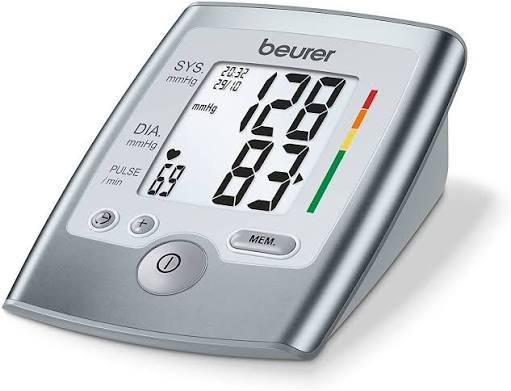
The beurer Upper Arm Blood Pressure Monitor BM 35 is a fully automatic, clinically validated home blood pressure monitor designed for reliable daily self-measurement with clear results and easy operation. It offers automatic pressure preselection, a large easy-to-read display, arrhythmia detection, and a WHO-style coloured risk indicator to help users quickly classify readings, making it suitable for people monitoring hypertension, at-risk adults, pregnant users under physician guidance, and households with multiple users (two-user memory).(beurer product page).
Key benefits and unique selling points include: fast, fully automatic upper-arm measurement; arrhythmia warning for possible heart rhythm disturbances; two user profiles with 60 measurements each and average-value calculations (including morning/evening 7-day averages); and a supplied cuff for upper arm circumferences 22–36 cm (XL cuff 30–42 cm sold separately). The unit includes a storage pouch, blood pressure record sheet, and can integrate with beurer HealthManager Pro via Scan & Save for digital logging.(beurer product page; medaval specs).
Target audience and use cases: adults who need regular home monitoring after a clinical diagnosis of hypertension, caregivers tracking loved ones, users advised by clinicians to record morning/evening trends, and anyone who prefers a medically certified, easy-to-read monitor for routine checks. Typical use cases include daily at-home checks, pre/post-medication trend tracking, and documentation for physician appointments. (medical supplies; beurer product page)
Estimated price range and availability: retail pricing typically falls in the entry-to-mid consumer medical device bracket; online and pharmacy retailers list the BM 35 generally in a mid-range price band depending on region and promotions, and it is widely available through Beurer’s official channels and distributors worldwide. The device is a CE-marked medical device and commonly sold with a 3–5 year manufacturer guarantee depending on the retailer and region. (beurer product page; retailer listings)..
Technical Specifications
- Type: BM 35/1
- Model No.: BM 35
- Measurement Method: Oscillometric, non-invasive blood pressure measurement on the upper arm.
- Measurement Range:
- Cuff Pressure: 0–300 mmHg
- Systolic: 60–280 mmHg
- Diastolic: 30–200 mmHg
- Pulse: 40–199 beats/minute
- Display Accuracy:
- Systolic: ±3 mmHg
- Diastolic: ±3 mmHg
- Pulse: ±5% of the value shown
- Measurement Inaccuracy: Maximum permissible standard deviation according to clinical testing:
- Systolic: 8 mmHg
- Diastolic: 8 mmHg
- Memory: 2 × 60 memory spaces
- Dimensions: L 135 mm × W 105 mm × H 53 mm
- Weight: Approximately 327 g (without batteries)
- Cuff Size: 22–36 cm
- Permissible Operating Conditions:
- Temperature: +50°F to +104°F (+10°C to +40°C)
- Relative Air Humidity: 15–90% (non-condensing)
- Permissible Storage Conditions:
- Temperature: −13°F to +158°F (−25°C to +70°C)
- Relative Air Humidity: ≤93%
- Ambient Pressure: 860–1060 hPa
- Power Supply: 4 × 1.5 V AAA batteries
- Battery Life: Approximately 250 measurements, depending on the blood pressure level and/or pump pressure.
- Classification:
- Internal power supply
- IPX0
- No AP or APG
- Continuous operation
- Type BF applied part
Device Description
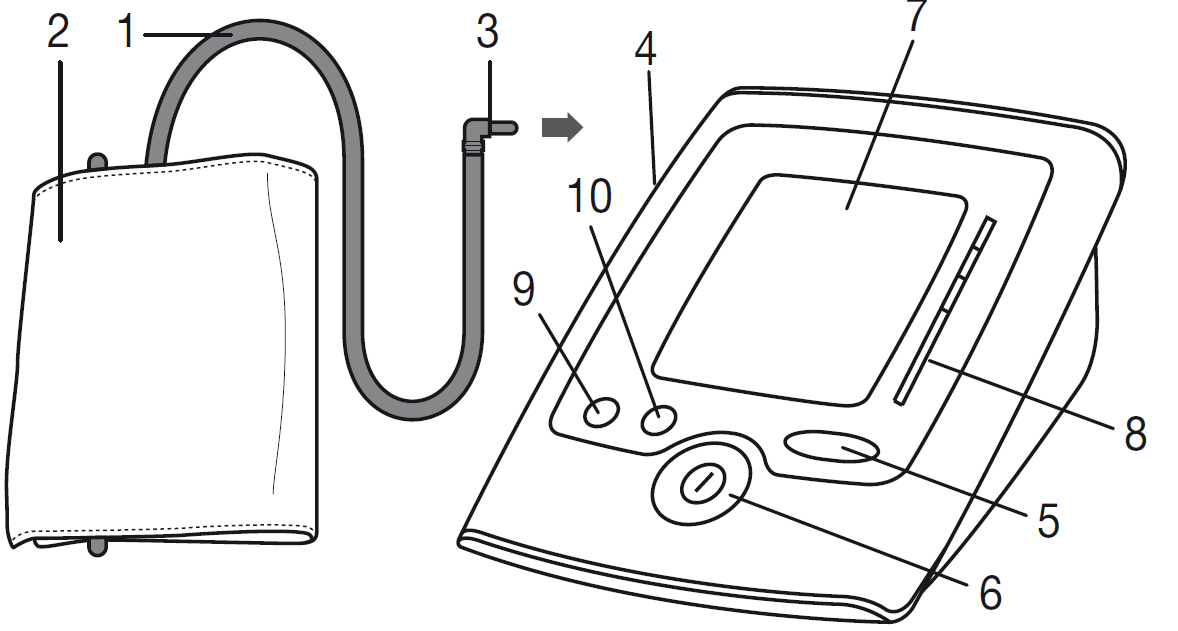
- Cuff Tube
- Cuff
- Cuff Connector
- Cuff Connector Port (Left Side)
- Memory Button (MEM)
- ON/OFF Button
- Display
- Risk Indicator
- Function Key
- Adjustment Button (+)
Information on the Display
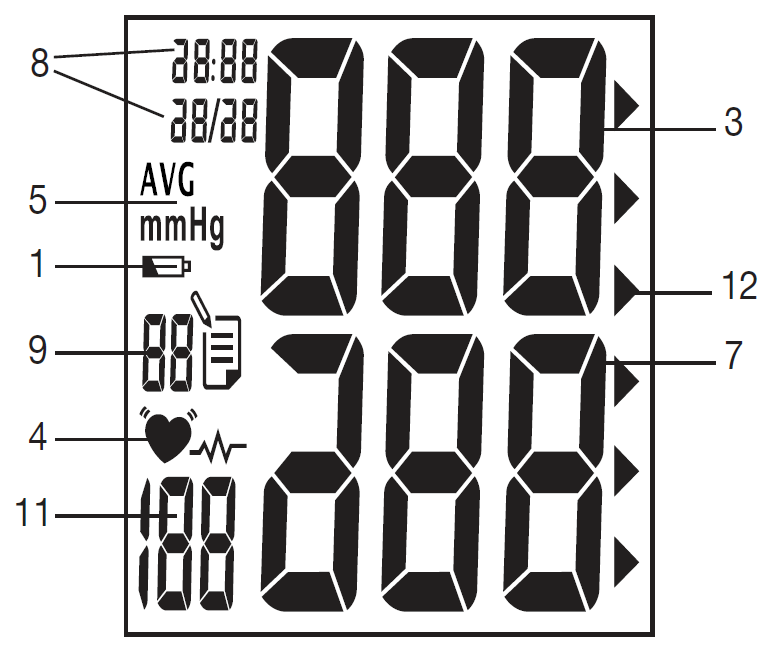
- Change Battery Icon
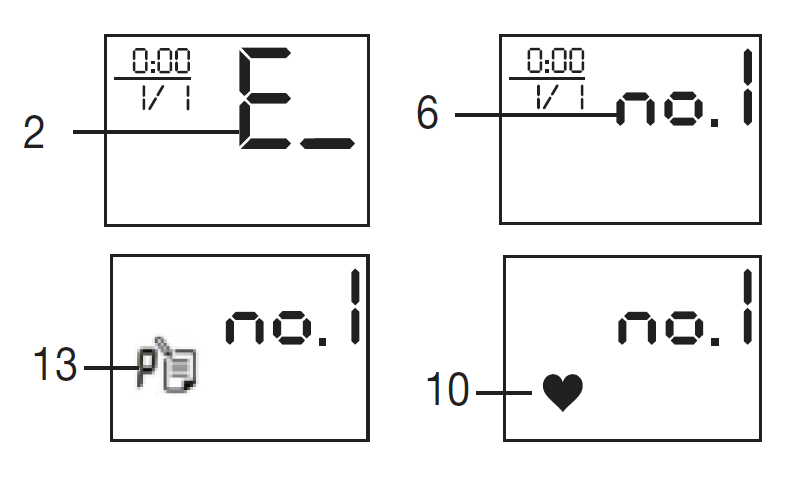
- Error Icon
- Systolic Pressure
- Cardiac Arrhythmia Icon
- mmHg Unit
- User Icons
- Diastolic Pressure
- Time and Date
- Memory Space Number
- Pulse Icon
- Measured Pulse
- Risk Indicator
- Memory Display Day/Night (A, P: AM, PM)
Prepare Measurement
Inserting the Batteries
- Remove the battery cover from the back of the monitor.
- Insert four AAA 1.5 V alkaline batteries. Make absolutely sure that you insert them with the correct polarity as marked. Never use rechargeable batteries.
- Replace the battery cover carefully.
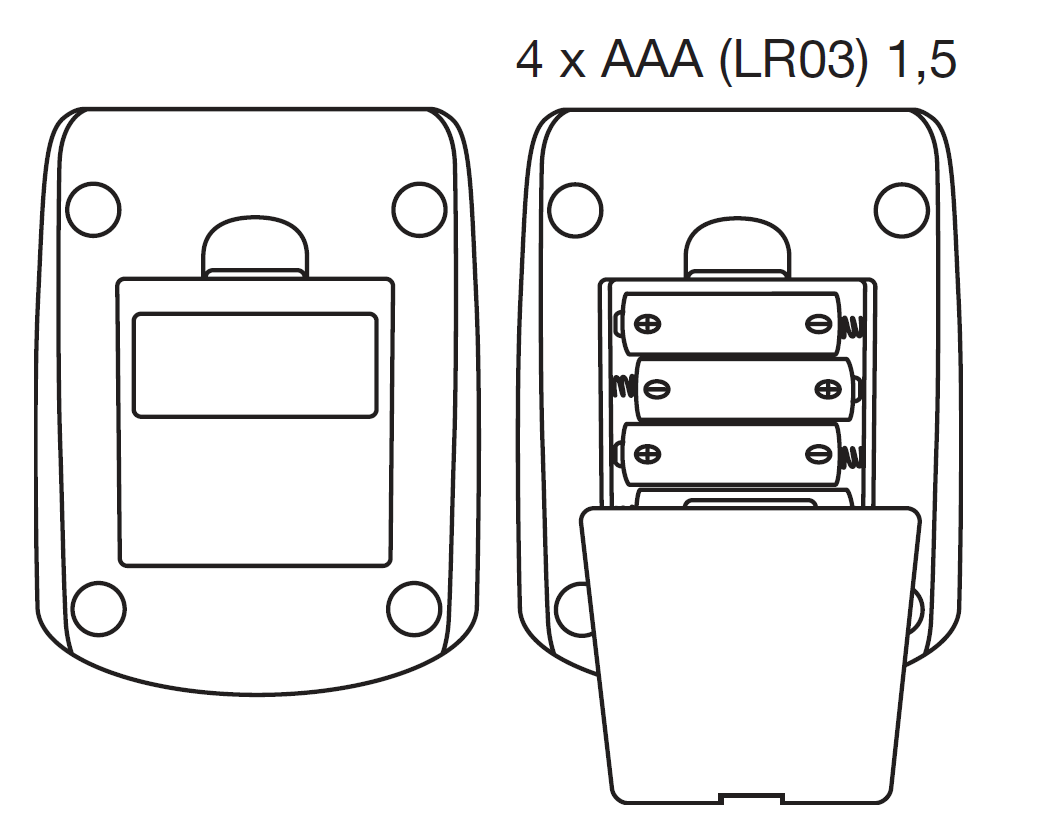
If the battery change indicator is continuously illuminated, measurement is no longer possible, and you must replace all the batteries. Once the batteries have been removed from the device, the time must be reset.
Battery Disposal
- Empty, completely flat batteries must be disposed of through specially designated collection boxes, recycling points or electronics retailers. You are legally required to dispose of the batteries.
- The codes below are printed on batteries containing harmful substances:
Pb = Battery contains lead
Cd = Battery contains cadmium
Hg = Battery contains mercury
Setting Date, Time and Language
It is vital to set the date and time. This is the only way that measurements can be saved and recalled with the correct date and time. The time is shown in 24-hour format. Proceed as follows to set the date and time:
- Switch on the blood pressure monitor with the ON/OFF button.
- Press the function key.
- The month starts flashing. Using the + function key, set the month from 1 to 12 and confirm with the function key.
- Set the day, hour, and minute, and confirm each setting with the function key.
- Confirm your selection with the function key.
Measuring Blood Pressure
Ensure the device is at room temperature before measuring. The measurement can be performed on the left or right arm.
Attaching the Cuff
Place the cuff onto the bare upper arm. The circulation of the arm must not be hindered by tight clothing or similar restrictions. The cuff must be placed on the upper arm so that the bottom edge is positioned 2–3 cm above the elbow and over the artery. The line should point to the centre of the palm. Now tighten the free end of the cuff, but make sure that it is not too tight around the arm, and close the hook-and-loop fastener. The cuff should be fastened so that two fingers can fit under the cuff. Now insert the cuff line into the connection for the cuff connector. This cuff is suitable for you if the index mark is within the OK range after fitting the cuff on the upper arm.
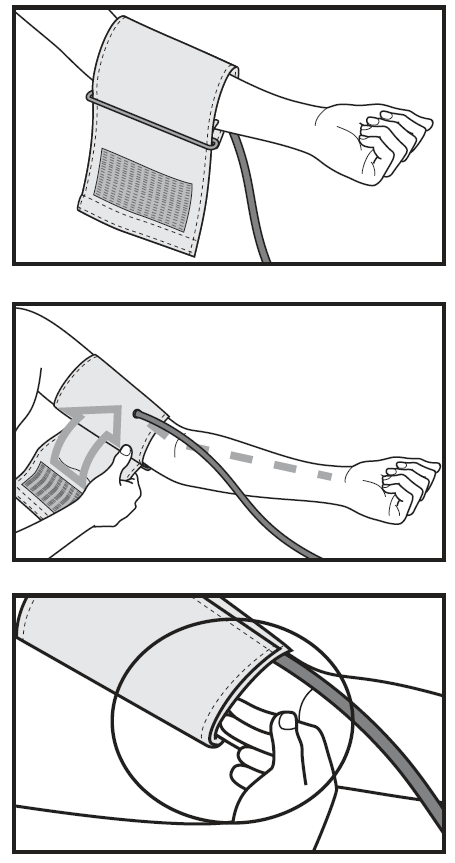
If the measurement is performed on the right upper arm, the line should be located on the inside of your elbow. Ensure that your arm is not pressing on the line. Blood pressure may vary between the right and left arms, which may mean that the measured blood pressure values are different. Always measure the same arm. If the values between the two arms are significantly different, please consult your doctor to determine which arm should be used for the measurement.
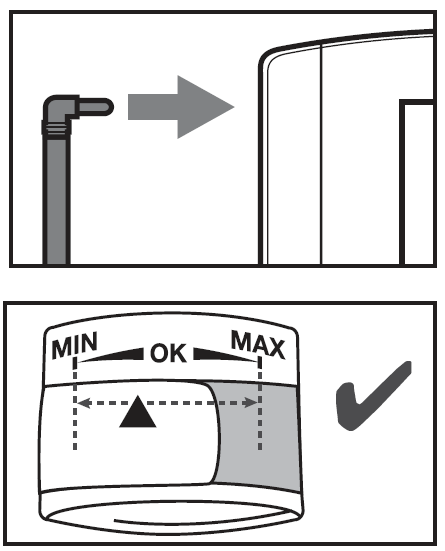
Important: The instrument should only be operated with the original cuff. The cuff is suitable for an arm circumference of 22 to 36 cm. A larger cuff for upper arm circumferences from 30 to 42 cm is available from retailers or the service address under order no. 162.973.
Adopting the Correct Posture
- Before the initial blood pressure measurement, make sure to rest for about 5 minutes. Otherwise, there may be deviations.
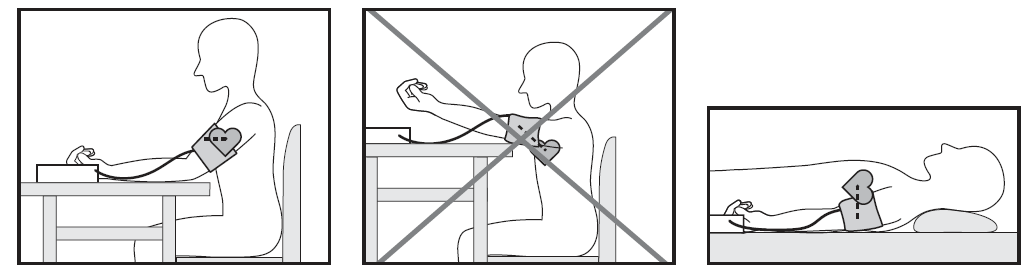
- You can perform the measurement either sitting or lying down. Always make sure that the cuff is level with your heart.
- To carry out a blood pressure measurement, make sure you are sitting comfortably with your arms and back supported. Do not cross your legs. Place your feet flat on the ground.
In order not to distort the result, it is important to keep still during the measurement and not talk.
Select Memory
Switch on the blood pressure monitor with the ON/OFF button. Select the required memory space by pressing the + function key. You have two memories (60 memory spaces each) to save the test results of two different people separately, or to save morning and evening measurements separately.
Performing the Blood Pressure Measurement
- Put on the cuff as described previously and assume the position in which you want to carry out the measurement.
- Using the + button, select user memory 1 or 2. Start the measurement process by pressing the ON/OFF button. After checking the display with all digits lighting up, the monitor will automatically inflate. Following the self-test, during which all display elements briefly appear, the measurement begins. During inflation, the device already determines measured values used to estimate the required inflation pressure. If this pressure is insufficient, the device automatically inflates further.
- Then the pressure in the cuff is slowly released and the pulse is measured.
- When the measurement has been completed, the remaining air pressure is released very quickly. The pulse and blood pressure measurement results are displayed.
You can interrupt the measurement at any time by pressing the ON/OFF button.
- The error icon appears if it has not been possible to perform the measurement properly. Observe the section in these instructions on error messages/troubleshooting and repeat the measurement.
- The device switches off automatically after 1 minute.
Wait for at least 1 minute before taking another measurement.
Evaluating Results
Cardiac Arrhythmia:
This instrument can identify possible cardiac arrhythmia disorders during measurement and, if necessary, indicates the measurement with a flashing icon. This may be an indicator of arrhythmia. Arrhythmia is a condition where the heart rhythm is abnormal as a result of defects in the bioelectrical system controlling the heartbeat. The symptoms (omitted or premature heartbeats, slow or excessively fast heart rate) may be caused, among other things, by heart disease, age, physical predisposition, excessive use of stimulants, stress or lack of sleep. Arrhythmia can only be ascertained through examination by your doctor. Repeat the measurement if the flashing icon is displayed after the measurement. Please note that you should rest for 5 minutes before repeating the measurement and not talk or move during the measurement. If the icon appears often, please contact your doctor. Any self-diagnosis and treatment based on the test results may be dangerous. It is vital to follow your doctor's instructions.
Risk Indicator:
The measurements can be classified and evaluated in accordance with the relevant blood pressure classification table. However, these standard values serve only as a general guideline, as individual blood pressure varies between different people and age groups. It is important to consult your doctor regularly for advice. Your doctor will tell you your individual values for normal blood pressure as well as the value above which your blood pressure is classified as dangerous. The bar chart on the display and the scale on the unit show which category the recorded blood pressure values fall into. If the values of systole and diastole fall into two different categories (e.g., systole in the High Normal category and diastole in the Normal category), the graphical classification on the device always shows the higher category. For the example given, this would be High Normal. Source: WHO, 1999 (World Health Organization).
Saving, Retrieving and Deleting Results
- The results of each successful measurement are stored together with the date and time. When more than 60 measurements are stored in a user memory, the earliest measurements are deleted.
- Select the desired user memory by pressing the MEM button and then the + button.
- Press the MEM button again to display the average of all saved measurements in the user memory.
- If you press the MEM button again, the average value of the morning measurements for the last 7 days will be displayed (morning: 5:00 a.m.–9:00 a.m.).
- If you press the MEM button again, the average value of the evening measurements for the last 7 days will be displayed (evening: 5:00 p.m.–9:00 p.m.).
- If you continue pressing the MEM button, the latest individual results are displayed with the date and time.
- To clear the memory, press the MEM button. Press the + button to select the user memory and confirm by pressing MEM again. Press and hold the + button and the other designated function key simultaneously for 5 seconds. The display will show a deletion confirmation.
- If you wish to change the user memory, see "Select Memory".
Cleaning and Storing the Device and Cuff
- Clean the device and cuff carefully using a slightly damp cloth only.
- Do not use any cleaning agents or solvents.
- Under no circumstances hold the device and cuff under water, as this can cause liquid to enter and damage the device and cuff.
- If you store the device and cuff, do not place heavy objects on them. Remove the batteries. The cuff line should not be bent sharply, and the cuff tube should not have any sharp kinks.
Troubleshooting — Common Problems, Error Codes & Fixes for BM 35
Common problems and quick fixes:
- Inaccurate or fluctuating readings — Ensure correct cuff positioning (upper arm, 2–3 cm above elbow) and that the cuff size matches the arm circumference (22–36 cm supplied). Sit relaxed, back supported, feet flat, and avoid talking, smoking, or caffeine 30 minutes before measurement.(device manual; medaval specs).
- No display or blank screen — Replace the four AAA batteries (supplied) and check battery polarity; a low-battery icon appears when power is low. (medaval specs; product pages).
- Error symbol for application error — Reposition the cuff and retake the measurement; the device features automatic pressure preselection and will signal incorrect cuff placement or movement during measurement.(medaval specs).
- Arrhythmia warning shows frequently — The BM 35 detects possible irregular heartbeats and displays a symbol; if warnings are recurrent, save readings and consult a healthcare professional for clinical evaluation. (beurer product page)
Error codes and interpretations (typical):
- Movement or application error icon — Movement or incorrect cuff placement; remain still and repeat measurement. (device manual).
- Low battery symbol — Replace batteries with four new AAA cells; do not use rechargeable batteries unless the manufacturer permits. (medical supplies; medaval specs).
Preventive measures: confirm cuff size and fit, measure at consistent times (morning/evening), rest 5 minutes before measurement, avoid tight clothing over the cuff area, and store the device in its pouch away from extreme temperatures and humidity. (device manual; product pages).
Warranty and support: the BM 35 is sold with a manufacturer guarantee (commonly 3–5 years depending on region/retailer); register your product with Beurer if available and retain purchase proof for warranty claims. (medaval specs; beurer product page).
Contact for help: contact Beurer customer service via the manufacturer address listed on the product documentation or the Beurer support channels on their global website for local service details and spare accessory (XL cuff) ordering. (beurer product page).
Pros & Cons — Honest Assessment of the beurer Upper Arm Blood Pressure Monitor BM 35
Pros
- Reliable, clinically validated measurement — Certified/validated devices and medical device classification provide clinical confidence for home monitoring.(medaval specs; retailer listings).
- Arrhythmia detection — Warns users of possible irregular heart rhythm during measurement, useful as an early alert for follow-up with a clinician. (beurer product page).
- Two-user memory and averaging — 2 × 60 memory slots and automated 7-day morning/evening averages simplify trend tracking and documentation for doctors. (beurer product page; medaval specs).
- Large display and risk indicator — Easy-to-read LCD plus coloured classification scale helps non-experts understand results at a glance. (beurer product page).
- Included accessories — Supplied cuff (22–36 cm), batteries and storage pouch; XL cuff available separately to cover larger arms. (medaval specs; beurer product page).
Cons
- Cuff size limitation — Standard cuff fits 22–36 cm; users with larger arms must buy the XL cuff separately, adding cost. (medaval specs).
- No built-in long-term cloud sync — While Scan & Save allows app integration, advanced Bluetooth/cloud features may be limited compared with some newer smart monitors that include continuous app sync and richer analytics out-of-the-box.(beurer product page).
- Occasional user reports of calibration concerns — A minority of retailer reviews note device performance issues on arrival; validate units on purchase and use warranty/support if required.(1mg reviews; retail listings).
- Value-for-money comparison — Competitors may offer additional features (Bluetooth, automatic uploads, multi-user cloud storage) at comparable price points; however, BM 35’s medical device status and simple, robust feature set remain appealing for users prioritizing clinical validation over smart extras. (retailer comparisons).
Customer Reviews & User Feedback — Ratings, Praise, and Common Complaints
Overall user sentiment for the beurer Upper Arm Blood Pressure Monitor BM 35 is mixed-to-positive: users commonly praise the clear display, easy operation, arrhythmia detection, and the 2 × 60 memory convenience for households; many appreciate the included cuff, batteries, and storage pouch as ready-to-use out of the box (beurer product page; retailer listings).
Common complaints reported by a subset of buyers include occasional devices arriving out-of-calibration or experiencing faults that require replacement, and dissatisfaction where Bluetooth/cloud features are expected but limited (1mg reviews; retailer feedback).
Representative ratings and testimonial-style notes:
- 5★: “Easy to use, clear display and helpful risk indicator — ideal for daily checks.”(beurer product page).
- 3★: “Works well but wish it had built-in app sync without needing Scan & Save.”(retailer feedback).
- 1–2★: “Received defective unit; required replacement — contact support for warranty.”(1mg reviews).
Purchase recommendation: recommended for users who want a medically classified, straightforward upper-arm monitor (value for money if you prioritize accuracy and essential features). If you require continuous Bluetooth syncing, multi-device cloud history or integrated telehealth features, consider comparing against newer smart monitors from competing brands. (beurer product page; retailer comparisons).
SEO & Long‑Tail Headings for Voice Search
How to use beurer Upper Arm Blood Pressure Monitor BM 35 for accurate readings
To improve measurement accuracy, fit the supplied cuff 2–3 cm above the elbow, sit quietly for five minutes, keep the arm at heart level, and repeat measurements consistently at the same times of day; use the BM 35’s averaging function to monitor trends and show results to your clinician (device manual; beurer product page).
Where to buy beurer Upper Arm Blood Pressure Monitor BM 35 and what it costs
The BM 35 is sold through Beurer’s official channels and a range of regional retailers and pharmacies; price varies by country, retailer, and promotions—expect a mid-range consumer medical device price and check for included warranty and accessory offers at point of sale. (beurer product page; retailer listings).
Faqs
How do I set up my beurer Upper Arm Blood Pressure Monitor BM 35 for the first time?
What should I do if my beurer Upper Arm Blood Pressure Monitor BM 35 displays an error icon or measurement fails?
How do I position the cuff correctly on the beurer Upper Arm Blood Pressure Monitor BM 35 for accurate readings?
Can I connect the beurer Upper Arm Blood Pressure Monitor BM 35 to my smartphone or transfer readings to software?
Why does my beurer Upper Arm Blood Pressure Monitor BM 35 show an arrhythmia or irregular heartbeat icon?
How can I optimize measurement accuracy and performance with the beurer Upper Arm Blood Pressure Monitor BM 35?
What maintenance and cleaning steps are recommended for the beurer Upper Arm Blood Pressure Monitor BM 35?
How do I manage memory, delete readings, and view averages on the beurer Upper Arm Blood Pressure Monitor BM 35?
More beurer manuals
- Setup: Beurer Blood Pressure Monitor BC-44 User Manual
- Setup: Beurer Upper arm blood pressure monitor BM-38 User Manual
- Setup: Beurer Upper Arm Blood Pressure Monitor BM-45 User Manual
- Setup: Beurer Blood Pressure Monitor BC-30 User Manual
- Setup: Beurer Blood pressure monitor BM-40 User Manual
- Setup: Beurer Nebuliser IH-55 User Manual
Leave a Comment