
Setup: Beurer Blood Pressure Monitor with ECG Function BM-96 Cardio User Manual
Content
Beurer Blood Pressure Monitor with ECG Function BM-96 Cardio: Comprehensive Product Manual
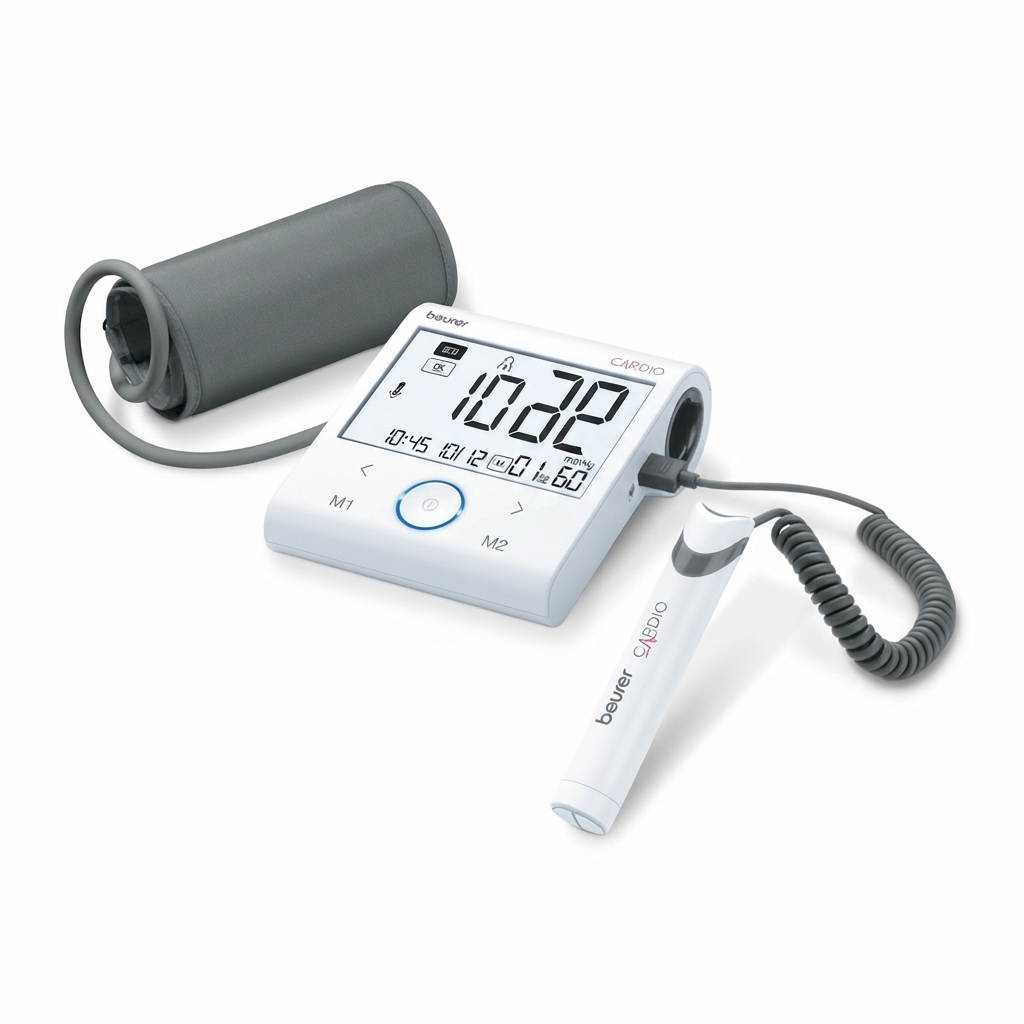
Introduction to Beurer Blood Pressure Monitor with ECG Function BM-96 Cardio
The Beurer Blood Pressure Monitor with ECG Function BM-96 Cardio is a cutting-edge 2-in-1 device that combines fully automatic upper arm blood pressure and pulse measurement with a 1-channel ECG for heart rhythm recording. This Bluetooth-enabled health companion empowers users to monitor cardiovascular health comprehensively at home, detecting advanced arrhythmias like atrial fibrillation to help prevent strokes. Ideal for adults with hypertension, heart rhythm concerns, or those seeking proactive wellness tracking, the BM-96 Cardio suits daily home use, travel, or sharing data with doctors via the “beurer HealthManager Pro” app or “beurer MyCardio Pro” service for instant ECG analysis.
Key benefits include inflation technology for faster, more comfortable readings, a resting indicator for precise results, and a risk indicator with a colored scale for easy classification of measurements. The device features an easy-to-read XL display, touch-sensor buttons, and supports two users with 60 measurements each, plus USB connectivity for PC transfers. Its universal cuff fits upper arm circumferences of 22–42 cm, making it versatile for most adults. As a medical device, it offers arrhythmia detection (AFib + PVC), cuff fit check, and averages for the last 7 days' morning/evening readings.
Targeted at health-conscious individuals, seniors, and cardiac patients, this upper arm blood pressure monitor with ECG excels in routine check-ups and early detection. Priced in the estimated range of $150–$250, it's widely available online and in pharmacies across Germany, UK, Spain, France, Italy, Australia, and Bahrain. Experience reliable home heart monitoring with the **Beurer BM-96 Cardio**—your partner in preventing cardiovascular risks through smart, app-connected technology.
Detailed Specifications of Beurer Blood Pressure Monitor with ECG Function BM-96 Cardio
- Measurement Functions: Fully automatic blood pressure, pulse, and 1-channel ECG on upper arm; detects atrial fibrillation (AFib), PVC, and arrhythmias for stroke prevention.
- Display & Indicators: XL illuminated display with risk indicator (colored scale), resting indicator (HSD for precise readings), cuff fit check, and immediate heart rhythm feedback.
- Connectivity: Bluetooth for “beurer HealthManager Pro” app; USB for PC; “beurer MyCardio Pro” for ECG analysis.
- Memory & Users: 2 users, 60 measurements each (30-second recordings); 7-day morning/evening averages.
- Cuff & Comfort: Universal cuff (22–42 cm); inflation technology for quick, comfortable measurements via hand-chest or hand-hand leads.
- Dimensions & Weight: Monitor: 490g (without batteries, with cuff); ECG stick: 40g; storage bag and blood pressure record included.
- Power & Operation: Touch-sensor buttons; medical device with patented features.
- Performance Comparison: Outperforms basic monitors like Beurer BM series with added ECG; lacks full clinical validation per Medaval, unlike validated rivals (e.g., Omron models), but excels in app integration and arrhythmia detection.
Intended Purpose
Intended use
The blood pressure monitor with ECG function is used to carry out non-invasive measurement and of the arterial blood pressure values on the upper arm and to calculate the heart rhythm.
The device provides information about the average pulse as well as changes in the heart rhythm. Using a Bluetooth® connection, the recorded electrocardiogram (ECG) can be read out on a smartphone and printed out for further examination by a doctor.
It is designed for self-measurement by adults in the home environment.
Target group
When taking the ECG measurement, the device provides information about the average pulse and any changes in the heart rhythm. The blood pressure measurement is suitable for adult users whose upper arm circumference is within the range printed on the cuff. The ECG measurement is suitable for all adult users who can independently take a recording based on lead one, two or three (see chapter 8 on using the ECG).
Clinical benefits
The user can record their blood pressure and pulse values quickly and easily using the device. The ECG stick is used to calculate the heart rhythm. The device provides information about your average pulse value as well as any divergence from a normal ECG. The recorded values of blood pressure measurement are classified according to internationally applicable guidelines and evaluated graphically. Furthermore, the device can detect any irregular heartbeats that occur during measurement and inform the user via a symbol in the display. The device saves the recorded measurements and can also output average values of previous measurements. This blood pressure monitor also has a haemodynamic stability display, which is referred to as a resting indicator throughout these instructions for use. This shows whether you, and consequently your circulatory system, are sufficiently at rest when the blood pressure measurement is being taken, and whether the measured blood pressure thus corresponds to your blood pressure when at rest. Read more about this under “Resting indicator” in the section on using the device. The recorded data can provide healthcare service providers with support during the diagnosis and treatment of blood pressure problems, and therefore plays a part in the long-term monitoring of the user's health.
Indication
In the event of hypertension or hypotension, the user can independently monitor their blood pressure and pulse values as well as arrhythmia at home. However, the user does not need to be suffering from hypertension or arrhythmia to use the device.
Contraindications
- Do not use the blood pressure monitor with ECG function on newborns, children or pets.
- People with restricted physical, sensory or mental skills should be supervised by a person responsible for their safety and receive instructions from this person on how to use the device.
- If you have any of the following conditions, you must consult your doctor before using the device: cardiac arrhythmia, circulatory problems, diabetes, pregnancy, pre-eclampsia, hypotension, chills, shaking.
- Do not use the device if you have implanted electrical implants (e.g. pacemaker).
- Do not use the device if you have metal implants.
- Do not use the cuff on people who have undergone a mastectomy.
- Do not place the cuff over wounds as this may cause further injury.
- Make sure that the cuff is not placed on an arm in which the arteries or veins are undergoing medical treat-ment, e.g. intravascular access or intravascular therapy, or an arteriovenous (AV) shunt.
- Do not use the device with persons with sensitive skin or allergies.
Warnings and safety notes
- The measured values taken by you are for your information only – they are no substitute for a medical examination.
- Discuss the measured values with your doctor and never make your own medical decisions based on them (e.g. regarding dosages of medicines).
The device is only intended for the purpose described in these instructions for use. - The manufacturer is not liable for damage resulting from improper or incorrect use.
- Using the blood pressure monitor outside your home environment or whilst on the move (e.g. whilst travelling in a car, ambulance or helicopter, or whilst undertaking physical activity such as playing sport) can influence the measurement accuracy and cause incorrect measurements. Cardiovascular diseases may lead to incorrect measurements or have a detrimental effect on measure-ment accuracy.
- Do not use the device at the same time as other medical electrical devices (ME equipment). This could lead to a malfunction of the device and/or an inaccurate measurement.
- Do not use the device outside of the specified storage and operating conditions. This could lead to incorrect measurements.
Measures for handling batteries
- If skin or eyes come into contact with battery fluid, rinse the affected area thoroughly with water and seek medical assistance.
- Choking Hazard: Small children may swallow batteries and choke. Keep batteries out of the reach of children.
- Risk of Explosion: Do not throw batteries into a fire.
- If a battery has leaked, wear protective gloves and clean the battery compartment with a dry cloth.
- Do not disassemble, open, or crush batteries.
- Observe the correct plus (+) and minus (-) polarity markings.
- Protect batteries from excessive heat.
- Do not charge or short-circuit batteries.
- If the device will not be used for a long period, remove the batteries from the battery compartment.
- Use only identical or equivalent battery types.
- Always replace all batteries at the same time.
- Do not use rechargeable batteries.
Notes on electromagnetic compatibility
- The device is suitable for use in all environments specified in these instructions, including domestic environments.
- Electromagnetic disturbances may limit the device’s operation and could cause error messages, display problems, or device failure.
- Avoid using the device directly beside or stacked on other electronic devices, as this may cause improper operation.
- If use beside or stacked with other devices is necessary, monitor all devices to ensure they are operating correctly.
- Use only accessories specified or supplied by the manufacturer.
- Using unauthorized accessories may increase electromagnetic emissions or reduce the device’s electromagnetic immunity, resulting in faulty operation.
- Failure to follow these precautions may impair the performance of the device.
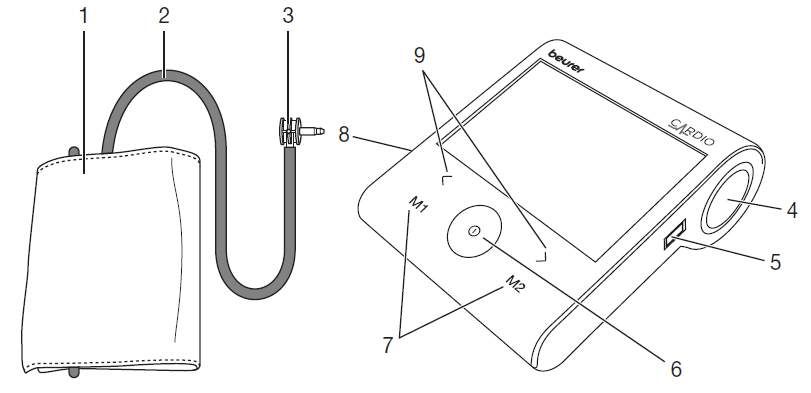
Blood pressure monitor with ECG stick and cuff
- Cuff
- Cuff Line
- Cuff Connector
- ECG Stick Holder
- Connector for ECG Stick and USB Cable
- START/STOP Button
- Memory Buttons M1 and M2
- Connection for Cuff Connector
- Setting Buttons
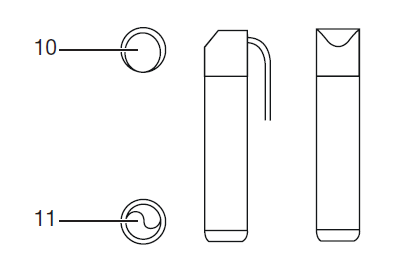
- Upper Electrode
- Lower Electrode
Display
- Systolic Pressure / ECG Measurement Countdown
- Diastolic Pressure
- Heart Rate: Shows the average heart rate during the recording
- Memory Display: Average value, morning value, evening value, and memory space number
- Low Battery Status Symbol
- Time and Date
- Risk Indicator
- Alarm Function
- Cuff Position Control
- Heartbeat Indicator: Indicates heartbeat during blood pressure and ECG measurement
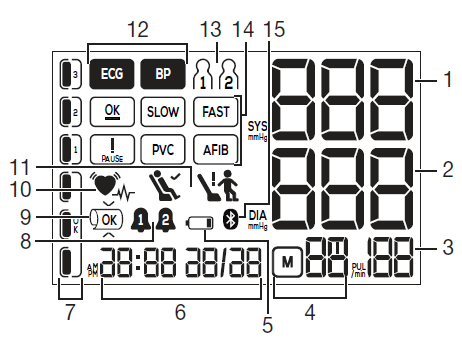
Irregular Heartbeat symbol for Blood pressure measurement
- Resting Indicator Display
- Measurement Mode: Blood Pressure / ECG
- Current User Memory
- ECG Result Display
- Bluetooth Connection Symbol
Initial use
Battery Installation and Initial Setup
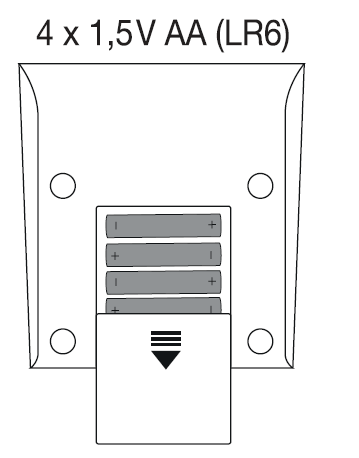
- Open the battery compartment lid.
- Insert four 1.5 V AA alkaline batteries (LR6).
- Make sure the batteries are inserted according to the correct plus (+) and minus (-) polarity markings.
- Do not use rechargeable batteries.
- Carefully close the battery compartment lid.
- All display elements will briefly appear after the batteries are inserted.
- Set the date and time before using the device.
- If the battery replacement symbol flashes, replace all four batteries before taking another measurement.
- After removing the batteries, the date and time must be set again.
- Previously saved measurement values are retained.
Setting the Hour Format, Time, and Date
- With the device switched off, press and hold the START/STOP button for approximately 5 seconds.
- Select the 12-hour or 24-hour format using the function buttons</>.
- Press the M2 button to confirm.
- When the hour display flashes, set the hour using the function buttons</>.
- Press M2 to confirm.
- Set the minutes, year, month, and day in the same way.
- Press M2 after each setting to confirm.
- Press M1 to return to the previous setting when required.

Setting the Alarms
- Two different alarm times can be set as reminders to take measurements.
- Alarm 1 appears on the display.
- Use the function buttons to activate or deactivate Alarm 1.
- Press M2 to confirm.
- If Alarm 1 is deactivated, the device automatically moves to the Alarm 2 setting.
- If Alarm 1 is activated, the hour display flashes.
- Select the desired hour using the function buttons and press M2.
- Select the desired minutes and press M2 to confirm.
- Alarm 2 then appears on the display.
- Set Alarm 2 using the same procedure as Alarm 1.
Bluetooth Setting
- Bluetooth can be switched on or off.
- Use the function buttons to activate or deactivate automatic Bluetooth data transfer.
- Press the M2 button to confirm the setting.
- Using Bluetooth data transfer may reduce battery life.
ECG Measurement Time Setting
- The ECG measurement duration can be set to 30, 60, 90, or 120 seconds.
- Select the desired ECG measurement time using the function buttons.
- Press M2 to confirm.
- After completing the settings, the blood pressure monitor switches off automatically.
Usage (blood pressure)
- Measure your blood pressure regularly and at the same times each day so the readings can be compared accurately.
- It is recommended to measure your blood pressure twice a day: once in the morning after getting up and once in the evening.
- Always take measurements when you are physically rested.
- Avoid measuring your blood pressure during stressful periods.
- Do not measure within 30 minutes of eating, drinking, smoking, or exercising.
- Before the first blood pressure measurement, rest for at least 5 minutes.
- If taking several measurements in succession, wait at least 1 minute between each measurement.
- Repeat the measurement if you are unsure about the measured value.
- Place the cuff only on your upper arm.
- Do not place the cuff on any other part of the body.
Attaching the cuff
- Blood pressure can generally be measured on either arm.
- Small differences between blood pressure readings on the right and left arms are normal and may occur for physiological reasons.
- Always take measurements on the arm that shows the higher blood pressure values.
- Consult your doctor before beginning regular self-measurement to determine which arm should be used.
- Once the appropriate arm has been selected, always measure blood pressure on the same arm.
- Use only a cuff that is compatible with the device.
- Select the cuff according to your upper arm circumference.
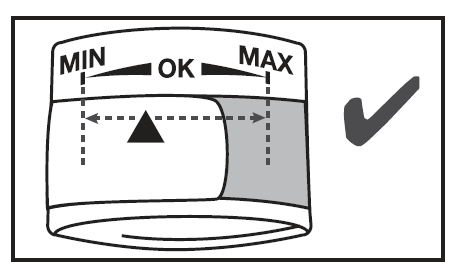
- Before measurement, check that the cuff fits correctly using the indicated index mark.
| Ref. no | Designation | Arm circumferences |
|---|---|---|
| 164.279* | Universal cuff | 22-42 cm |
- Place the cuff onto the bare upper arm. The circulation of the arm must not be hindered by tight clothing or similar.
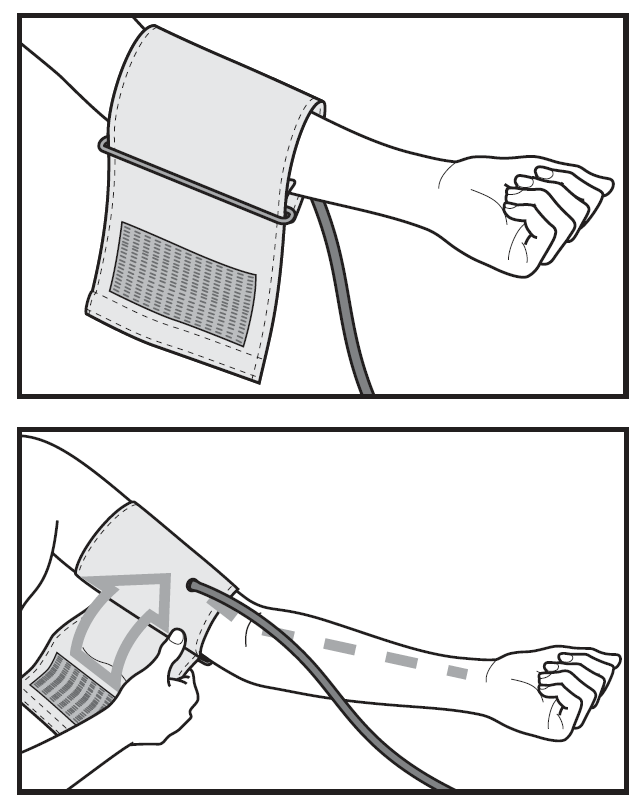
- The cuff must be placed on the upper arm so that the bottom edge is positioned 2–3 cm above the elbow and over the artery. The line should point to the centre of the palm here.
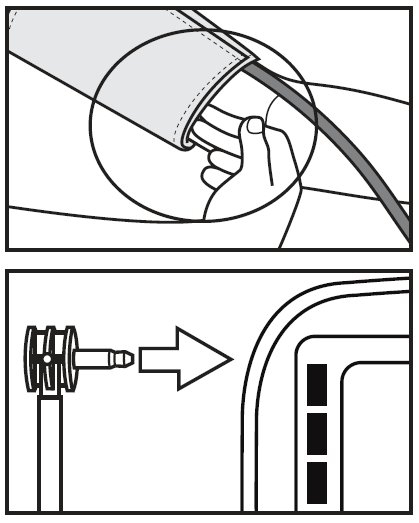
- Guide the end of the cuff that is sticking out through the metal ring, fold it back over the arm and close the cuff using the hook-and-loop fastener. The cuff should be fastened tightly, but not too tightly, so that two fingers can still fit under the closed cuff.
- Now insert the cuff line into the connection for the cuff connector.
- The cuff is suitable for you if the index mark (▼) is within the OK range after fitting the cuff.
Adopting the correct posture
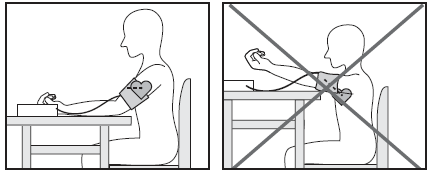
• To carry out a blood pressure measurement, make sure you are sitting upright and comfortably. Lean back and place your arm on a surface. Do not cross your legs. Place your feet next to each other flat on the floor.
• Always make sure that the cuff is at heart level.
• To avoid distorting the measurement, you should re-main as still as possible during the measurement and not speak.
Select the user memory
- The device has two user memories. Each user memory can store up to 60 measured values of the two categories: blood pressure and ECG. Once all memory spaces in a user memory have been used, the oldest measured values are replaced by the most recent.
- Press the START/STOP button on the switched-off device.
- With a 30-second measurement. Deviation is possible in the event of a longer measurement duration.
- Select the desired user by pressing the memory buttons M1 (for user 1 ) or M2 (for user 2 ).
- Confirm your selection by pressing the START/STOP button again. You can now proceed with ECG measurement or go to blood pressure measurement by pressing the START/STOP button again.
Performing the blood pressure measurement
As described above, attach the cuff and adopt the correct posture.
- Press the START/STOP button once and select the desired user memory as described in chapter 4.6.
- After you have made your selection, press the START/STOP button shown in the display.
- After approx. 3 seconds, the measurement starts automatically.
- The cuff automatically inflates. The measurement is taken while the cuff is being pumped up. As soon as a pulse has been detected, the pulse symbol will be displayed. After this, the cuff air pressure will be released again.
- The measurement results for systolic pressure, diastolic pressure and pulse will be displayed.
- The device has a cuff position control. This function allows the device to automatically check the correct fit of the cuff on your upper arm during the measurement.
- If the cuff has been correctly applied, the symbol will appear during the inflation process. It remains there until the measurement has been completed successfully and is then displayed together with the measured values determined.
- If the cuff is applied too tightly or too loosely, the symbol will be shown together with another symbol in the display. In such cases, the measurement is cancelled after approx. 5 seconds and the device switches itself off.
- Apply the cuff correctly and take a new measurement.
- The systolic pressure, diastolic pressure and pulse rate measurements are displayed.
- A symbol is displayed to indicate whether you were sufficiently relaxed during the blood pressure measurement: sufficiently at rest or not at rest.
- You can cancel the measurement at any time by pressing the START/STOP button.
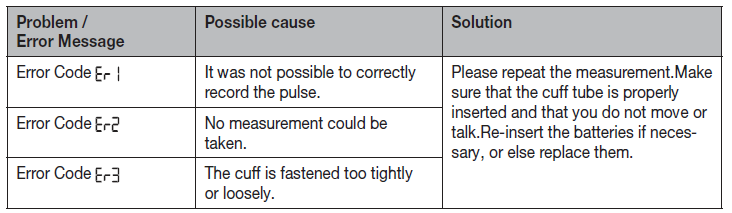
- An error symbol appears if the measurement could not be performed properly. Observe the chapter “What if there are problems?” and repeat the measurement.
- To switch off the device, hold the START/STOP button for 3 seconds or wait for 1 minute until the device switches off automatically.
- The measurement is automatically stored in the selected user memory.
Evaluating blood pressure measurement results
- Blood pressure is the force with which the bloodstream presses against the arterial walls. Arterial blood pressure constantly changes during a cardiac cycle.
- Blood pressure is always stated in the form of two values:
- The highest pressure in the cycle is called systolic blood pressure. This occurs when the heart muscle contracts and blood is pumped into the blood vessels.
- The lowest pressure is called diastolic blood pressure. This occurs when the heart muscle has completely relaxed and the heart fills with blood.
- Fluctuations in blood pressure are normal. Even during repeat measurements, considerable differences between measured values may occur.
- One-off or irregular measurements do not provide reliable information about actual blood pressure.
- Reliable assessment is only possible when measurements are performed regularly under comparable conditions.
Cardiac arrhythmia
This device can identify potential disruptions of the heart rhythm when measuring and if necessary, indicates this after the measurement with the symbol  . This can be an indicator for arrhythmia. Arrhythmia is an illness in which the heart rhythm is abnormal because of flaws in the bioelectrical system that regulates the heartbeat. The symptoms (skipped or premature heartbeats, pulse being slow or too fast) can be caused by factors such as heart disease, age, physical makeup, excess stimulants, stress or lack of sleep. Arrhythmia can only be determined through an examination by your doctor. If the symbol is shown on the display after the measurement has been taken, repeat the measurement. Please ensure that you rest for 5 minutes beforehand and do not speak or move during the measurement. If the symbol appears frequently, please consult your doctor. Self-diagnosis and treatment based on the measurements can be dangerous. Always follow your GP’s instructions.
Risk indicator
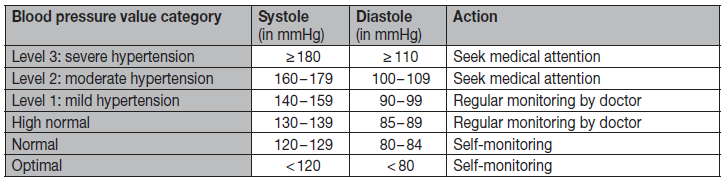
The measurements can be classified and evaluated in accordance with the following table. However, these standard values serve only as a general guideline, as the individual blood pressure varies in different people and different age groups etc. It is important to consult your doctor regularly for advice. Your doctor will tell you your individual values for normal blood pressure as well as the value above which your blood pressure is classified as dangerous. The bar chart on the display and the scale on the device show whic category the recorded blood pres-sure values fall into. If the values of systole and diastole fall into two different categories (e.g. systole in the high normal category and diastole in the normal category), the graphical classification on the device always shows the higher category; for the example given this would be high normal.
Atrial fibrillation
This device can identify atrial fibrillation when measuring the blood pressure and if necessary, indicates this after the measurement with the symbol AFIB. If you have atrial fibrillation, the displayed blood pressure value may not be correct. The display of AFIB can be influenced by factors such as heart disease, age, physical condition, over-stimulation, stress or lack of sleep. Atrial fibrillation is defined by an irregular and often rapid heart rate, increasing the risk of strokes, heart failure and other heart-related complications. Atrial fibrillation can only be determined through an examination by your doctor. If the symbol AFIB is shown on the display after the measurement has been taken, repeat the measurement. Please ensure that you rest for 5 minutes beforehand and do not speak or move during the measurement. If the symbol AFIB appears frequently, please consult your doctor. Selfdiagnosis and treatment based on the measurements can be dangerous. Always follow your GP's instructions.
Resting indicator measurement (using HSD diagnostics)
The most frequent error made when measuring blood pressure is taking the measurement when not at rest (haemodynamic stability), which means that both the systolic and the diastolic blood pressures are incorrect in this case. While measuring the blood pressure, the device automatically determines whether you are at rest or not. If there is no indication that the circulatory system is not sufficiently at rest, the symbol  (haemodynamic stability) appears in the display, and the measurement can be recorded as a reliable blood pressure at rest value.
Haemodynamically stable
The systolic and diastolic pressure measurements have been recorded when the circulatory system is sufficiently at rest and are a very reliable indicator of resting blood pressure. However, if there is an indication that the circulatory system is not sufficiently at rest (haemodynamic instability), the symbol  appears in the display. In this case, the measurement should be repeated after a period of physical and mental rest. The blood pressure measurement must be taken when the patient is physically and mentally rested, as it will be the basis for diagnosing the blood pressure level and therefore regulating the patient’s medical treatment.
Lack of haemodynamic stability
The systolic and diastolic blood pressures have probably been measured whilst the patient was not at rest and the measurements therefore deviate from the blood pressure at rest. Repeat the measurement after a minimum period of 5 minutes’ rest. Go to a sufficiently quiet and comfortable spot and remain there calmly; close your eyes, breathe deeply and evenly and try to relax. If the next measurement also shows insufficient stability, you can repeat the measurement after another resting period. If the measurements continue to show some instability, identify these blood pressure measurements as having been taken when the circulatory system had not been sufficiently rested. In this case, nervousness or inner anxiety may be the cause and this cannot be cured by brief periods of rest. Existing cardiac arrhythmias may also prevent a stable blood pressure measurement. A lack of resting blood pressure can have various causes, such as physical or mental strain or distraction, speaking or experiencing cardiac arrhythmias during the blood pressure measurement. In an overwhelming number of cases, the HSD diagnosis will give a very good guide as to whether the circulatory system is rested when taking the measurement. Certain patients suffering from cardiac arrhythmia or chronic mental conditions can remain haemodynamically unstable in the long term, something which persists even after repeated periods of rest. The accuracy of the blood pressure at rest results is reduced in these users. Like any medical measurement method, the precision of the HSD diagnosis is limited and can lead to incorrect results in some cases. The blood pressure measurements taken when the circulatory system was at rest represent particularly reliable results.
Saving, displaying and deleting measured values
The results of every successful measurement are stored together with the date and time. If there are more than 60 measurements, the oldest measurement is lost.
User memory
- Press the START/STOP button.
- Select the relevant user memory by pressing M1 for User 1 or M2 for User 2.
- Confirm your selection by pressing and holding the START/STOP button for 3 seconds. The device switches off automatically.
Average values
- Press the START/STOP button. The last stored measured value in the selected user memory is displayed.
- Press the function button. The average value of all saved measured values in the selected user memory is displayed.
- Press the function button again. The average value of the morning measurements for the last 7 days is displayed. Morning: 5 a.m.–9 a.m.
- Press the function button again. The average value of the evening measurements for the last 7 days is displayed. Evening: 6 p.m.–8 p.m.
Individual measured values
- Press the function button again to display the last individual measured values with the date and time.
- Continue pressing the function button to view the individual measured values.
- To switch the device off, hold the START/STOP button for 3 seconds.
Deleting measured values
- To delete the memory of the selected user, press and hold the function button for 5 seconds.
- The delete indication appears on the display. All values in the selected user memory are deleted.
Usage (ECG)
- The ECG measuring device is a single-channel electrocardiogram (ECG) device that can be used to rapidly record an electrocardiogram (ECG).
- The device also provides a clear evaluation of the recording, particularly regarding any disruption of the heart rhythm.
- The ECG measuring device displays changes in the heart rhythm, which may have various causes. These may be harmless or may be triggered by illnesses or diseases of differing degrees of severity.
- Consult a medical specialist if you believe you may have an illness or disease.
- Electrocardiograms recorded using the ECG measuring device show the heart’s function at the time of measurement.
- Changes occurring before or after the measurement may not necessarily be detected.
- ECG measurements taken with the device cannot identify all heart diseases.
- Regardless of the measurement result, consult your doctor immediately if you experience symptoms that could indicate acute heart disease.
- Such symptoms could include:
- Pain or pressure on the left side of the chest area or abdomen.
- Radiating pain in the mouth, jaw, face, shoulders, arms, or hands.
- Back pain.
- Nausea.
- Burning sensation in the chest.
- Tendency to collapse.
- Breathlessness.
- Rapid heartbeat or irregular heart rhythm.
- A combination of these symptoms.
Preparing the ECG measurement
Observe the following before beginning the ECG measurement:
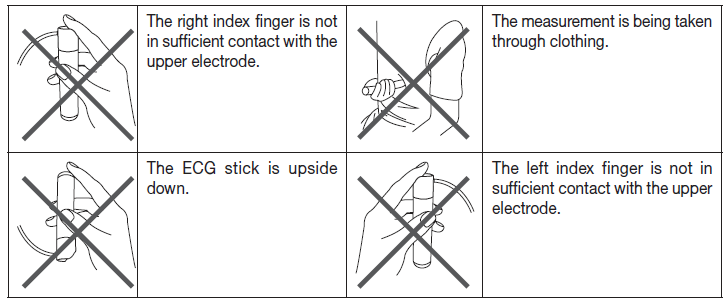
- Never use the ECG stick on top of clothing.
- If the electrode surfaces of the ECG stick are dirty, clean them with a damp cloth.
- If your skin or hands are dry, moisten them using a damp cloth before the measurement.
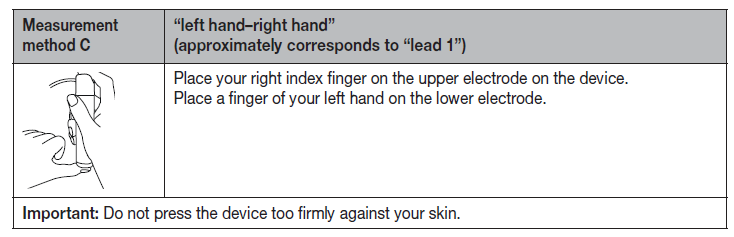
- Make sure there is no skin contact between your right and left hand for measurement method C, or between your hand and chest for measurement methods A/B.
- Ensure that your right hand does not come into contact with your body during the measurement.
- Press only lightly on the upper and lower electrodes of the ECG stick to ensure an accurate measurement.
- Never use the ECG stick upside down.
- Do not speak or move during the ECG measurement, as this may cause inaccuracies.
- Keep the device lying flat and horizontally on the table during the measurement.
Measurement methods
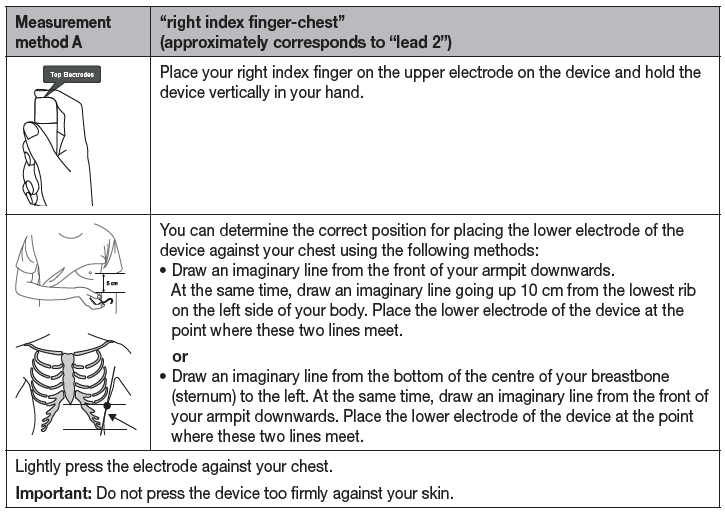
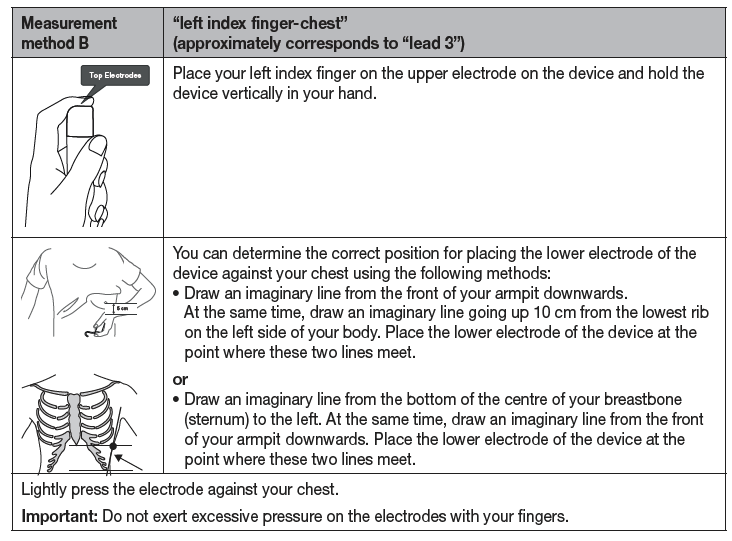
There are three different methods of taking the measurement. Start with measurement method A, “right index finger–chest”. If this method does not deliver measurements, or delivers only unstable measurements (“Er7” is frequently displayed), switch to method B “left index finger–chest” and, if necessary, to method C “left hand–right hand”. The most suitable method/procedure depends on the heart configuration (shape of the heart) of each individual user. If it is not possible to take stable measurements using a given measurement method, this could have a harmless cause such as the shape of the heart. However, the cause may also be an illness or disease.
Incorrect ECG measuring methods
NEVER take an ECG measurement if:
Evaluating ECG measured values
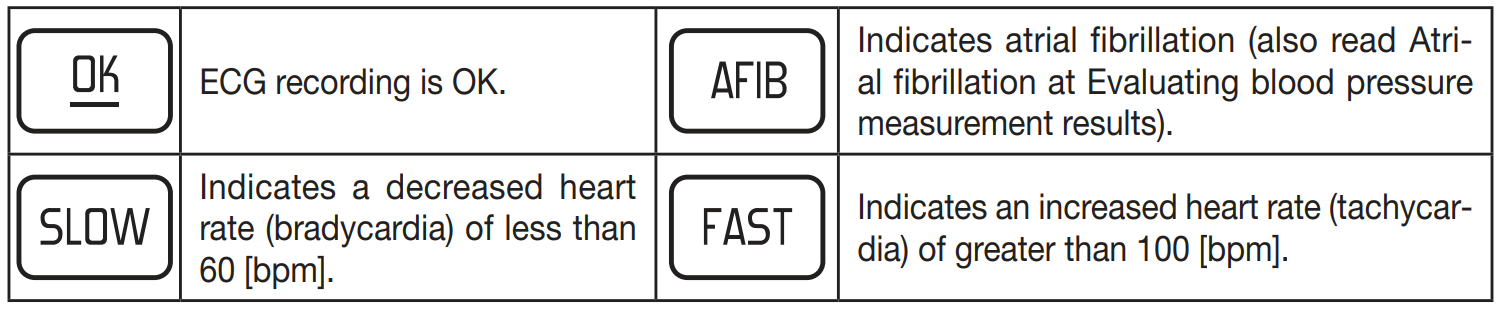
Once you have taken the measurement, the following results may appear on the LCD
Displaying and deleting ECG measured values
The device has two user memories. Each user memory can store up to 60 measurements. Once all memory spaces in a user memory have been used, the oldest measurements are replaced by the most recent.
Displaying
- You can access stored measurements on the device at any time.
- With the device switched off, press the START/STOP button. The last stored measured value in the selected user memory is displayed.
- To access the measured values in the second user memory, press M2.
Deleting
- To navigate between the individual measurements, press the function buttons.
- To delete the memory of the selected user, press and hold the function button for 5 seconds.
- The delete indication appears on the display.
- All values in the selected user memory are deleted.
Transferring measurements
Transfer via Bluetooth
- Download the free “beurer HealthManager Pro” app from the Apple App Store or Google Play.
- Activate Bluetooth on your smartphone.
- Open the “beurer HealthManager Pro” app.

- Select BM 96 in the app and follow the on-screen instructions.
- When connecting for the first time, a PIN code is displayed on the device.
- Enter the displayed PIN code on your smartphone.
- After the PIN code is entered successfully, the device will be connected to your smartphone.
- Check the list of system requirements and compatible devices to ensure your smartphone is supported.
Cleaning and maintenance
- Clean the main unit, ECG stick and cuff carefully using a slightly damp cloth only.
- Do not use any corrosive cleaning agents or solvents.
- If the electrode surfaces of the ECG stick are dirty, clean them with a damp cloth.
- When you are not using the ECG stick, disconnect it from the main unit.
- Under no circumstances should you hold the main unit, ECG stick or cuff under water, as this can cause liquid to enter and damage the device internally.
- Do not place heavy objects on top of the device during storage.
- Remove the batteries before storing the device.
- Do not bend the cuff line sharply.
Troubleshooting Guide for Beurer BM-96 Cardio Blood Pressure Monitor with ECG
Encounter issues with your **Beurer Blood Pressure Monitor with ECG Function BM-96 Cardio**? Follow these steps for common problems in this advanced upper arm device.
- Erratic Readings or Error Codes (e.g., E1-E5): Check cuff fit—ensure proper placement (22–42 cm arm); relax per resting indicator. Solution: Reposition and retry after 1-minute rest. Preventive: Maintain cuff cleanliness.
- No ECG Signal: Verify hand-chest or hand-hand lead contact. Solution: Moisten fingers, ensure steady hold; clean ECG stick. Preventive: Avoid movement during 30-second recording.
- Bluetooth/App Sync Fails: Confirm app compatibility (“beurer HealthManager Pro”). Solution: Restart device, re-pair via Bluetooth; update app. Preventive: Keep software current.
- Power/Battery Issues: Device won't turn on. Solution: Replace batteries; check USB for charging. Preventive: Use recommended batteries.
- Arrhythmia False Alerts: Possible disturbance detected. Solution: Consult doctor if persistent; log via app for analysis.
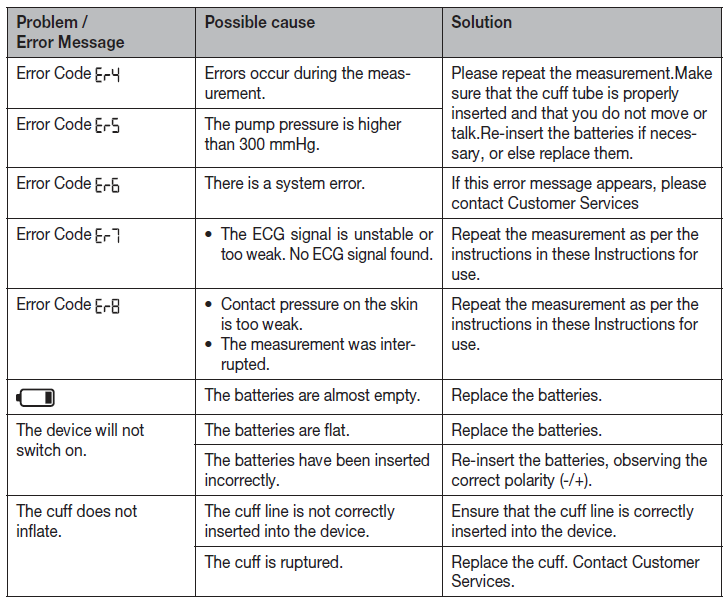
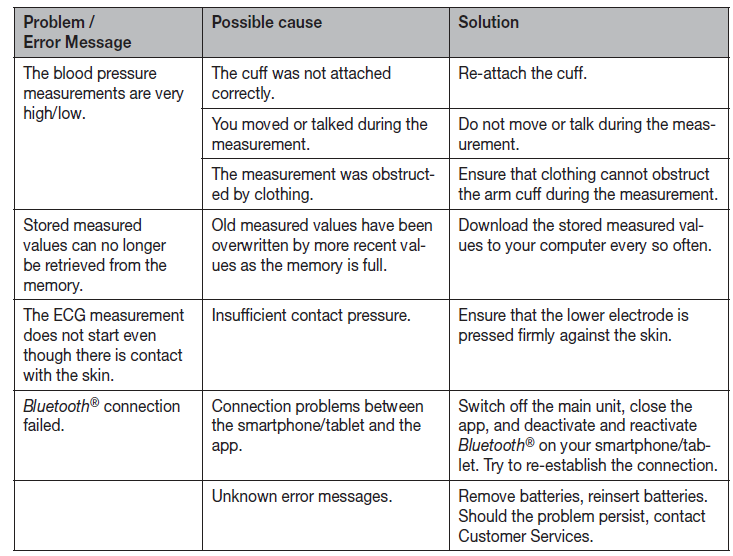
Warranty: 3–5 years standard (check retailer). Contact Beurer support: Germany (Söflinger Straße 218, 89077 Ulm) via website or app. For Bahrain/Australia users, local distributors like Noon or JB Hi-Fi offer help. Always reference manual for preventive maintenance.
Pros & Cons of Beurer Blood Pressure Monitor BM-96 Cardio with ECG Function
Pros
- 2-in-1 ECG + blood pressure for comprehensive heart monitoring at home, with app analysis saving doctor visits.
- Fast inflation tech and resting indicator deliver accurate, comfortable readings—users report 20% quicker than traditional cuffs.
- Bluetooth/USB connectivity and dual-user memory enhance tracking; excellent value vs. separate devices ($150–$250 range).
- Advanced AFib detection outperforms basic monitors like Beurer BM 85, aiding stroke prevention.
Cons
- No peer-reviewed clinical validation for BP accuracy (Medaval not recommended), potentially less reliable than Omron Platinum.
- Limited to single measurements; no multi-position averaging like premium competitors.
- App-dependent for full ECG insights—basic display lacks depth without “MyCardio Pro” service.
- Cuff size (22–42 cm) may not fit very large arms, requiring separate purchase.
Overall, strong value for tech-savvy users prioritizing ECG over validated BP alone.
Customer Reviews: Beurer BM-96 Cardio Blood Pressure Monitor ECG Insights
Users praise the Beurer Blood Pressure Monitor with ECG Function BM-96 Cardio for its ease and life-saving alerts, averaging 4.3/5 stars across retailers like JB Hi-Fi and Noon. “Detected my AFib early—app analysis was spot-on!” raves one (5/5). Common praises: Intuitive touch buttons, quick Bluetooth sync, and clear risk scale for hypertension management.
Complaints include occasional sync glitches (fixed by updates) and unvalidated accuracy concerns: “Great ECG, but BP varies slightly from clinic” (3/5). Frequently mentioned: Reliable for daily use, but consult pros for medical decisions. 80% recommend for home heart health monitoring—ideal if you value arrhythmia detection over perfect validation.
Faqs
How do I set up the beurer Blood Pressure Monitor with ECG Function BM-96 Cardio for the first time?
How do I perform an ECG measurement with the beurer Blood Pressure Monitor with ECG Function BM-96 Cardio ECG stick?
What should I do if the beurer Blood Pressure Monitor with ECG Function BM-96 Cardio shows inaccurate blood pressure readings?
How do I connect the beurer Blood Pressure Monitor with ECG Function BM-96 Cardio to the smartphone app via Bluetooth?
What are common troubleshooting tips for beurer Blood Pressure Monitor with ECG Function BM-96 Cardio not turning on or cuff issues?
Is the beurer Blood Pressure Monitor with ECG Function BM-96 Cardio compatible with my smartphone and what are the requirements?
How do I optimize blood pressure accuracy on beurer Blood Pressure Monitor with ECG Function BM-96 Cardio using advanced features?
How do I clean and maintain the beurer Blood Pressure Monitor with ECG Function BM-96 Cardio for long-term use?
More beurer manuals
- Setup: Beurer Blood Pressure Monitor BC 87 User Manual
- Setup: Beurer Blood Pressure Monitor BM-85 User Manual
- Setup: Beurer Upper Arm Blood Pressure Monitor BM-64 User Manual
- Setup: Beurer Blood Pressure Monitor BC-54 User Manual
- Setup: Beurer Upper Arm Blood Pressure Monitor BM 53 User Manual
- Setup: Beurer Blood Pressure Monitor BM-58 User Manual
Leave a Comment