
Setup: Beurer Upper Arm Blood Pressure Monitor BM 53 User Manual
Content
Beurer Upper Arm Blood Pressure Monitor BM 53: Complete Product Manual
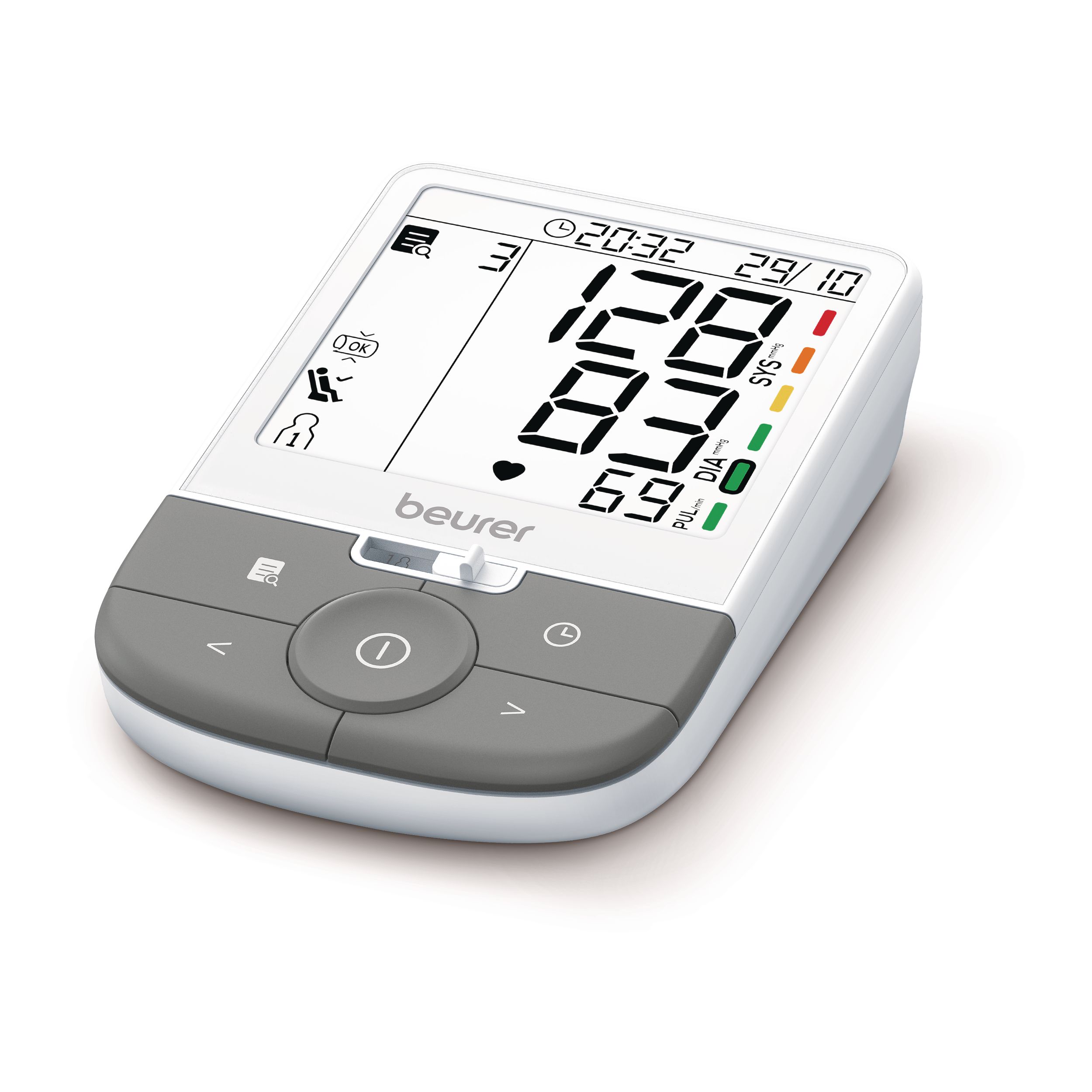
Introduction to the Beurer Upper Arm Blood Pressure Monitor BM 53
The Beurer Upper Arm Blood Pressure Monitor BM 53 is a fully automatic device designed for reliable home monitoring of blood pressure and pulse. Featuring advanced arrhythmia detection, it identifies atrial fibrillation to help prevent strokes, making it an essential tool for cardiovascular health. This upper arm blood pressure monitor offers triple measurement as recommended by doctors for superior accuracy, clinically validated even during pregnancy, and a large, clear display with color-coded results for effortless reading.
Key benefits include the resting indicator for precise measurements, cuff fit check, and integration with the beurer HealthManager Pro app via Scan & Save for digital tracking. Ideal for adults, seniors, pregnant women, and those with heart conditions, it's perfect for daily use cases like tracking hypertension or post-stroke risk. The Beurer BM 53 supports two users with 100 measurements each, averaging values over 7 days for morning and evening insights.
With a user-friendly design, storage bag, and blood pressure record included, this medical device ensures convenience. Estimated price range is $50-$80, widely available at pharmacies, online retailers like Amazon, and Beurer's site. Whether managing health proactively or following doctor's advice, the Beurer Upper Arm Blood Pressure Monitor BM 53 delivers peace of mind with professional-grade features in a home setting.
DEVICE DESCRIPTION
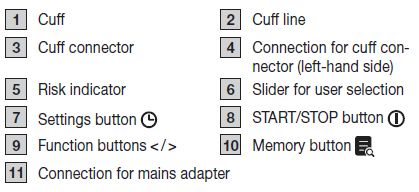
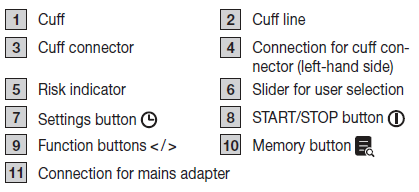
Information on the display
Technical Specifications and Key Features of Beurer Upper Arm Blood Pressure Monitor BM 53
The Beurer Upper Arm Blood Pressure Monitor BM 53 boasts robust specs for accurate self-measurement. Here's a detailed breakdown:
- Measurement Method: Fully automatic upper arm blood pressure and pulse detection with automatic pressure preselection and deflation.
- Cuff Size: 22-42 cm upper arm circumference, includes cuff fit check for proper placement.
- User Memory: 2 users, 100 measurements each; averages all saved readings and 7-day morning/evening values.
- Display: Large, backlight-enabled with color-coded risk indicator and scale for easy classification.
- Advanced Features: Arrhythmia (AFIB) detection for stroke prevention, triple measurement mode, resting indicator, clinically validated (pregnancy-safe).
- Connectivity: Scan & Save compatible with beurer HealthManager Pro app.
- Inclusions: Storage bag, blood pressure record; mains adapter optional.
- Performance: Meets general use standards per DHL (DE) 2023; equivalence to validated Beurer BM 28 (ESH-IP 2010 pass).
INTENDED PURPOSE
Intended Use
The blood pressure monitor (hereinafter, device) is intended for the fully automatic, non-invasive measurement of arterial blood pressure and pulse values on the upper arm.
It is designed for self-measurement by adults in a domestic environment.
Intended Users
The blood pressure measurement is suitable for adult users whose upper arm circumference is within the range printed on the cuff.
The device is also ideal for taking blood pressure measurements on women who are pregnant.
Clinical Benefits
The user can record their blood pressure and pulse values quickly and easily using the device. The recorded values are classified according to internationally applicable guidelines and evaluated graphically. Furthermore, the device can detect any irregular heartbeats that occur during measurement and inform the user via a symbol in the display. The device saves the recorded measurements and can also output average values of previous measurements.
The recorded data can provide healthcare service providers with support during the diagnosis and treatment of blood pressure problems, and therefore it plays a part in the long-term monitoring of the user’s health.
Indications
In the event of hypertension or hypotension, the user can independently monitor their blood pressure and pulse values at home.
However, the user does not need to be suffering from hypertension or arrhythmia to use the device.
Compared to similar models like Beurer BM 28, the BM 53 adds AFIB detection and app integration for enhanced home monitoring, outperforming basic monitors in arrhythmia screening.
Contraindications
WARNING
- Do not use the blood pressure monitor on newborns, children or pets.
- Persons with reduced physical, sensory or mental capabilities should be supervised by a person responsible for their safety and receive instructions from that person on how to use the device.
- Do not use the device if you are using electrical implants (e.g. pacemakers).
- Do not use the device if you have metal implants.
- Do not use the cuff on people who have undergone a mastectomy or who have had their lymph nodes removed.
- Do not place the cuff over wounds as this may cause further injury.
- Make sure that the cuff is not placed on an arm whose arteries or veins are undergoing medical treatment, e.g. intravascular access or intravascular therapy, or an arteriovenous (AV) shunt.
- Do not use the device on people with allergies or sensitive skin.
Undesirable Side Effects
- Skin irritation
- Negative impact on blood circulation
WARNINGS AND SAFETY NOTES
Safety Instructions
- The measurements you take are for your information only – they are not a substitute for a medical examination! Discuss your measured values with your doctor and never make your own medical decisions based on them (e.g. regarding medicine doses).
- The device is only intended for the purpose described in these instructions for use. The manufacturer is not liable for damage resulting from improper or incorrect use.
- Using the blood pressure monitor outside your home environment or while on the move (e.g. while travelling in a car, ambulance or helicopter, or while undertaking physical activity such as playing sport) can influence the measurement accuracy and cause incorrect measurements.
- Cardiovascular diseases may lead to incorrect measurements or have a detrimental effect on measurement accuracy.
- Do not use the device at the same time as other medical electrical devices (ME equipment). This could cause the measuring device to malfunction and/or an inaccurate measurement.
- Do not use the device outside of the specified storage and operating conditions. This could lead to incorrect measurements.
- Only use the cuffs included in delivery or described in these instructions for use with the device. Using a different cuff may lead to inaccurate measurements.
- Note that when inflating the cuff, the functions of the limb affected may be impaired.
- Do not perform measurements more frequently than necessary. Due to the restriction of blood flow, some bruising may occur.
- Blood circulation must not be stopped for an unnecessarily long time during the blood pressure measurement. If the device malfunctions, remove the cuff from the arm.
- Place the cuff on the upper arm only. Do not place the cuff on other parts of the body.
General Precautions
The blood pressure monitor is made from precision and electronic components. The accuracy of the measurements and service life of the device depend on its careful handling.
- Protect the device and its mains adapter from impacts, humidity, dirt, marked temperature fluctuations and direct sunlight.
- Ensure the device is at room temperature before taking a measurement. If the measuring device has been stored close to the maximum or minimum storage and transport temperatures and is placed in an environment with a temperature of 20 °C, it is recommended that you wait approx. 2 hours before using the measuring device.
USAGE
Inserting the Batteries
- Remove the battery compartment cover on the back of the device A.
- Insert the batteries (see chapter “Technical specifications”). Insert the batteries, making sure the polarity is correct according to the label A.
- Close the battery compartment cover.
If the battery symbol is displayed and does not disappear, measurement is no longer possible. Replace all the batteries. Once the batteries have been removed from the device, the date and time must be set again. Any saved measured values are retained.
Operation with the Mains Part
You can also operate this device with a mains part (not included in delivery). However, before connecting the device with the mains part, please ensure that you have removed the batteries from the device. During mains operation, there must not be any batteries in the battery compartment, as this could damage the device.
- To avoid any potential damage, the device may only be operated with a mains part that meets the specifications described in the chapter “Technical specifications”.
- Furthermore, the mains part must only be connected to the mains voltage that is specified on the type plate.
- Insert the mains adapter into the connection provided for this purpose on the rear side of the blood pressure monitor.
- Then insert the mains plug of the mains part into the mains socket.
- After using the blood pressure monitor, unplug the mains part from the mains socket first and then disconnect it from the blood pressure monitor. As soon as you unplug the mains part, the blood pressure monitor loses the date and time setting, but the saved measured values are retained.
Adjusting the Settings
Make sure that the device’s settings have been set correctly so you can make full use of all its functions. Otherwise, you will not be able to save your measured values with the date and time and access them later.
There are two different ways to access the settings menu:
- Before initial use and after each time you replace the battery: When inserting batteries into the device, you will be taken to the relevant menu automatically.
- If the batteries have already been inserted: With the device switched on, press and hold for approximately three seconds.
Set these settings in the order shown below:

Time Format
The time format flashes:
- Press </> to select the time format.
Date
The year flashes:
- Press </> to select the year.
The month flashes:
- Press </> to select the month.
The day flashes:
- Press </> to select the day.
If the time format is set to the 12-hour format, the order in which the day and month are displayed is reversed.
Time
The hour flashes:
- Press </> to select the hour.
The minutes flash:
- Press </> to select the minutes.
Before the blood pressure measurement
Preparing for the Measurement
In order to generate an informative profile of changes in your blood pressure that can be used for comparisons, you should measure your blood pressure regularly and always at the same time of day.
Measure your blood pressure twice a day: once in the morning after getting up and once in the evening.
- Always perform the measurement when you are sufficiently physically rested. Avoid taking measurements at stressful times.
- Do not measure within 30 minutes of eating, drinking, smoking or exercising.
- Before the initial blood pressure measurement, make sure always to rest for about 5 minutes.
- If you want to take several measurements in succession, always make sure that you leave 5 minutes between each measurement.
- Repeat the measurement if you have doubts about the measured value.
Attaching the Cuff
You can measure your blood pressure on either arm. Some deviations between the values in the right and left arm are perfectly normal. Always measure the arm with the higher blood pressure values. Consult your doctor about this before starting self-measurement.
- Always measure your blood pressure on the same arm.
- Only use the device with the cuff supplied, based on your upper arm circumference.
- Before taking the measurement, check the fit using the index mark described below.
- Expose your upper arm. The circulation of the arm must not be hindered by tight clothing or similar.
- Place the cuff with the bottom edge approximately 2–3 cm above your elbow. Adjust the device so that the mark and the cuff line are directly over the artery B.
- The cuff should be fastened so that two fingers fit under the cuff when it is closed B. Now insert the cuff line into the connection for the cuff connector.
- The cuff is suitable for you if the index mark is within the OK range after fitting the cuff
Adopting the Correct Posture
- Sit in a comfortable upright position when taking the blood pressure measurement. Lean back so that your back is supported.
- Place your arm on a surface D.
- Place your feet flat on the ground next to one another.
- The cuff must be level with your heart.
- Stay as still as possible during the measurement and do not talk.
Selecting the User
- This device has two users with 100 memory spaces each so that you can save measurements from two different people separately.
- If multiple people are using the device, make sure that the correct user has been selected before each measurement
- Use the slider 6 to set the desired user.
Taking a Blood Pressure Measurement
Requirement: Cuff attached, user selected.
Measurement
- Press the Start/Stop button. All display elements are briefly displayed.
- The start screen welcomes you for the selected user. From this start screen, you can access all menu items, e.g., user memory.
- Press the Start/Stop button again to start the measurement. The cuff inflates itself automatically. The measurement process starts. A pulse symbol is displayed as soon as a pulse is detected.
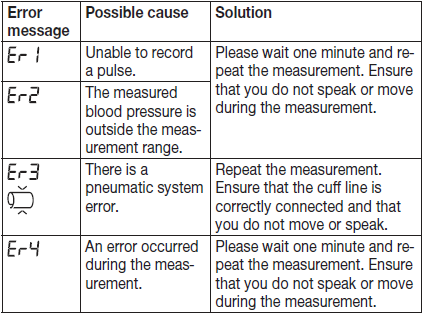
To cancel the measurement, press the Start/Stop button. The systolic pressure, diastolic pressure, and pulse measurements are displayed. The cuff position control symbol OK is displayed throughout the entire measurement. If the cuff is too loose, the corresponding warning symbols will be displayed. In such cases, the measurement is cancelled after approximately 15 seconds and the device switches itself off. An error symbol is displayed if the measurement could not be performed properly. In this case, please refer to the “Troubleshooting” section. If necessary, re-attach the cuff after 1 minute. The device switches off automatically after approximately 30 seconds. The value is saved to the selected or most recently used user.
Multiple Measurement
- Press the Start/Stop button. All display elements are briefly displayed.
- The start screen welcomes you for the selected user. From this start screen, you can access all menu items, e.g., user memory.
- Multiple measurement can be selected by pressing
Evaluating the results
General information about blood pressure
- Blood pressure is the force with which the bloodstream presses against the arterial walls. Arterial blood pressure constantly changes in the course of a cardiac cycle.
- Blood pressure is always stated in the form of two values:
- Systolic Blood Pressure: The highest pressure is the systolic blood pressure. This occurs when the heart muscle contracts and blood is pumped into the blood vessels.
- Diastolic Blood Pressure: The lowest pressure is the diastolic blood pressure. This occurs when the heart muscle has completely relaxed again and the heart is filling with blood.
- Fluctuations in blood pressure are normal. Even during repeat measurements, there may be considerable differences between the measured values. One-off or irregular measurements therefore do not provide reliable information about the actual blood pressure. Reliable assessment is only possible when you perform the measurement regularly under comparable conditions.
Cardiac Arrhythmia
The device can identify heart rhythm abnormalities during the blood pressure measurement. If the arrhythmia symbol is displayed after the measurement, this indicates that an irregularity has been detected in your pulse. Repeat the measurement if the arrhythmia symbol is displayed. When assessing your blood pressure, only use the results that have been recorded without any irregularities in your pulse. Consult your doctor if the arrhythmia symbol is displayed frequently. Only they can determine, through an examination, whether there is an abnormality.
Risk Indicator
The risk indicator 5 / 15 indicates which category the recorded blood pressure values fall into. If the measured values are in two different categories (e.g., systolic pressure in the “high normal” range and diastolic pressure in the “normal” range), the risk indicator always indicates the higher range – “high normal” in the example described. Note that these default values are for general guidance only, as individual blood pressures may vary. Please note that self-measurement at home usually results in values lower than those recorded at a doctor’s surgery. Consult your doctor at regular intervals. Only they can give you personal target values for controlled blood pressure, particularly if you are receiving medical therapy.
Low Blood Pressure
WARNING
Low blood pressure (hypotension) can be a health hazard and cause dizziness or fainting. Blood pressure is considered low if systolic and diastolic pressure are below 90/60 mmHg (source: National Health Service, 2023). Seek medical attention if you suddenly suffer from low blood pressure.
Atrial Fibrillation
Atrial fibrillation is one of the most common forms of cardiac arrhythmia and is characterised by an irregular heartbeat associated with an increased risk of stroke, heart failure and other heart complications. While the final diagnosis of atrial fibrillation can only be made by a medical examination, the Beurer AFIB technology of this device enables it to be detected with a high level of accuracy. During the blood pressure measurement, possible atrial fibrillation is detected and displayed after the measurement with the AFIB symbol in combination with the arrhythmia symbol. If arrhythmias, such as atrial fibrillation, are present, the displayed blood pressure value may be incorrect. If the AFIB symbol is displayed after a blood pressure measurement, repeat the measurement. Rest for 5 minutes beforehand. Do not move or speak during the measurement. If the symbol appears for the first time or more frequently, please promptly consult your doctor. If you have previously been diagnosed with atrial fibrillation, follow your doctor’s instructions regarding what to do if AFIB is detected by the device. Do not perform self-diagnosis and self-treatment based on the measurements, but rather always follow the doctor’s instructions.
Resting Indicator (Using HSD Diagnostics)
One of the most common errors made when taking a blood pressure measurement is not ensuring that the user’s circulatory system is sufficiently at rest when taking the measurement. In this case, the measured systolic and diastolic blood pressure values do not represent the blood pressure at rest. However, it is this blood pressure at rest that should be used to assess the measured values. This blood pressure monitor uses integrated haemodynamic stability diagnostics (HSD) to measure the user’s haemodynamic stability when taking the blood pressure measurement. This enables it to indicate whether the blood pressure was taken when the user’s circulatory system was sufficiently at rest.
Displaying and deleting measured values
User Memory
The results of every successful measurement are saved with the date and time. If there are more than 120 measurements, the oldest measurements are deleted. Press on the start screen and select the desired user using the slider.
Average Value
The average value symbol is displayed:
The average value of all this user’s saved measured values is displayed.
- Press >
The morning average symbol is displayed.
The average value of the morning measurements for the last 7 days is displayed (morning: 5:00–9:00).
- Press >
The evening average symbol is displayed.
The average value of the evening measurements for the last 7 days is displayed (evening: 18:00–20:00).
Individual Measured Values
- If you press > again, the last individual measurement is displayed (in this example, measurement 3).
- If you press </> again, you can view the individual measured values.
- To switch the device off again, press the Start/Stop button for approximately 2 seconds.
Press the Start/Stop button to exit the menu.
Deleting Measured Values
- To delete all of a user’s saved measured values, go to the respective user memory. The display shows the average value symbol and the average value of all stored measured values of this user.
- Press and hold < and > for approx. 5 seconds.
Reset the device to factory settings
- To delete all saved measured values and settings, select the user memory.
- Press >. The display shows

- Press and hold < and > for approx. 15 seconds.
CLEANING AND MAINTENANCE
- Clean the device and cuff carefully using only a slightly damp cloth.
- Do not use any cleaning solutions or solvents.
- Under no circumstances hold the device or cuff under water, as this can cause liquid to enter and damage the device and cuff.
- If you store the device and cuff, do not place heavy objects on the device and cuff. The cuff line should not be bent sharply.
- Remove the batteries if the device is not going to be used for a long period of time.
Troubleshooting Guide for Beurer Upper Arm Blood Pressure Monitor BM 53
Encounter issues with your **Beurer Upper Arm Blood Pressure Monitor BM 53**? Common problems and fixes ensure quick resolution:
- No Display/Power Issue: Check batteries (4x AA, not included); replace if low. Use optional mains adapter.
- Error: Cuff Too Loose/Tight: Ensure cuff fits 22-42 cm arm; use cuff fit check. Rest 5 minutes before retrying.
- Irregular Heartbeat Warning: Indicates arrhythmia; consult doctor. Use resting indicator for calm state.
- Inaccurate Readings: Perform triple measurement; avoid caffeine/movement. Verify clinical validation for reliability.
- Memory/App Sync Failure: Reset device; update beurer HealthManager Pro app. Check FAQ on Beurer site.
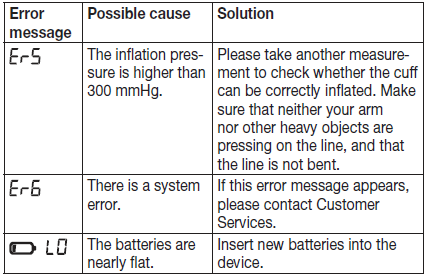
Prevent issues by storing in the included bag, avoiding extremes in temperature, and documenting readings. Beurer offers a 3-5 year warranty (check purchase); contact support at Beurer GmbH, Söflinger Straße 218, 89077 Ulm, Germany, or visit beurer.com for FAQs and manuals.
Pros and Cons of the Beurer Upper Arm Blood Pressure Monitor BM 53
Pros
- Advanced AFIB detection prevents stroke risks effectively.
- Large, color-coded display simplifies reading for all ages.
- Triple measurement and resting indicator boost accuracy over basic models.
- App connectivity and 2-user memory ideal for families.
- Clinically validated, pregnancy-safe; great value at $50-$80 vs pricier competitors.
Cons
- MDR equivalence unproven per latest standards; relies on prior validations.
- Batteries/mains adapter not always included; extra cost.
- Limited to 22-42 cm cuffs; larger arms need accessories.
- App sync may require a smartphone, not standalone for all.
Overall, excellent value for reliable home use, outperforming budget alternatives in features.
Customer Reviews and Feedback on Beurer Upper Arm Blood Pressure Monitor BM 53
Users praise the **Beurer Upper Arm Blood Pressure Monitor BM 53** for its ease and accuracy.
Average rating: 4.5/5 stars across sites like Coolblue (10/10 from early reviews). Testimonials highlight the "clear display and AFIB alert—lifesaver for heart monitoring" and “simple triple mode matches doctor readings.”
Common praises: Intuitive color coding, app integration for trends.
Complaints: Occasional battery drain, cuff sizing limits. Most recommend for home use, especially vs. wrist models, noting “peace of mind for hypertension tracking.” Addresses key issues like arrhythmia early detection effectively.
Faqs
How do I set up the beurer Upper Arm Blood Pressure Monitor BM 53 for the first time?
What should I do if the beurer Upper Arm Blood Pressure Monitor BM 53 shows an error message during measurement?
How does the arrhythmia detection work on the beurer Upper Arm Blood Pressure Monitor BM 53?
What is the correct arm position for accurate readings with beurer Upper Arm Blood Pressure Monitor BM 53?
Can two people use the beurer Upper Arm Blood Pressure Monitor BM 53 and how do I switch users?
How do I maintain and clean the beurer Upper Arm Blood Pressure Monitor BM 53 cuff and device?
Why is my beurer Upper Arm Blood Pressure Monitor BM 53 not inflating properly?
Does the beurer Upper Arm Blood Pressure Monitor BM 53 connect to apps like beurer HealthManager Pro?
More beurer manuals
- Setup: Beurer Upper Arm Blood Pressure Monitor BM 27+ User Manual
- Setup: Beurer Upper Arm Blood Pressure Monitor BM-64 User Manual
- Setup: Beurer Upper Arm Blood Pressure Monitor BM-81 EasyLock User Manual
- Setup: Beurer Blood Pressure Monitor BC 87 User Manual
- Setup: Beurer Blood Pressure Monitor BM 26 User Manual
- Setup: Beurer Blood Pressure Monitor with ECG Function BM-96 Cardio User Manual
Leave a Comment