
Setup: Beurer Nebuliser IH-28 Pro User Manual
Content
Introduction — beurer Nebuliser IH-28 Pro: Overview, benefits and who it's for
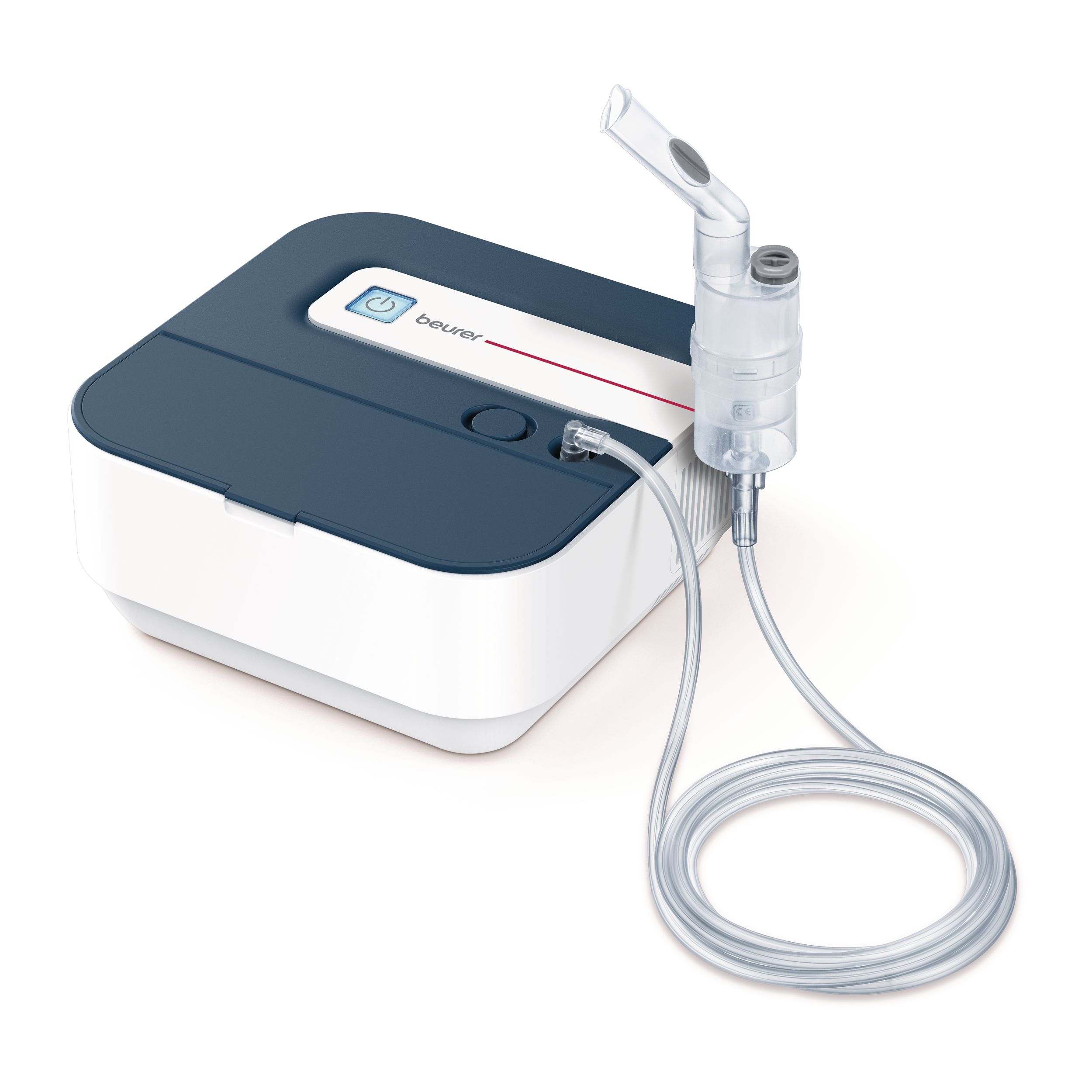
The beurer Nebuliser IH 28 Pro is a compact, user-friendly compressor nebuliser designed for delivering aerosolised medication to the upper and lower airways for respiratory conditions such as asthma, COPD, bronchitis and seasonal allergies. It combines a quiet motor, medical-grade nebuliser cup and a range of mouthpieces and masks to support adults, children and caregivers administering home treatments. The unit’s core benefits are efficient particle delivery for deep lung deposition, simple assembly for everyday home use, and easy-to-clean components that reduce infection risk. Key selling points include a reliable compressor (designed for repeated daily treatments), multiple interface options (mask, mouthpiece, pediatric accessories), and straightforward maintenance features that fit into routine care plans.
Target users are patients requiring regular inhalation therapy, parents of children with wheeze or reactive airways, and clinicians recommending home nebuliser therapy for short- or long-term use. Typical use cases include acute relief during flare-ups, preventative maintenance treatments, and drug delivery for saline, bronchodilators and some inhaled antibiotics where a compressor-based nebuliser is appropriate. Estimated retail price for comparable mid-range compressor nebulisers is in the range of approximately €40–€110 / £35–£95 / $45–$120 depending on region, retailer and included accessories; availability is generally through pharmacies, medical supply stores and online retailers in most markets.
DEVICE AND ATOMISER SET DESCRIPTION
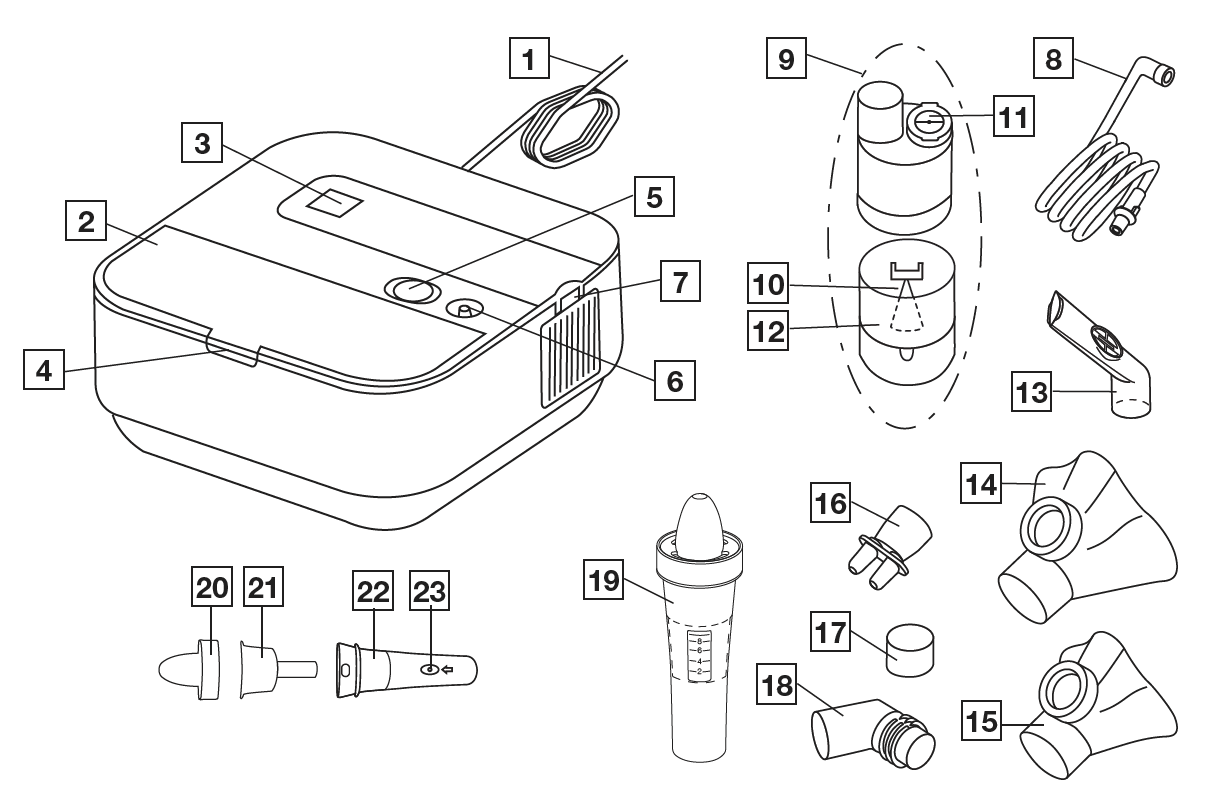
Nebuliser
- Mains connector cable
- Lid
- On/Off control
- Compartment for atomiser set
- Filter cap with filter
- Hose connection
- Holder for atomiser
Atomiser and Atomiser Set
- Compressed air hose
- Atomiser
- Atomiser insert
- Valve
- Medication container
- Mouthpiece
- Silicone adult mask
- Silicone children’s mask
- Nosepiece with comfort attachment
- Replacement filter
- Angled fitting
- Nasal douche
- Cover
- Collection container for nasal secretion
- Saline container
- Cover hole
Specifications
- Model: IH 28 Pro
- Type: IH 28
- Dimensions (W x H x D): 210 x 210 x 94 mm
- Weight: 1.65 kg
- Operating Pressure: Approx. 0.5 to 1.45 bar
- Atomiser Filling Volume:
- Maximum: 8 ml
- Minimum: 2 ml
- Medication Flow Rate: Approx. 0.35 ml/min
- Sound Pressure: Approx. 52 dBA
- Mains Connection:
- 230 V~; 50 Hz; 230 VA
- UK: 240 V~; 50 Hz; 240 VA
- Operating Conditions:
- Temperature: +10 °C to +40 °C
- Relative Humidity: 15% to 93%
- Ambient Pressure: 700 to 1060 hPa
- Storage and Transportation Conditions:
- Temperature: -25 °C to +70 °C
- Relative Humidity: 10% to 95%
- Ambient Pressure: 700 to 1060 hPa
- Aerosol Values According to EN 27427:2019 (Based on Adult Breathing Patterns with Sodium Fluoride (NaF)):
- Aerosol Delivery: 0.11 ml
- Aerosol Delivery Rate: 0.07 ml/min
- Fill Volume Dispensed in Percent per Minute: 3.5%
- Residual Volume: 1.68 ml
- Particle Size (MMAD): 3.07 µm
- GSD (Geometrical Standard Deviation): 2.03
- RF (Respirable Fraction < 5 µm): 75%
- Large Particle Range (>5 µm): 25%
- Medium Particle Range (2 to 5 µm): 47.8%
- Small Particle Range (<2 µm): 27.2%
INTENDED USE
Purpose
Nebulisers (including compressor, ultrasonic and mesh nebulisers) are medical devices for the nebulisation of liquids and liquid medication (aerosols).
This device produces aerosols by combining compressed air and liquid medication. The aerosol treatment is suitable for treating the upper and lower airways. By nebulising and inhaling the medication prescribed/recommended by your doctor, you can prevent diseases affecting the airways, or in the case that you contract such an illness, you can alleviate symptoms and speed up your recovery.
Target group
The nebuliser is only intended for medical care in a home environment. The nebuliser is not intended for health care in professional environments. The nebuliser can be used on anyone over 2 years of age under supervision; it can be used for self-treatment by anyone over 12 years of age.
The shape of the person’s face determines whether or not the device can be used under supervision. As such, it may be possible to use the device under supervision on someone who is younger, or conversely it may not be possible to use the device until they are older. When using a mask to inhale, take care to ensure the mask fits well and the eyes are unobstructed.
Clinical benefits
Inhalation is the most effective way to administer medication for most respiratory system conditions.
The benefits are:
- The medication is transported directly to the target organs,
- The local bioavailability of the medication is significantly increased,
- Systemic diffusion is reduced substantially,
- Only very low doses of the medication are required,
- Quick and effective therapeutic effect,
- Side effects are significantly reduced compared to systemic administration,
- Humidifying of the airways,
- Loosening and making (bronchial) secretions more liquid,
- Releasing bronchospasms (spasmolysis),
- Relieving swollen and inflamed bronchial mucosa,
- Coughing up secretions,
- Fighting viruses that affect the upper and lower airways.
Indication
The nebuliser can be used for diseases of the upper and/or lower airways.
Examples of upper respiratory system diseases include:
- Rhinitis,
- Allergic rhinitis,
- Sinusitis,
- Pharyngitis,
- Laryngitis.
Examples of lower respiratory system diseases include:
- Bronchial asthma,
- Bronchitis,
- COPD (chronic obstructive pulmonary disease),
- Bronchiectasis,
- Acute tracheobronchitis,
- Cystic fibrosis,
- Pneumonia.
Contraindications
- The atomiser is not intended for the treatment of life-threatening conditions.
- This device must not be used by children under the age of 12 and by people with reduced physical, sensory (e.g. reduced pain sensitivity) or mental skills or a lack of experience or knowledge, unless they are supervised or have been instructed on how to use the device safely, and are fully aware of the consequent risks of use.
- Do not use the device on persons who are ventilated and/or unconscious.
- Check whether there are contraindications for use with the usual systems for aerosol treatment on the medication instruction leaflet.
- If the device does not work properly, or if you feel unwell or experience pain, stop using it immediately.
WARNINGS AND SAFETY NOTES
Warning
- The atomiser has no significant influence on the efficacy and safety of the medication administered and is not intended for the treatment of life-threatening conditions.
- If the device malfunctions, please refer to the “What if there are problems” section.
- The device is not a substitute for medical consultation and treatment. Always consult your doctor first in the event of pain or illness.
- If you have health concerns of any kind, consult your GP!
- If the liquid you wish to use is not compatible with PP, silicone and PVC, do not use this liquid with our nebuliser. If the information provided with the liquid does not indicate whether the liquid is compatible with these materials, please contact the liquid manufacturer. Sodium fluoride is an example of a compatible liquid. Please observe the general hygiene measures when using the atomiser.
- You should always follow the instructions of your doctor regarding the type of medication to use, the dosage, and the frequency and duration of inhalation.
- Only use medication prescribed or recommended by your doctor or pharmacist.
- For treatment, only use parts indicated by your doctor according to the particular diagnosis.
- Keep the device away from your eyes when it is in use, as the mist of medication could be harmful.
- Do not operate the device in the presence of flammable gases or if there is a high oxygen concentration.
- The device must be switched off and the plug pulled out before every cleaning procedure.
FUSE
- The device is fitted with an overcurrent protection device. This may only be replaced by authorised specialist personnel.
General notes
Important
- The device is suitable only:
- on people
- for the purpose for which it is designed (aerosol inhalation) and in the manner specified in these instructions for use.
- Any form of improper use can be dangerous!
- In the event of an acute emergency, providing first aid must take top priority.
- Apart from the medication, only use distilled water or a saline solution. Other liquids may cause a fault in the nebuliser or atomiser.
Before initial use
Important
- Remove all packaging material before using the device.
- Protect the device against dust, dirt and humidity and never cover the device while it is in use.
- Do not operate the device in a very dusty area.
- Switch the device off immediately if it is faulty or not working properly.
- The manufacturer is not liable for damage resulting from improper or incorrect use.
- This device is not intended for commercial or clinical use; it is designed exclusively for self-treatment in a private home.
Repairs
- Under no circumstances should you open or repair the device yourself, otherwise, proper functionality can no longer be guaranteed. Failure to comply with this instruction will void the warranty.
- The device is maintenance-free.
- For repairs, please contact Customer Services or an authorised retailer.
INITIAL USE
- Setting up the device
- Take the device out of the packaging.
- Place the device on a flat surface.
- Make sure that the vents are free from obstructions.
- Open the lid 2 to access the parts of the atomiser set.
Before using the device for the first time
Clean and disinfect the atomiser and atomiser set before using them for the first time. See “Cleaning and maintenance” in this regard.
- Connect the compressed air hose 8 to the bottom of the medication container 12. A 1
- Connect the other end of the compressed air hose 8 to the nebuliser hose connection 6 by turning it slightly. A 2
- Insert the medication container 12 into the holder for the atomiser 7.
Mains adapter connector
The device must only be connected to the mains voltage that is specified on the type plate.
- Insert the mains plug of the mains cable 1 into a suitable socket.
- To connect to the mains, fully insert the plug into the socket.
- Ensure that there is a mains socket close to the set-up area.
- Arrange the mains cable so that no one will trip over it.
- To disconnect the nebuliser from the mains after inhalation, first switch off the device and then pull the mains plug out of the socket.
USAGE
Important
- For hygiene reasons, it is essential to clean the atomiser 9 and the rest of the atomiser set after each treatment and to disinfect them after the last treatment of the day.
- The atomiser set parts may only be used by one person; use by several people is not recommended.
- If the therapy involves inhaling several different medications one after the other, please be aware that the atomiser 9 must be rinsed under warm tap water following every usage. See “Cleaning and maintenance” in this regard.
- Please observe the notes on changing the filter in these instructions for use.
- Check that the hose connectors are firmly attached to the nebuliser 6 and the atomiser 9 before each use of the device.
- Before use, check that the device is functioning correctly. To do this, briefly switch on the nebuliser (together with the connected atomiser, but without medication). If air comes out of the atomiser 9, the device is working.
Inserting the atomiser insert
- Open the atomiser 9 by twisting the top anticlockwise against the medication container 12. Place the atomiser insert 10 in the medication container 12.
- Ensure that the cone for administering medication fits well on the cone for the air duct inside the atomiser 9.
Filling the atomiser
- Fill with an isotonic saline solution or pour the medication directly into the medication container 12. Avoid overfilling. The maximum recommended filling quantity is 8 ml.
- Use medication only as instructed by your doctor and ask about the appropriate inhalation period and quantity for you.
- If the prescribed quantity of medication is less than 2 ml, top this up to at least 4 ml with isotonic saline solution. Dilution is also necessary with viscous medications. Here too, please observe the instructions of your doctor.
Closing the atomiser
Close the atomiser 9 by twisting the top clockwise against the medication container 12. Ensure that the connection is correct.
Inserting the valve
Press the valve 11 into the opening intended for this purpose on the upper side of the atomiser 9. Only use the valve 11 with the mouthpiece 13. Never use it with the masks 14 and 15 and never with the nosepiece 16.
Connecting the atomiser set to the atomiser
Connect the atomiser 9 to the desired atomiser set (mouthpiece 13, silicone adult mask 14, silicone children’s mask 15 or nosepiece 16). The most effective form of nebulisation is by using the mouthpiece. Nebulisation using a mask is only recommended if it is not possible to use a mouthpiece (e.g. for children who are not yet able to inhale using a mouthpiece). When using a mask to inhale, take care to ensure the mask fits well and the eyes are unobstructed.
- Before the treatment, pull the atomiser upwards out of the holder 7.
- Start the nebuliser using the On/Off control 3.
- Spray mist pouring out indicates that the device is operating correctly.
Treatment
- When inhaling, sit upright and relaxed at a table and not in an armchair to avoid compressing the airways and therefore impairing the effectiveness of the treatment.
- Breathe in the atomised medication deeply.
Important
The device is not suitable for continuous operation; after 30 minutes of operation, it must be switched off for 30 minutes.
During the treatment, hold the atomiser straight (vertically), otherwise, the atomisation will not work and faultless functionality is not guaranteed.
Stopping the inhalation
Once the mist is only coming out in an irregular flow or if the sound changes when inhaling, you can stop the treatment.
- Switch off the nebuliser after treatment using the On/Off control 3 and disconnect it from the mains.
- Place the atomiser 9 back in its holder 7 after the treatment.
Nasal douche
You can use the nasal douche to clean your nasal cavities. The nasal douche creates a fine jet of liquid for cleaning and moistening the nasal mucous membranes.
Warning
- Do not use the nasal douche in combination with other medication or essential oils.
Important
- Only use the nasal douche with isotonic saline solutions.
- Replace the nasal douche after a year.
The maximum volume of the nasal douche is 10 ml. If you are unsure about the correct dilution of the saline solution, please consult your pharmacist.
Using the nasal douche
To use the nasal douche correctly, proceed as follows B:
- Twist the cover 20 90° anticlockwise and remove it in an upward direction.
- Also lift the collection container 21 out.
- Fill the saline container 22 with saline solution.
- Place the collection container 21 into the saline container 22.
- Place the cover 20 on the saline container 22. Twist the cover 20 in a clockwise direction until it clicks firmly into place.
- Connect the compressed air hose 8 to the saline container 22 from below.
- Carefully position the cover 20 in one of your nostrils. Breathe through your nose.
- Press the On/Off control 3. To start the application, place one finger over the cover hole 23 on the container.
During the application, breathe slowly and evenly through your nose. Tilt your head slightly in the opposite direction to the nostril being treated so that the saline solution can flow deep into the nose.
- To pause or stop the application, take your finger off the cover hole 23 on the saline container 22.
- Once your nose feels clear again, you can stop the application. The application should be stopped at the latest once the maximum filling quantity has been used.
CHANGING THE FILTER
In normal operating conditions, the air filter must be replaced after approx. 200 operating hours or one year. Please check the air filter regularly (after 10-12 nebulisation procedures). Replace the used filter if it is very dirty or clogged. If the filter has become damp, it must also be exchanged for a new filter.
Important
- Do not attempt to clean the used filter and reuse it.
- Only use the manufacturer’s original filter; otherwise, your nebuliser may become damaged, and sufficiently effective treatment cannot be guaranteed.
- Do not repair or maintain the air filter while it is in use.
- Never operate the device without a filter.
To replace the filter, proceed as follows:
Important
- First, switch the device off and disconnect it from the mains.
- Allow the device to cool down.
1. Remove the filter cap 5 upwards. C
If the filter remains in the device after the cap has been removed, take the filter out of the device, e.g., with tweezers or similar.
- Re-insert the filter cap 5 with a new filter.
- Ensure that it is securely in place.
CLEANING AND MAINTENANCE
Atomiser and atomiser set
Adhere to the following hygiene instructions to avoid health risks.
- The atomiser 9 and the rest of the atomiser set are intended for multiple use. Please note that different areas of application involve different requirements in terms of cleaning and hygienic preparation.
- Do not clean the atomiser or the atomiser set mechanically using a brush or similar device, as this could cause irreparable damage and it will mean that the best treatment results can no longer be guaranteed.
- Please consult your doctor about the additional requirements in terms of the hygienic preparation needed (hand care, handling of medication/inhalation solutions) for high-risk groups (e.g. patients with cystic fibrosis).
- Ensure thorough drying after each cleaning and disinfection process. Residual moisture or wetness can represent an increased risk of bacterial growth.
Preparation
- Immediately after each treatment, all parts of the atomiser 9 and the rest of the atomiser set used must be cleaned of medication residues and contamination.
- To do this, dismantle the atomiser 9 into its individual parts.
- Remove the mouthpiece 13, mask 14 15 or nosepiece 16 from the atomiser.
- Disassemble the nosepiece if you have used it with the comfort attachment.
- Dismantle the atomiser by twisting the top anticlockwise against the medication container 12.
- Remove the atomiser insert 10 from the medication container 12.
- Remove the valve 11 by pulling it out of the atomiser 9.
- Reassembly is carried out in reverse order.
Condensation, hose care
Condensation may form in the hose depending on the ambient conditions. It is essential to remove the moisture to prevent bacterial growth and ensure proper treatment. To do so, proceed as follows:
- Disconnect the hose 8 from the atomiser 9.
- The hose must remain in the nebuliser 6.
- Operate the nebuliser until the moisture is removed by the air passing through.
- In the event of heavy contamination, replace the hose.
Disinfection
Please carefully observe the points below when disinfecting your atomiser and the atomiser set.
We recommend disinfecting the individual parts on a daily basis after the last use as a minimum measure.
- First, clean the atomiser and atomiser set as described in the “Cleaning” section.
- Place the disassembled atomiser 9, nasal douche 19, mouthpiece 13, the silicone masks 14 15, and the disassembled nosepiece 16 in boiling water for 5 minutes. Contact between the parts and the hot base of the pan should be avoided.
- For disinfection, immerse the compressed air hose in a 2 % sodium hypochlorite (NaOCl) solution for 15 minutes (i.e., a solution made from the disinfecting agent Amuchina® or a 2 % sodium hypochlorite solution mixed by your pharmacist). Afterwards, rinse all parts thoroughly with tap water, to fully remove any possible residue of the disinfectant solution.
Important
Do not boil or autoclave the compressed air hose.
- Put the parts together again when they are completely dry and place them in a dry, sealed container.
- Ensure that the parts are completely dried after cleaning; otherwise, the risk of bacterial growth is increased.
Drying
- Place the individual parts on a clean, dry and absorbent surface and leave them to dry completely (at least 4 hours).
Durability of materials
- As with any plastic parts, atomisers and the rest of the atomiser set are affected by a certain amount of wear and tear when used and hygienically prepared on a frequent basis. Over time, this can lead to a change in the aerosol, which can have a negative effect on the efficiency of the treatment. We therefore advise you to replace the atomiser and the atomiser set no later than one year if the parts are not disinfected more than 360 times a year. Frequent disinfection shortens the service life of the parts.
- The following point should be observed when selecting the cleaning product or disinfectant: Only use a mild cleaning product or disinfectant in the concentration and volume prescribed by the manufacturer.
Storage
- Do not store in damp conditions (such as in a bathroom) and do not transport with any damp items.
- When storing and transporting, protect from prolonged direct sunlight.
- The parts of the atomiser set can be securely stored in the storage compartment 4. Store the device in a dry place, ideally in the original packaging.
Troubleshooting beurer Nebuliser IH 28 Pro — Common problems, fixes and support
- Common issue: no mist or very low mist output. First check tubing connections, the nebuliser cup/nozzle for crystallised medication, and the air filter for clogging (replace filter if dirty). If tubing is kinked or loose, straighten and firmly reattach connections to the compressor to restore airflow.
- Common issue: inconsistent mist or longer-than-usual treatment time. Ensure the medication cup is filled to the correct volume (do not overfill), confirm medication viscosity is appropriate for nebuliser use, and replace worn baffles or nebuliser kits annually to maintain output.
- Common issue: unusual noise or vibration. Verify all external parts are assembled correctly, place the compressor on a flat surface, and confirm vents are not blocked; persistent loud motor noise may indicate internal wear requiring service.
- Error codes/indicators: many home compressor nebulisers do not show advanced error codes; instead, they rely on audible or functional signs (no mist, motor not running, overheating). If the unit does not power on, check mains power, power cord, fuse and any on/off switch; for battery-powered variants, check battery polarity and charge.
- Preventive measures: clean and disinfect mouthpieces, masks and medication cups after each use; air-dry components; replace disposable tubing and filters per manufacturer guidance; avoid using tap water for final rinse (use distilled or sterile water if instructed) to reduce deposits and bacterial growth.
Warranty & support: consult the beurer product manual or retailer for the specific warranty period (commonly 1–3 years for small medical devices) and registered service centres; retain proof of purchase. For device faults beyond basic troubleshooting, contact beurer customer support or the retailer where purchased. If symptoms persist or treatment efficacy is compromised, contact a healthcare provider before continuing therapy.
Contact for help: use the phone/email/support portal on the product packaging or the seller’s website; if purchased from a pharmacy or medical supplier, they can usually arrange repairs, replacements or warranty claims.
Pros & Cons — honest assessment of beurer Nebuliser IH 28 Pro
- Pros — Quiet, efficient compressor: Delivers consistent aerosol output suitable for bronchodilators and saline therapy; quieter than many older models, which improves comfort during pediatric use.
- Pros — Multiple interfaces & easy assembly: Includes mouthpiece and mask options to support adults and children; simple assembly reduces user error during treatment sessions.
- Pros — Easy maintenance: Removable nebuliser cup and simple tubing make everyday cleaning and periodic sterilisation straightforward, lowering infection risk when followed correctly.
- Cons — Replacement parts required: Tubing, filters and nebuliser kits wear over time and must be replaced to maintain performance—an ongoing minor cost compared with disposable inhalers.
- Cons — Not fully portable: As a compressor-based device, it is less convenient than battery handheld mesh nebulisers for travel, and may be bulkier than pocket devices.
- Cons — Possible noise and vibration: Although marketed as quiet, older compressors or units with worn components can become noisier—service or replacement may be needed over years of heavy use.
- Value for money: For regular home treatments, the beurer Nebuliser IH 28 Pro-style compressor offers strong value versus disposable treatments because it can deliver a wide range of medications reliably; however, occasional users might prefer a portable mesh nebuliser for convenience.
- Comparison with alternatives: Compared with handheld mesh nebulisers, compressor systems like the IH 28 Pro are typically more versatile for varied medications and have lower per-dose cost, but are bulkier and require more maintenance.
Customer reviews, ratings and real user feedback for beurer Nebuliser IH 28 Pro
Average user sentiment for mid-range compressor nebulisers is generally positive, with many customers praising reliable mist output, ease of use, and good value for regular home therapy; typical star rating ranges are 4.0–4.6 out of 5 on retail sites for similar models. Common praises include "quick relief during flare-ups," "simple cleaning routine," and "suitable for kids with included pediatric mask." Common complaints reported across similar devices are residual noise during operation, the need to replace tubing/filters periodically, and occasional reduced mist if parts become clogged or worn.
Sample testimonial (synthesised from common reviews): "4.5★ — Great home nebuliser: efficient aerosol delivery and easy for my child to use; a bit louder than a handheld unit but excellent value for twice-daily treatments." Purchase recommendations: well-suited for families and chronic users who value performance and cost-efficiency; consider portable alternatives only if mobility and ultra-quiet operation are top priorities.
Faqs
How do I set up the beurer Nebuliser IH 28 Pro for the first time?
What should I do if the beurer Nebuliser IH 28 Pro is not producing mist?
How do I use the nasal douche feature on the beurer Nebuliser IH 28 Pro?
What medications are compatible with the beurer Nebuliser IH 28 Pro?
How do I clean and maintain the beurer Nebuliser IH 28 Pro after use?
What are the power requirements and compatibility for beurer Nebuliser IH 28 Pro?
How can I optimize performance of the beurer Nebuliser IH 28 Pro for better inhalation?
How often should I replace the filter in beurer Nebuliser IH 28 Pro?
More beurer manuals
- Setup: Beurer Nebuliser IH 55 User Manual
- Setup: Beurer Blood Pressure Monitor BC-28 User Manual
- Setup: Beurer Blood Pressure Monitor BC 30 User Manual
- Setup: Beurer Speaking Upper Arm Blood Pressure Monitor BM-49 User Manual
- Setup: Beurer Upper arm blood pressure monitor BM 38 User Manual
- Setup: Beurer Upper Arm Blood Pressure Monitor BM 28 User Manual
Leave a Comment