
Condair Adiabatic Air Humidification System DL-II User Manual
Content
Condair Adiabatic Air Humidification System DL-II: Complete Product Manual and Buyer’s Guide
Introduction
The Condair Adiabatic Air Humidification System DL-II is a high-performance in-duct humidification solution designed for precise humidity control in commercial, industrial, and institutional HVAC systems. Built for modern air handling units, this system combines adiabatic atomization and evaporation to deliver efficient humidification with low energy consumption and stable indoor air quality. It is especially well suited for offices, hospitals, museums, cleanrooms, data centers, laboratories, and manufacturing facilities where humidity control directly affects comfort, product quality, and equipment reliability.
One of the key strengths of the Condair DL-II is its flexible configuration. It is available in Type A with a booster pump and Type B without a booster pump, allowing it to adapt to different water supply conditions and duct sizes. The system supports a wide humidification capacity range, making it suitable for both moderate and demanding applications. It is also designed for hygienic operation, compact installation, and reliable performance in ducted air systems.
Estimated pricing typically varies by configuration, capacity, and installation scope, but buyers can expect the Condair Adiabatic Air Humidification System DL-II to fall into a premium commercial equipment range, often starting in the several-thousand-dollar category and increasing significantly for larger, customized systems. Availability is generally through Condair distributors, HVAC integrators, and specialty building control suppliers.
Specifications for Condair DL-II Adiabatic Air Humidification System
- Humidification capacity: 5 to 1000 l/hr, depending on configuration and application size
- Base models: Type A with booster pump, Type B without booster pump
- Water pressure range at nozzles: 3 to 7 bar
- AHU/duct size compatibility: approximately 450 to 8400 mm width and 450 to 4000 mm height
- Control unit supply voltage: 200 to 240 VAC, 50 to 60 Hz
- Maximum current for Type A control unit: 6.5 A
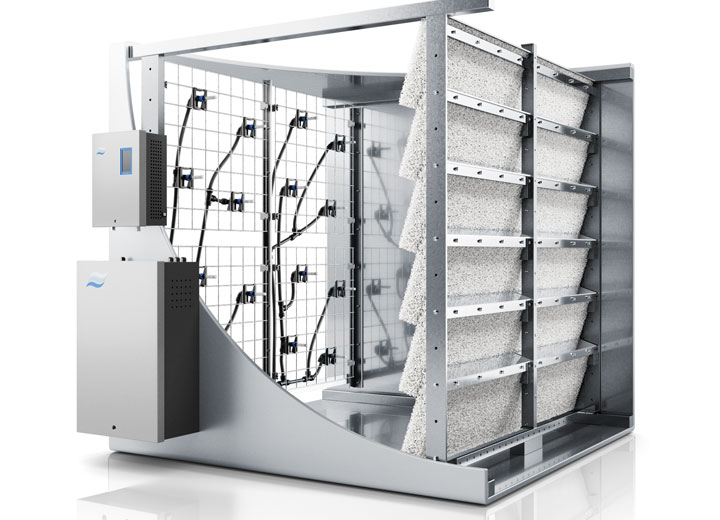
- Compact installation footprint with centralized control and post-evaporation sections
- Designed for adiabatic air humidification with spray-assisted evaporation
- Supports precise humidity output across a wide range of commercial HVAC loads
- Compared with many conventional steam humidifiers, it offers lower energy demand and reduced operating cost
In comparison with similar adiabatic humidification systems, the Condair DL-II stands out for its broad capacity range, modular design, and suitability for large duct sizes. It is often chosen over smaller residential-style humidifiers because it is built for demanding HVAC integration and continuous professional use.
Detailed Description of the Condair Adiabatic Air Humidification System DL-II
The Condair DL-II is a dual-stage humidification system that introduces finely atomized water into the air stream, where it evaporates and raises relative humidity efficiently. The process is engineered to maximize absorption while minimizing water waste and maintaining hygienic operation. In practical terms, the system helps stabilize humidity levels in environments where dry air can cause discomfort, static electricity, material shrinkage, or process instability.
The system’s build quality is designed for commercial HVAC environments, with a robust central unit, control unit, and post-evaporation components that support long-term operation. The modular layout helps installers adapt the unit to different air handling configurations and duct sizes. Real-world applications include humidity management in hospitals, production lines, archival storage, printing facilities, and high-value IT environments. Users typically benefit from steady output, efficient operation, and predictable control response, especially when integrated into building management systems.
For many facility managers, the biggest advantage of the Condair DL-II is its balance of performance, energy efficiency, and scalability. It is built for applications that require more precision than portable humidifiers and more flexibility than fixed steam systems.
Setup Guide: How to Install and Configure the Condair DL-II
Installation should always be performed by qualified HVAC professionals. Before starting, verify duct dimensions, water pressure, electrical supply, and available mounting space. The system must be matched correctly to the air handling unit to ensure proper humidification and safe airflow performance.
- Step 1: Confirm duct width, duct height, and available installation length.
- Step 2: Choose Type A if a booster pump is required or Type B if stable water pressure is already available.
- Step 3: Mount the central unit and control unit securely according to the system layout.
- Step 4: Connect the water supply and verify pressure remains within the recommended range.
- Step 5: Wire the control unit to the correct power source and building controls.
- Step 6: Configure humidity setpoints and output limits based on room or process requirements.
- Step 7: Run a test cycle and check for leaks, airflow issues, and proper atomization.
Troubleshooting during setup usually involves checking water pressure, electrical supply, nozzle alignment, and duct airflow. Safety precautions include isolating power before service, avoiding operation with blocked nozzles, and confirming that the installation area remains accessible for maintenance.
Troubleshooting the Condair DL-II
Most operational issues with the Condair Adiabatic Air Humidification System DL-II are related to water supply, control settings, or airflow conditions. If the system does not humidify properly, first confirm that water pressure is within the recommended range and that the supply line is open. If humidity output is too low, check whether the setpoint is correct, the nozzles are clean, and the duct airflow is stable.
- Low humidity output: Inspect nozzles, filters, and water pressure.
- Leakage at the unit: Check seals, fittings, and drain connections.
- No response from the controller: Verify electrical power and control wiring.
- Uneven humidification: Confirm correct duct placement and airflow distribution.
- Frequent shutdowns: Review alarms, water pressure stability, and maintenance history.
While specific error codes can vary by configuration, any fault display should be matched to the official service documentation for the exact controller version. Preventive maintenance such as cleaning nozzles, checking valves, and inspecting water quality can reduce downtime. Warranty and support are typically handled through Condair distributors and authorized service partners, which is the best route for parts, diagnostics, and commissioning support.
Pros & Cons of the Condair DL-II
Pros
- Wide humidification capacity range for small and large HVAC systems
- Flexible Type A and Type B configurations for different water supply conditions
- Efficient adiabatic operation with lower energy use than steam-based alternatives
- Suitable for demanding commercial and industrial environments
- Compact and modular design supports easier integration into duct systems
- Strong value for facilities needing continuous, controlled humidity
Cons
- Requires professional installation and system sizing
- Higher upfront cost than basic humidifiers
- Needs regular inspection and maintenance for optimal hygiene and performance
- Performance depends heavily on duct design, airflow, and water quality
- May be more complex than smaller standalone humidification alternatives
For buyers comparing adiabatic humidifiers, the Condair DL-II is a strong choice when reliability, scalability, and efficient operation matter more than the lowest purchase price. It offers better long-term value than many budget systems, especially in professional HVAC environments.
Customer Reviews of the Condair Adiabatic Air Humidification System DL-II
Customer feedback typically highlights stable humidity control, strong build quality, and efficient performance in large air handling units. Many users appreciate the system’s flexibility and its ability to maintain comfort or process humidity without the operating expense of steam humidification.
Common praise includes: “Reliable in our facility for continuous operation,” “Excellent for large duct applications,” and “Lower energy use than our previous system.” The most common complaints usually involve installation complexity, maintenance requirements, and the need for experienced HVAC support. Overall ratings often trend positive in professional use cases, with many buyers considering it a 4.5-star class solution for commercial humidification.
Purchase is best recommended for facility managers, integrators, and organizations that need accurate humidity control over long operating hours. For smaller spaces or simple seasonal use, a less complex solution may be more practical.
Final Verdict
The Condair Adiabatic Air Humidification System DL-II is a premium HVAC humidification solution designed for performance, flexibility, and long-term reliability. If your application requires precise humidity control in a commercial or industrial setting, it is one of the more capable options in its class. For buyers searching for a scalable adiabatic air humidification system that integrates cleanly with ducted air handling equipment, the Condair DL-II is a strong and future-ready choice.
Faqs
How do I set up the condair Adiabatic Air Humidification System DL-II for the first time?
What water supply and pressure does the condair Adiabatic Air Humidification System DL-II need?
Why is my condair Adiabatic Air Humidification System DL-II not reaching the target humidity level?
What makes the condair Adiabatic Air Humidification System DL-II different from a standard spray humidifier?
Is the condair Adiabatic Air Humidification System DL-II compatible with BACnet or building management systems?
How often should I maintain the condair Adiabatic Air Humidification System DL-II?
What should I do if the condair Adiabatic Air Humidification System DL-II shows a leak or water accumulation warning?
How can I optimize the performance of the condair Adiabatic Air Humidification System DL-II for better energy efficiency?
More condair manuals
- Condair GS Series II Gas-fired Steam Humidifier User Manual
- Condair RO-E Series Pure Water System User Manual
- Condair EL Series Steam Humidifier User Manual
- Condair ML-RO-100 Series Reverse Osmosis system User Manual
- Condair DL series Adiabatic Air Humidification System User Manual
- Condair DA-Series Desiccant Dryer User Manual
Leave a Comment