
Setup: Beurer Nebuliser IH-15 User Manual
Content
Introduction — beurer Nebuliser IH-15: overview, benefits & who it's for
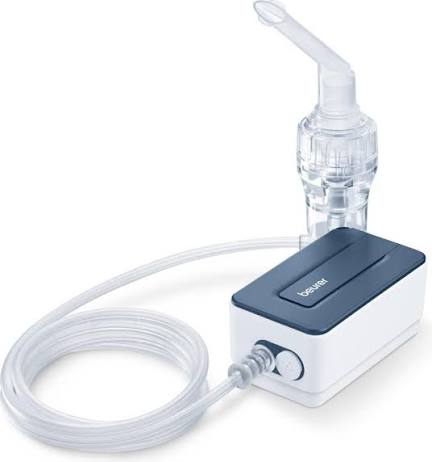
The beurer Nebuliser IH 15 is a compact compressor nebuliser designed to deliver aerosolised medication to the upper and lower respiratory tract for conditions such as colds, asthma, bronchitis and other respiratory diseases, making inhalation therapy practical at home or on the go. (Product page)
Key benefits and unique selling points include fast and effective nebulisation using DC compressed‑air technology, a high proportion of respirable particles for targeted delivery, short inhalation times, a single‑button intuitive operation and removable parts for easy cleaning—features that make the IH 15 suitable for daily therapy and travel use. (Product page)
Target users include adults and children (use for young children should be supervised) with recurrent upper or lower airway problems, people requiring routine inhaled medication, caregivers seeking an easy‑to‑use device, and travellers wanting a lightweight nebuliser solution. Typical use cases are asthma maintenance treatments, treatment of acute bronchitis or severe colds, and delivery of physician‑prescribed inhalation solutions. (IFU summary)
Estimated price range varies by region and retailer but typically places the IH 15 in the entry- to mid‑range home nebuliser category (commonly offered at affordable consumer prices on official distributors and medical suppliers). Availability: sold through Beurer regional sites, medical suppliers and authorised retailers; check local Beurer websites or authorized dealers for current stock and pricing. (Beurer product pages)
Beurer IH 15 Specifications:
- Type: IH 15
- Dimensions (W × H × D): 112 × 59 × 46 mm
- Weight: 175 g (without atomiser set or cable)
- Operating Pressure: Approx. 0.35–0.6 bar
- Atomiser Filling Volume:
- Minimum: 2 ml
- Maximum: 6 ml
- Medication Flow Rate: Approx. 0.25 ml/min
- Sound Pressure: Max. 48 dBA
- Power Input: 5 V; 2 A
- Expected Service Life of the Device: Information on the service life of the product can be found on the manufacturer's website.
Aerosol Values According to EN ISO 27427:2023:
Based on adult breathing patterns with sodium fluoride (NaF).
- Aerosol Delivery: 0.15 ml
- Aerosol Delivery Rate: 0.03 ml/min
- Fill Volume Dispensed per Minute: 1.49%
- Residual Volume: 1.66 ml
- Particle Size (MMAD): 4.12 ± 0.09 µm
- GSD (Geometrical Standard Deviation): 2.07 ± 0.03
- RF (Respirable Fraction, < 5 µm): 59.8 ± 1.29%
- Large Particle Range (>5 µm): 40.2%
- Medium Particle Range (2–5 µm): 43.8 ± 0.84%
- Small Particle Range (<2 µm): 15.9 ± 0.80%
Operating Conditions:
- Temperature: +10°C to +40°C
- Relative Humidity: 10% to 95%
- Ambient Pressure: 700 to 1060 hPa
Storage and Transportation Conditions:
- Temperature: −20°C to +60°C
- Relative Humidity: 10% to 95%
DEVICE AND ATOMISER SET DESCRIPTION
Overview of Nebuliser:
- On/Off Control
- USB-C Port
- Holder for Atomiser
- Filter Cap with Filter
- Hose Connection
Overview of Atomiser and Accessories:
- Compressed Air Hose
- Atomiser
- Medication Container
- Atomiser Insert
- Atomiser Attachment
- Mouthpiece
- Adult Mask
- Children’s Mask
- Nosepiece
- Replacement Filter
- USB-C Cable
INTENDED PURPOSE
Intended Use
Nebulisers (including compressor, ultrasonic and mesh nebulisers) are medical devices for the nebulisation of liquids and liquid medication (aerosols). This device produces aerosols by combining compressed air and liquid medication. The aerosol treatment is suitable for treating the upper and lower airways. By nebulising and inhaling the medication prescribed/recommended by your doctor, you can prevent diseases affecting the airways, or in the case that you contract such an illness, you can alleviate symptoms and speed up your recovery.
Intended Users
The nebuliser is intended for use in the home healthcare environment, not in professional healthcare facilities. The nebuliser can be used on anyone over 2 years of age under supervision; it can be used for self-treatment by anyone over 12 years of age. The shape of the person’s face determines whether or not the device can be used under supervision. As such, it may be possible to use the device under supervision on someone who is younger, or conversely it may not be possible to use the device until they are older. When using a mask to inhale, take care to ensure the mask fits well and the eyes are unobstructed.
Clinical Benefits
Inhalation is the most effective way to administer medication for most respiratory system conditions.
The benefits are:
- The medication is carried directly to the target organs.
- The local bioavailability of the medication is significantly increased.
- Systemic diffusion is reduced substantially.
- Only very low doses of the medication are required.
- Quick and effective therapeutic effect.
- Side effects are significantly reduced.
Indication
The nebuliser can be used for diseases of the upper and/or lower airways. Examples of upper respiratory system diseases include nasal mucosal inflammation, allergic nasal mucosal inflammation, nasal sinus infection, pharyngitis and laryngitis. Examples of lower respiratory system diseases include bronchial asthma, bronchitis, COPD (chronic obstructive pulmonary disease), bronchiectasis, acute tracheobronchitis, cystic fibrosis and pneumonia.
Contraindications
- The device is not intended for the treatment of life-threatening conditions.
- This device must not be used by children under the age of 12 and by people with reduced physical, sensory (e.g. reduced pain sensitivity) or mental skills or a lack of experience or knowledge, unless they are supervised or have been instructed on how to use the device safely, and are fully aware of the consequent risks of use.
- Do not use the device on persons who are ventilated and/or unconscious.
- Check whether there are contraindications for use with the usual systems for aerosol treatment on the medication instruction leaflet.
- If the device does not work properly, or if you feel unwell or experience pain, stop using it immediately.
Warnings and Safety Notes
WARNING
- If the device is not used according to the specifications, it may not work correctly!
- The device has no significant effect on the efficacy and safety of the medication administered.
- Once it has been properly prepared, the device can be used again. Preparation involves replacing all the components, including the atomiser and air filter, and disinfecting the surface of the device using a standard disinfectant. We recommend that you replace the atomiser and other components after one year at the latest. For hygiene reasons, it is essential that every user uses their own components.
- To avoid health risks, follow the general hygiene instructions as well as those listed below.
- The device is not a substitute for medical consultation and treatment. For this reason, always consult your doctor first if you have health concerns of any kind or if anything is unclear.
- You should always follow the instructions of your doctor or pharmacist regarding the type of medication to use, the dosage, and the frequency and duration of inhalation.
- Store the cable and compressed air hose out of the reach of children (danger of strangulation).
- Never submerge the device in water and do not use it in the bathroom. Under no circumstances may liquid enter the device.
- Never touch the USB cable, device or mains adapter with wet hands, as you could get an electric shock.
- To reduce the risk of electric shock or fire, only use the device when it is dry.
- Do not spray water on the device.
- If liquid penetrates the device, this could cause damage to the electrics or other nebuliser parts and lead to a malfunction.
- If the device has been dropped, exposed to high levels of moisture or heavy impacts, or suffered any other damage, it must no longer be used. If in doubt, contact Customer Services or the retailer.
- Power cuts, sudden interference or other unfavourable conditions could lead to the device becoming inoperable. We therefore recommend that you obtain a replacement device or medication (the latter should be agreed with your doctor).
- The device must only be connected to the mains voltage that is specified on the type plate.
- Do not pull the mains adapter out of the socket by the cable.
- Do not crush or bend the cable, pull it over sharp-edged objects, or leave it dangling down, and protect it from sources of heat.
- Fully unroll the cable to avoid dangerous overheating.
CAUTION
- The device is not suitable for continuous operation; after 30 minutes of operation, it must be switched off for 30 minutes.
- Never operate the device without a filter.
- The used filter must not be cleaned and reused.
- Do not use the device in a room in which a spray has previously been used. Air the room before carrying out the treatment.
- Never use the device if it is making an abnormal sound.
- Always disconnect the device from the mains connection after use.
- Should you require a mains adapter or extension lead, this must meet the applicable safety requirements. The power limit and the maximum output specified on the mains adapter must not be exceeded.
- Do not clean the device or atomiser set in the dishwasher!
Repairs
- Under no circumstances should you open or repair the device yourself. If you do so, it may no longer function correctly. Failure to comply with this instruction will void the guarantee.
- The device is maintenance-free.
- For repairs, please contact Customer Services or an authorised retailer.
Notes on Electromagnetic Compatibility
- The device is suitable for use in all environments listed in these instructions for use, including domestic environments.
- The device may not be fully usable in the presence of electromagnetic disturbances. This could result in issues such as error messages or the failure of the display/device.
- Avoid using this device directly next to other devices or stacked on top of other devices, as this could lead to faulty operation. If, however, it is necessary to use the device in the manner outlined above, this device as well as the other devices must be monitored to ensure they are working properly.
- The use of an atomiser set other than that specified or provided by the manufacturer of this device can lead to an increase in electromagnetic emissions or a decrease in the device’s electromagnetic immunity; this can result in faulty operation.
INITIAL USE
Setting Up the Device
- Take the device out of the packaging.
- Place the device on a flat surface.
- Before Using the Device for the First Time
NOTICE
Clean and disinfect the atomiser and atomiser set before using them for the first time (section “Cleaning and maintenance”).
- Connect the compressed air hose 6 to the bottom of the medication container 8. A
- Connect the other end of the compressed air hose 6 to the nebuliser hose connection 5 by turning it slightly. B
- Connect the USB-C cable 16 included in delivery to the USB-C port 2 on the bottom of the nebuliser and a USB mains adapter (not included in delivery; the mains adapter must comply with protection class 2, with 5 V / 2 A and have been tested in accordance with the European standard EN 60601-1). Plug the USB mains adapter into a suitable socket.
Switching On the Nebuliser
To switch on the nebuliser, press the On/Off control 1 on the nebuliser. The nebuliser is now operational.
Usage
CAUTION
- For hygiene reasons, it is essential to clean the atomiser 7 and the atomiser set after each treatment and to disinfect them after the last treatment of the day (section “Cleaning and maintenance”).
- If the therapy involves inhaling several different medications one after the other, please be aware that the atomiser 7 must be rinsed under warm tap water following every usage (section “Cleaning and maintenance”).
Inserting the Atomiser Insert
- Open the atomiser 7 by twisting the top 10 anticlockwise against the medication container 8. Place the atomiser insert 9 in the medication container 8.
- Ensure that the cone for administering medication fits well on the cone for the airflow inside the atomiser 8.
- Proceed in reverse order to subsequently disassemble the parts.
Filling the Atomiser C
- Pour an isotonic saline solution or the medication directly into the medication container 8. Avoid overfilling.
- If the prescribed quantity of medication is less than 2 ml, top this up to at least 2 ml with isotonic saline solution. Dilution is also necessary with viscous medications. Please observe the instructions of your doctor in this case, too.
Closing the Atomiser
- Close the atomiser 7 by twisting the top clockwise against the medication container 8. Ensure that the connection is correct.
Connecting the Atomiser Set to the Atomiser
- Connect the atomiser 7 to the desired atomiser set (mouthpiece 11, adult mask 12, children’s mask 13 or nosepiece 14).
Treatment
- Before the treatment, pull the atomiser upwards out of the holder 3.
- Start the nebuliser using the On/Off control 1.
- Spray mist pouring out of the atomiser indicates that the device is operating correctly.
- When inhaling, sit upright and relaxed at a table and not in an armchair to avoid compressing the airways and therefore impairing the effectiveness of the treatment.
- Breathe in the atomised medication deeply.
Inhaling Correctly – Breathing Technique
- It is important to use the correct breathing technique to ensure that the particles are distributed as widely as possible throughout the airways. For the particles to reach your airways and lungs, you need to breathe in slowly and deeply, then hold your breath briefly (5 to 10 seconds)and then exhale quickly.
- Certain medications require a prescription. Only liquids and medications indicated for inhalation may be used.
Stopping the Inhalation
Once the mist is only coming out in an irregular flow or if the sound changes when inhaling, you can stop the treatment.
- Switch off the nebuliser after treatment using the On/Off control 1 and disconnect it from the mains.
- Place the atomiser 7 back in its holder 3 after the treatment.
Changing the Filter
In normal operating conditions, the air filter must be replaced after approx. 200 operating hours or one year. Please check the air filter regularly (after 10–12 nebulisation procedures). Replace the used filter if it is very dirty or clogged. If the filter has become damp, it must also be exchanged for a new filter. To replace the filter, proceed as follows:
- Pull off the filter cap 4 towards the front. D
- If the filter remains in the device after the cap has been removed, take the filter out of the device, e.g., with tweezers or similar.
- Re-insert the filter cap 4 with a new filter.
- Ensure that it is securely in place.
CLEANING AND MAINTENANCE NOTICE
Do not clean the atomiser or the atomiser set mechanically using a brush or similar device, as this could cause irreparable damage and it will mean that the best treatment results can no longer be guaranteed.
- Ensure thorough drying after each cleaning or disinfection process. Residual moisture or wetness can represent an increased risk of bacterial growth.
Atomiser and Atomiser Set
The atomiser 7 and atomiser set are intended for multiple use. Please note that different areas of application involve different requirements in terms of cleaning and hygienic preparation.
Preparation C
- Immediately after each treatment, all parts of the atomiser 7 and the used atomiser set must be cleaned of residual medication and contamination.
- To do this, dismantle the atomiser 7 into its individual parts.
- Remove the mouthpiece 11, mask 12 or 13, or nosepiece 14 from the atomiser.
Cleaning
To clean the device, use a soft, dry cloth and a cleaning product that is not abrasive or harsh. The atomiser and the atomiser set used, such as the mouthpiece, mask, etc., must be washed with hot but not boiling water after each use. Dry the parts carefully using a soft cloth. Put the parts together again when they are completely dry and place them in a dry, sealed container or disinfect them. When cleaning, ensure that any residue is removed. Never use any substances for cleaning that could potentially be toxic if they came into contact with the skin or mucous membranes, or if they were swallowed or inhaled.
Disinfection
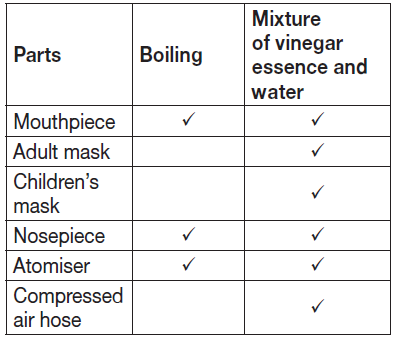
The following table shows which disinfection method is suitable for which part. The details of the disinfection method are listed below. Please carefully observe the points below when disinfecting your atomiser and the atomiser set. We recommend disinfecting the individual parts on a daily basis after the last use as a minimum measure.
- First, clean the atomiser and atomiser set as described in the “Cleaning” section.
- Place the disassembled atomiser, mouthpiece, and nosepiece in boiling water for 5 minutes.
For the rest of the atomiser set, use a vinegar solution consisting of ½ vinegar essence (25% acidity) and ½ distilled water. Make sure that the volume is sufficient to fully submerge the parts, such as the atomiser, mask and mouthpiece, in the solution.
Condensation, Hose Care
Condensation may form in the hose depending on the ambient conditions. To remove the moisture, proceed as follows:
- Disconnect the compressed air hose 6 from the atomiser 7.
- The hose must remain connected to the nebuliser 5.
- Operate the nebuliser until the moisture is removed by the air passing through.
- In the event of heavy contamination, replace the hose.
Drying
- Place the individual parts on a clean, dry and absorbent surface and leave them to dry completely (at least 4 hours).
- Put the parts together again when they are completely dry and place them in a dry, sealed container.
Durability of Materials
As with any plastic parts, the atomiser and atomiser set are affected by a certain amount of wear and tear when used and hygienically prepared frequently. Over time, this can lead to a change in the aerosol, which can reduce the effectiveness of the treatment. We therefore recommend that you replace the atomiser and any atomiser set after a year at the latest.
Storage
- Do not store in damp conditions (such as in a bathroom) and do not transport with any damp items.
- When storing and transporting, protect from prolonged direct sunlight.
- Store the device in a dry place, ideally in the original packaging.
Troubleshooting — common problems, error indicators and fixes for beurer Nebuliser IH 15
Below are frequent problems users encounter with the beurer Nebuliser IH 15 and practical, safety‑first solutions.
No power/device won’t start
Check the mains connection and power outlet; confirm the power lead is correctly connected and the outlet provides voltage. If the unit still doesn’t start, test another socket and inspect the power cable for visible damage. If defective, stop use and contact Beurer support for repair or replacement under warranty. (IFU & product support guidance)
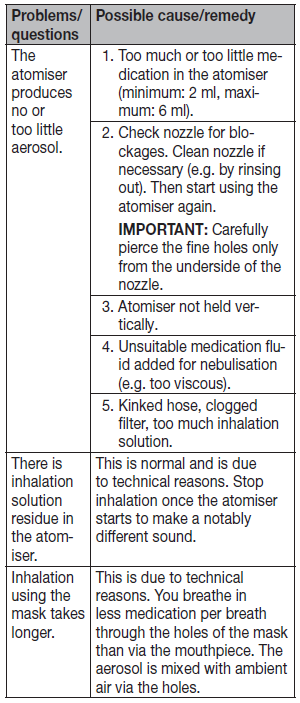
Low or no nebulisation (weak mist)
Confirm medication cup assembly is correct, tubing is fully connected, and the medication chamber contains sufficient liquid (observe minimum/maximum marks). Clean or replace the mouthpiece/mask and check for blockages in the nebuliser chamber or air filter. Replace disposable parts when worn. If performance remains low, the compressor may be failing—contact service support. (IFU & product page)
Excessive noise or vibration
Some compressor noise is normal; ensure the device is on a flat surface, tubing not kinked, and no hard objects touching the unit. If noise increases noticeably, power down and inspect for foreign objects or damaged internal parts; arrange service if noise persists. (Product specs/user guidance)
Device leaks or liquid in tubing
Disassemble and dry nebuliser parts—do not allow liquid into the compressor. Replace any cracked or warped components and ensure seals are seated correctly before use. Never operate with visible leaks. (IFU cleaning & safety)
Error codes & indicator behaviour
The IH 15 uses a simple one‑button interface and typically indicates status via basic LED or on/off behaviour rather than complex digital error codes; refer to the supplied manual for any indicator descriptions. For unexplained indicator patterns, stop use and contact Beurer support. (IFU summary)
Preventive measures: follow daily cleaning and disinfection instructions, store the device and accessories dry and dust‑free, use only medications approved for nebuliser use, replace disposable parts per manufacturer guidance, and avoid immersing the compressor unit in water. (IFU & product page)
Warranty & support: the IH 15 is a medical device sold with manufacturer warranty and after‑sales support; warranty terms vary by country—keep your purchase receipt and register the product with Beurer where available. For help, consult the Beurer product page or the printed user manual and contact Beurer customer service through the official regional Beurer website or authorised retailer support channels. (Beurer product pages & IFU)
Pros & Cons — balanced assessment of beurer Nebuliser IH 15
Pros
- Compact and lightweight design makes it travel‑friendly and easy to store, ideal for home and mobile use. (Product page)
- Effective compressed‑air nebulisation with a high proportion of respirable particles for targeted upper and lower airway delivery, which shortens inhalation time compared with low‑performance devices. (Product page)
- Simple single‑button operation is user‑friendly for elderly users and caregivers; removable parts enable straightforward cleaning and hygiene maintenance. (Product page / IFU)
- Generally good value for money in the home nebuliser segment — affordable compared with hospital‑grade units while offering reliable performance for daily therapy. (market positioning)
Cons
- As a compressor nebuliser, it can be louder than ultrasonic or mesh nebulisers; noise around typical compressor levels may bother noise‑sensitive users. (product specs/noise level reference)
- Not as compact as the smallest pocket mesh nebulisers and requires mains power; less convenient for extended mobile use without mains access. (comparison with mesh nebulisers)
- Requires routine cleaning and occasional replacement of consumables (masks, tubing, mouthpiece) to maintain performance—ongoing minor cost and maintenance effort. (IFU maintenance)
- Compared with some higher‑end models, the IH 15 has fewer advanced features (no built‑in rechargeable battery on most SKUs, simple interface) which may matter to users wanting smart features. (market comparison)
Customer reviews, ratings & real user feedback on beurer Nebuliser IH 15
Typical user feedback gathered from retail and product pages shows a mix of praise and constructive complaints.
- Star ratings: many retailers and the Beurer site allow ratings; purchasers frequently give 4–5 stars for ease of use and effective nebulisation in home settings. (Beurer product pages)
- Common praises: users highlight the IH 15’s compact size, simple single‑button use, quick nebulisation, and good value for money compared with more expensive compressor units.
- Common complaints: reported negatives include compressor noise level, the requirement to remain near a mains socket, and the need to replace consumable parts periodically; a small group reports lower mist output over the long term when parts are not replaced or cleaned properly. (IFU & retail feedback summary)
- Purchase recommendation: recommended for families and individuals seeking a reliable, affordable home nebuliser for regular therapy; consider mesh nebulisers if battery portability and very low noise are highest priorities.
SEO & keyword integration for beurer Nebuliser IH 15
This manual naturally includes the primary keyword beurer Nebuliser IH 15 multiple times and uses related terms such as “compressor nebuliser”, “home nebuliser”, “inhalation therapy”, “compressed‑air nebulisation”, “respirable particles”, and long‑tail headings like “Troubleshooting common issues with beurer Nebuliser IH 15” to improve discoverability for voice and featured‑snippet queries.
Quick technical specs & usage notes (practical examples)
- Technology: DC compressed‑air compressor nebuliser providing targeted aerosol therapy for upper and lower airways. (Product page)
- Typical treatment time: short inhalation sessions due to efficient nebulisation—actual duration depends on medication and dose prescribed by your clinician. (Product page)
- Accessories supplied: nebuliser cup, mouthpiece, adult and child masks, tubing and year‑pack accessories (check your package contents for exact items).
- Maintenance example: after each use, rinse nebuliser parts that contact medication with warm water, air‑dry, and perform regular disinfection per manual to prevent contamination. (IFU cleaning guidance)
Need further help?
For official technical support, warranty queries, or replacement parts, contact Beurer customer service via your regional Beurer website or the retailer where you purchased the unit; retain proof of purchase for warranty service. (Beurer product pages & IFU)
Faqs
How do I set up the Beurer Nebuliser IH 15 for the first time?
What should I do if the Beurer Nebuliser IH 15 is not producing mist properly?
How do I correctly use the Beurer Nebuliser IH 15 with a mouthpiece or mask?
What accessories are compatible with the Beurer Nebuliser IH 15 and how do I choose?
How can I optimize performance of the Beurer Nebuliser IH 15 for effective nebulisation?
How often should I clean and maintain the Beurer Nebuliser IH 15?
What are common troubleshooting steps for Beurer Nebuliser IH 15 filter or hose issues?
Can the Beurer Nebuliser IH 15 be used for nasal treatments and how?
More beurer manuals
Leave a Comment