
Setup: Beurer Portable Mesh Atomiser IH-51 User Manual
Content
Beurer Portable Mesh Atomiser IH-51: Comprehensive Product Manual
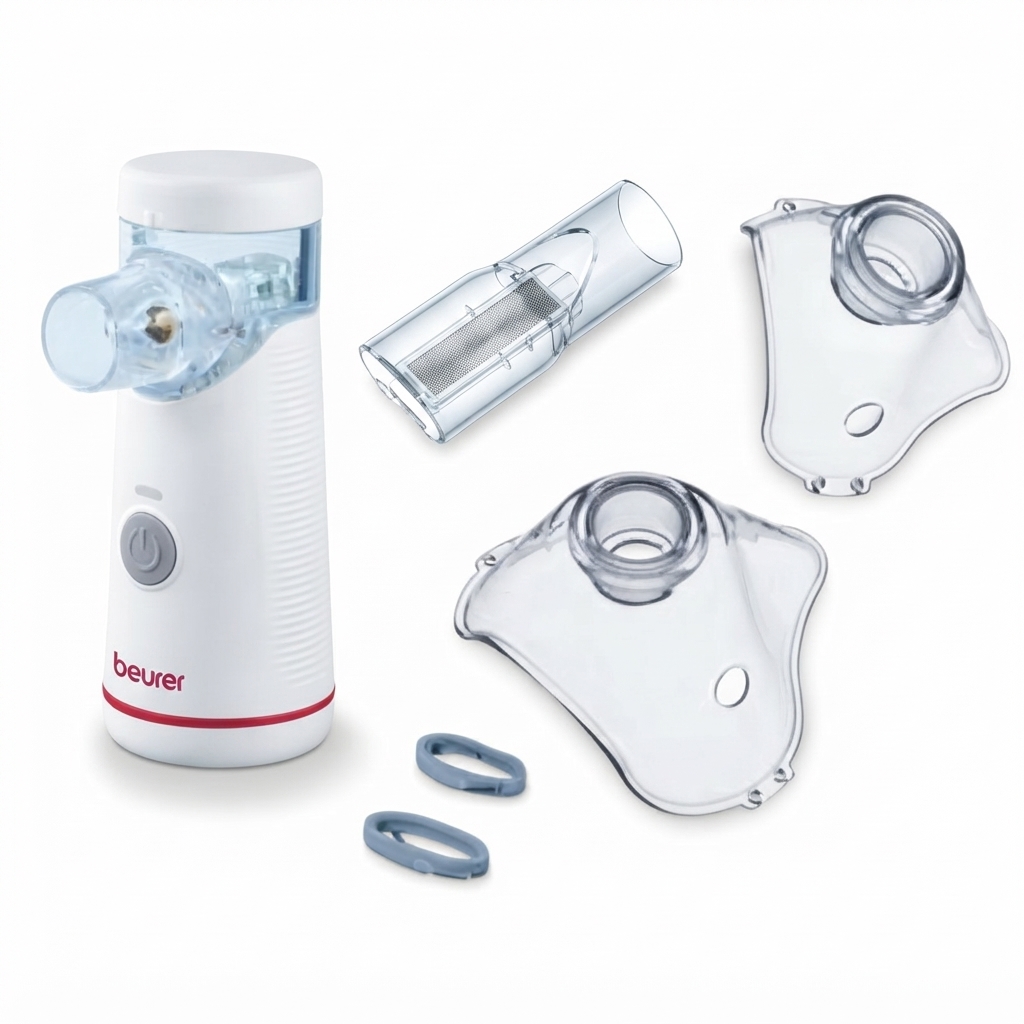
Introduction to Beurer Portable Mesh Atomiser IH 51
The Beurer Portable Mesh Atomiser IH 51 is a cutting-edge rechargeable nebuliser designed for fast, effective inhalation therapy at home or on the go. Utilizing advanced vibrating membrane technology, this compact device generates fine aerosol particles (MMAD: 3.89 μm) for targeted treatment of upper and lower airways, making it ideal for colds, asthma, and respiratory diseases. Its high nebulisation performance—low rate approx. 0.2 ml/min, high rate approx. 0.4 ml/min—ensures short inhalation times, while whisper-quiet operation at 42 dB(A) allows relaxed use for adults and children alike.
Key benefits include a hygienic self-cleaning function, single-button operation, and removable elements for easy maintenance. The portable design (46 x 62 x 112 mm, 93 g) features a rechargeable lithium battery offering up to 3.5 hours of use, charged via USB-C. Accessories include a mesh atomiser with medication container (0.5-10 ml capacity), mouthpiece, adult and child masks, storage bag, and year pack for ongoing hygiene. Target users range from families managing seasonal allergies to travelers needing reliable respiratory support. Estimated price ranges from $100-$150, widely available at retailers like The Good Guys and JB Hi-Fi. This medical device (EU MDR compliant) combines German engineering with portability, delivering efficient nebulisation for daily wellness.
Specifications
- Type: IH 51
- Dimensions (L x W x H): Approx. 46 x 62 x 112 mm
- Weight: 0.093 kg ± 0.005 kg
- Power Input: 5 V DC; 500 mA
- Energy Consumption: 2.5 W
- Capacity: Min. 0.5 ml, max. 10 ml
- Flow Rate for the Medication:
- Low nebulisation rate: Approx. 0.2 ml/min
- High nebulisation rate: Approx. 0.4 ml/min
- Sound Pressure: Approx. 42 dB(A)
- Vibration Frequency: 108 kHz ± 10%
Operating Conditions:
- Temperature: +5°C to +40°C
- Relative Humidity: 15–85%, non-condensing
- Ambient Pressure: 700–1060 hPa
Storage and Transport Conditions:
- Temperature: -20°C to +55°C
- Relative Humidity: ≤ 85%, non-condensing
Expected Service Life of the Device:
- Device: 855 hours
- Medication Container: 125 hours
Battery Specifications:
- Capacity: 700 mAh
- Nominal Voltage: 3.7 V
- Type Designation: Lithium-ion
Aerosol Values According to EN ISO 27427:2023:
Based on adult breathing patterns with sodium fluoride (NaF).
- Aerosol Delivery: 0.28 ml
- Aerosol Delivery Rate: 0.05 ml/min
- Fill Volume Dispensed Per Minute: 2.50%
- Residual Volume: 0.63 ml
- Particle Size (MMAD): 3.89 ± 0.35 μm
- GSD (Geometrical Standard Deviation): 1.81 ± 0.05
- RF (Respirable Fraction, < 5 μm): 63.0 ± 5.86%
- Large Particle Range (﹥ 5 μm): 37.0 ± 5.86%
- Medium Particle Range (2 to 5 μm): 48.3 ± 1.87%
- Small Particle Range (< 2 μm): 14.7 ± 4.07%
INTENDED PURPOSE
Intended Use
Nebulisers (including compressor, ultrasonic and mesh nebulisers) are medical devices for the nebulisation of liquids and liquid medication (aerosols). This device produces aerosols by combining an oscillating mesh with holes and a liquid medication. The aerosol treatment is for treating the upper and lower airways. By nebulising and inhaling the medication prescribed/recommended by your doctor, you can prevent diseases of the airways, or in the case that you contract such an illness, you can alleviate symptoms and speed up your recovery.
Intended Users
The nebuliser is intended for use in the home healthcare environment, not in professional healthcare facilities. The nebuliser can be used on anyone over 2 years of age under supervision; it can be used for self-treatment by anyone over 12 years of age. The shape and size of the person's face determine whether or not the device can be used under supervision. As such, it may be possible to use the device under supervision on someone who is younger, or conversely it may not be possible to use the device until they are older. When using a mask to inhale, take care to ensure the mask fits well and the eyes are unobstructed.
Clinical Benefit
Inhalation is the most effective way to administer medication for most respiratory system conditions.
The benefits are:
- The medication is carried directly to the target organs.
- The local bioavailability of the medication is significantly increased.
- Systemic diffusion is reduced substantially.
- Only very low doses of the medication are required.
- Quick and effective therapeutic effect.
- Side effects are significantly lower compared to systemic administration.
- Humidifying the airways.
- Loosening and making (bronchial) secretions more liquid.
- Releasing bronchospasms (spasmolysis).
- Relieving swollen and inflamed bronchial mucosa.
- Coughing up secretions.
- Fighting viruses that affect the upper and lower airways.
Indications
The nebuliser can be used for diseases of the upper and/or lower airways.
Examples of upper airway diseases include:
- Nasal mucosal inflammation.
- Allergic nasal mucosal inflammation.
- Nasal sinus infection.
- Pharyngitis.
- Laryngitis.
Examples of lower airway diseases include:
- Bronchial asthma.
- Bronchitis.
- COPD (chronic obstructive pulmonary disease).
- Bronchiectasis.
- Acute tracheobronchitis.
- Cystic fibrosis.
- Pneumonia.
Contraindications
- The atomiser is not intended for the treatment of life-threatening diseases.
- This device must not be used by children under the age of 12 and by people with reduced physical, sensory (e.g. reduced pain sensitivity) or mental skills or a lack of experience or knowledge, unless they are supervised or have been instructed on how to use the device safely, and are fully aware of the consequent risks of use.
- Do not use the device on persons who are ventilated and/or unconscious.
- Check whether there are contraindications for use with the usual systems for aerosol treatment on the medication instruction leaflet.
- If the device does not work properly, or if you feel unwell or experience pain, stop using it immediately.
WARNINGS AND SAFETY NOTES
WARNING
- The atomiser has no significant effect on the efficacy and safety of the medication administered and is not intended for the treatment of life-threatening conditions. The atomiser is not suitable for use in anaesthesia or other ventilation systems.
- After proper preparation, the device can be reused. This preparation includes the replacement of all components, including the atomiser. We recommend that you replace the medication container and other components after one year at the latest. This recommendation for the timing of the replacement is based on the assumption that the device is used for a maximum of 2 cycles per day and for ≤ 10 min per cycle and is regularly disinfected and cleaned in accordance with the instructions for use (8. Cleaning and maintenance). For hygiene reasons, each user must use their own components.
- Always follow the instructions of your doctor or pharmacist regarding the type of medication to be used, the dosage and the frequency and duration of inhalation. When using with medications/medication nebulisation, observe the conditions and restrictions applicable to these medications. Notice: Use only the medications prescribed by your doctor for treatment according to the respective diagnosis.
- The device is not a substitute for medical advice and treatment. Always consult your doctor first in case of pain or illness.
- If you have any health concerns, consult your GP.
- Do not use liquids with our nebuliser that are not compatible with steel, PP, PC, silicone or PVC. If the information supplied with the liquid does not indicate its compatibility with these materials, contact the liquid manufacturer. Examples of compatible liquids include: Albuterol solution and sodium chloride solution.
CAUTION
- Never store the device (or the USB-C cable) near heat sources.
- Do not use the device in a room where a spray has previously been used. Ventilate the room before performing the treatment.
- Never use the device if it makes unusual noises.
- Store the device in a location protected against weather conditions. The device must be stored under the specified ambient conditions.
- Do not operate the device near electromagnetic transmitters.
- Protect the device from heavy impacts.
- Disconnect the device from the power supply after the battery is fully charged.
- If you need an adapter or extension cable, it must comply with the applicable safety requirements. The power limit and maximum power specified on the adapter must not be exceeded.
Before Initial Use
- Remove all packaging material before using the device.
- Protect the device from dust, dirt, and humidity, and never cover the device while it is in use.
- Do not operate the device in a very dusty area.
- Switch off the device immediately if it is faulty or does not function properly.
- The manufacturer is not liable for damage resulting from improper or incorrect use.
Repairs
- Never open or repair the device yourself. Otherwise, malfunctions may occur. Failure to comply with this instruction will invalidate the guarantee.
- The device is maintenance-free.
- For repairs, please contact Customer Services or an authorised retailer.
Notes on Handling Batteries
WARNING
- Risk of explosion! Risk of fire! Failure to comply with the points mentioned can result in personal injury, overheating, leakage, venting, breakage, explosion, or fire.
- Always use the correct or supplied charging cable/charger/mains adapter for charging.
- Avoid continuous charging or overcharging. Unplug the charger when charging is complete.
- Charge the device under supervision, paying attention to any heat generated, deformation, or release of gases. If in doubt, stop charging.
- If batteries/charging cables/chargers are defective, stop using them and dispose of them properly as soon as possible (see chapter on disposal).
- Do not throw the device or batteries into a fire.
- Never forcibly discharge, heat, disassemble, open, crush, deform, encapsulate, modify, or knock the device or batteries.
- Never short-circuit batteries or the connections of the battery-powered device.
- Protect the device or batteries from direct sunlight, rain, heat, and water.
- Exposure of batteries to an environment with extremely high temperatures or an extremely low air pressure may result in explosion or leakage of flammable liquids and gases.
- If fluid from a battery comes into contact with your skin or eyes, wash the affected areas with water and seek medical assistance.
NOTICE: This device contains a battery that is not replaceable. Once a battery has reached the end of its service life, the device must be disposed of properly (see chapter on disposal).
Notes on Electromagnetic Compatibility
- The device is suitable for use in all environments listed in these instructions for use, including domestic environments.
- The use of the device may be restricted if electromagnetic disturbance occurs. This could result in issues such as the failure of the device.
- Avoid using this device directly next to other devices or stacked on top of other devices, as this could lead to faulty operation. If, however, it is necessary to use the device in the manner stated, this device as well as the other devices must be monitored to ensure they are working properly.
- The use of an atomiser set other than that specified or provided by the manufacturer of this device can lead to an increase in electromagnetic emissions or a decrease in the device's electromagnetic immunity; this can result in faulty operation.
- Keep portable RF communication devices (including peripheral equipment, such as antenna cables or external antennas) at least 30 cm away from all device parts, including all cables included in delivery.
- Failure to comply with the above could impair the performance of the device.
DEVICE AND ATOMISER SET DESCRIPTION
Atomiser Set
Only use the atomiser set recommended by the manufacturer. If this is not respected, the device may not function safely.
Leakage Protection
When pouring the medication into the medication container, ensure that you only fill it up to the maximum mark (10 ml). The recommended filling volume for the device is 0.5 to 10 ml. The substance to be nebulised must be in contact with the mesh for nebulisation to take place. If this is not the case, the nebulisation will stop automatically. Therefore, keep the device as vertical as possible.
INITIAL USE
Before Using the Device for the First Time
NOTICE: Clean and disinfect the medication container (2) and the atomiser set before first use. See the "Cleaning and maintenance" section in this regard.
Assembly
Remove the device from the packaging. If the medication container (2) has not been assembled, slide it onto the housing (3) vertically from above.
Charging the Nebuliser Battery
Proceed as follows to charge the nebuliser battery:
- Connect the USB-C cable (8) included in delivery to the USB-C port (7) on the bottom of the nebuliser and a USB mains adapter (not included in delivery; the mains adapter must comply with protection class 2 and have been tested in accordance with the European standard EN 60601-1; 5V, 500mA). Plug the USB mains adapter into a suitable socket. Lie the nebuliser flat on its back during the charging process.
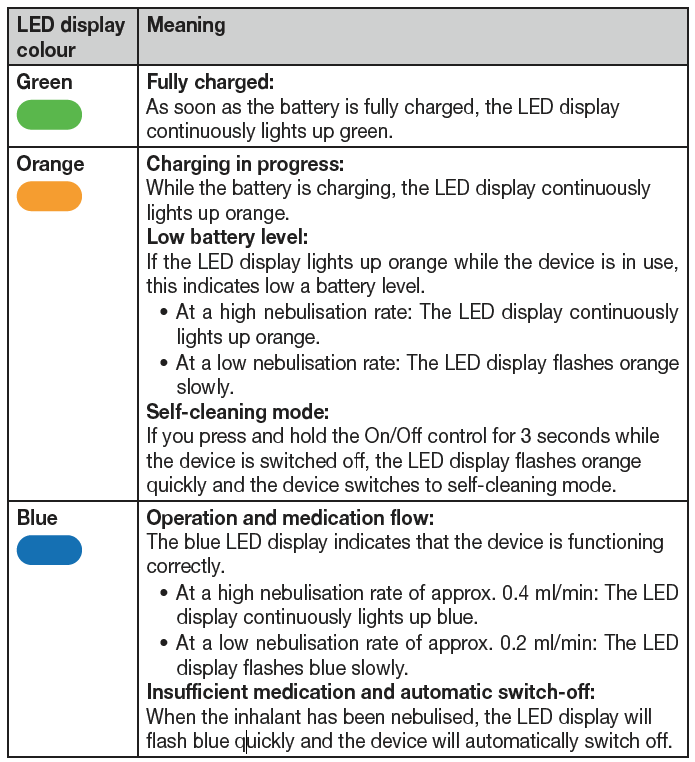
- While charging, the LED display (5) will continuously light up orange. As soon as the battery is fully charged, the LED display will continuously light up green.
- It usually takes approximately 2 hours for the battery to be fully charged.
- As soon as the battery is fully charged, remove the USB-C cable (8) with the USB mains adapter from the socket and the USB-C port (7) on the nebuliser.
- When the battery is fully charged, the battery life is approximately 1.5 hours. If the LED display (5) lights up orange while the device is in use, this indicates a low battery level.
- The type of low battery level display depends on how the device is used. If you have selected a high nebulisation rate, the LED display (5) will be continuously orange. If you have selected a low nebulisation rate, the LED display (5) will slowly flash orange.
- The nebuliser cannot be used during the charging process.
USAGE
Preparing the Nebuliser
- For hygiene reasons, it is essential to clean and disinfect the medication container (2) and the atomiser set regularly. See the "Cleaning and maintenance" section in this regard.
- If the therapy involves inhaling several different medications one after the other, please note that the medication container (2) must be rinsed under warm tap water after each use. See the "Cleaning and maintenance" section in this regard.
Filling the Medication Container
- Open the lid of the medication container (2) by turning it anti-clockwise and fill the medication container with an isotonic saline solution or pour the medication straight in. Do not overfill the medication container.
- The maximum recommended filling quantity is 10 ml.
- Use medication only as instructed by your doctor and ask about the appropriate inhalation duration and quantity for you.
- If the prescribed quantity of medication is less than 0.5 ml, it must be topped up with isotonic saline solution. Dilution is also required for viscous medication (viscosity < 3). Please follow your doctor's instructions in this case as well.
Closing the Medication Container
- Close the lid of the medication container (2) by turning the lid clockwise until the markings on the lid and the medication container are aligned.
Connecting the Atomiser Set
Securely connect the part of the atomiser set that you would like to use (mouthpiece (11), adult mask (9), or children's mask (10)) to the mounted medication container (2). If you are using the adult mask (9) or children's mask (10), you may use one of the straps included. Ensure that you tie the strap securely to the mask with a knot. Now move the device to your mouth and put your lips firmly around the mouthpiece. When using the mask(s), please place it over your nose and mouth.
- Ensure that you have filled it up with liquid before switching on the device. Start the device by pressing the On/Off control (4).
- If the spray mist comes out of the device and the LED display (5) continuously lights up blue, the device is working correctly.
NOTICE
The device is not suitable for continuous operation; after 20 minutes of operation, it must be switched off for 40 minutes. The most effective inhalation is when using the mouthpiece. Inhalation when using a mask is only recommended if the use of a mouthpiece is not possible (e.g. for children who are not yet able to inhale with a mouthpiece). When inhaling with a mask, make sure that the mask fits well and that the eyes are not covered. The flow rate for the medication is set to high in the factory settings of the device. You can adjust the medication flow rate during use by pressing and holding the On/Off control (4) for 3 seconds until the LED display (5) flashes blue. You can switch from high to low nebulisation rate and back again. A continuously blue illuminated LED display (5) indicates a high nebulisation rate of approx. 0.4 ml/min; a slowly flashing blue LED display (5) indicates a low nebulisation rate of approx. 0.2 ml/min. Adjust the medication flow rate to your needs.
Inhaling Correctly
Breathing Technique
- It is important to use the correct breathing technique to ensure that the particles are distributed as widely as possible throughout the airways. For the particles to reach your airways and lungs, you need to breathe in slowly and deeply, then hold your breath briefly (5 to 10 seconds) and then exhale quickly.
- Only use nebulisers for the treatment of respiratory diseases after consulting your doctor. They will advise you on selecting suitable medications for inhalation therapy, as well as their dosage and usage.
- Certain medications require a prescription. Only liquids and medications indicated for inhalation may be used.
NOTICE
Keep the device as vertical as possible. However, a small angle does not affect usage, as the container is leak-proof. Make sure that the medication is in contact with the mesh for proper functioning of the device during use. If the device is tipped gently by 45 degrees with a maximum volume of 10 ml of liquid, the device will work as before.
CAUTION
For health reasons, essential oils, cough mixtures, gargling solutions and drops for rubbing into the skin or for use in steam baths are completely unsuitable for inhalation with a nebuliser. These additives are also often viscous and can impair the correct functioning of the device and therefore the effectiveness of its usage in the long term. In people with a hypersensitive bronchial system, medications that contain essential oils can sometimes cause acute bronchospasm (a sudden cramp-like narrowing of the bronchi with shortness of breath). Talk to your doctor or pharmacist about this.
Stopping the Inhalation
a) Manually Ending Nebulisation:
- When you have finished the treatment, switch off the device using the On/Off control (4).
- The LED display (5) will go out.
b) Automatically Ending Nebulisation:
- If the inhalant has been nebulised, the LED display (5) will flash blue quickly, and the device will automatically switch off. For technical reasons, a small amount of the medication remains in the medication container. Do not use this.
Automatic Switch-Off
The device has an automatic switch-off function. When there is only a very small amount of medication or liquid left, or when the substance to be nebulised is no longer in contact with the mesh, the device switches off automatically to prevent damage to the mesh. If nebulisation ends automatically, the automatic switch-off function has been activated. The LED display (5) flashes blue quickly, and the device then switches off. After a nebulisation period of 20 minutes, the device switches off automatically. Do not use the device if the medication container (2) is empty. The device detects when there is no medication in the medication container and will switch off automatically.
CLEANING AND MAINTENANCE
WARNING
Follow these hygiene instructions to avoid health risks. The medication container (2) and the atomiser set are intended for multiple use. Please note that different areas of application involve different requirements in terms of cleaning and hygienic preparation.
NOTICE
- Do not clean the mesh or the atomiser set mechanically with a brush or similar devices, as this can lead to irreparable damage and optimal treatment results can no longer be guaranteed.
- Ask your doctor for additional requirements regarding hygienic preparation (hand cleaning, handling of medications/inhalation solutions) for high-risk groups (e.g. patients with cystic fibrosis).
- The water mentioned later in the cleaning instructions should be as soft as possible. Distilled water is suitable for all cleaning steps except self-cleaning.
Disassembling
- Hold the device with one hand. The button (6) on the back of the device should face towards you. Press the button (6) with your thumb and pull the medication container (2) vertically upwards with your free hand.
- Remove the mouthpiece (11) or the mask (9 or 10) from the medication container (2).
- Open the lid of the medication container (2) by turning the lid anti-clockwise.
- Assembly is carried out in reverse order.
Troubleshooting Beurer Portable Mesh Atomiser IH 51: Common Issues and Fixes
Encountering problems with your Beurer Portable Mesh Atomiser IH 51? Start with basic checks. If no mist appears, ensure medication volume is 0.5-10 ml and viscosity under 3; clean the mesh if clogged. Low battery shows orange LED—recharge via USB-C until green LED indicates full charge.
- No nebulisation: Verify single-button activation (blue LED for operation). Rinse parts with warm water post-use; run self-cleaning cycle (orange LED).
- Weak flow: Switch between low/high rates; replace year pack mesh if performance drops below 0.2 ml/min.
- Error indicators: Orange LED signals low battery or cleaning; persistent issues mean contact support.
Prevent issues by following daily cleaning: detach elements, rinse, air-dry. Store in the included bag. Backed by a 5-year warranty, contact Beurer support at local distributors or via beurer.com for replacements. Avoid overfilling or non-approved medications—consult a physician for optimal use of this portable mesh nebuliser.
Pros and Cons of Beurer Portable Mesh Atomiser IH 51
Pros
- Exceptional portability and battery life (up to 3.5 hours), perfect for travel compared to bulky compressor models.
- High-efficiency mesh technology with respirable particles (3.89 μm MMAD) for quick relief from asthma or colds.
- Hygienic self-cleaning and quiet 42 dB(A) operation enhance user comfort, especially for children.
- Comprehensive kit including masks and a 5-year pack offers great value at $100-$150, outpacing basic nebulisers.
- 5-year warranty provides long-term reliability over competitors like entry-level ultrasonics.
Cons
- No built-in timer, requiring manual monitoring unlike some advanced units.
- IP22 water resistance limits deep cleaning; careful handling needed around liquids.
- Higher initial cost than disposable nebulisers, though the year pack mitigates ongoing expenses.
- Best for viscosities under 3—thicker medications may need alternatives.
Overall, the Beurer Portable Mesh Atomiser IH 51 excels in portability and performance, delivering superior value for frequent users versus stationary options.
Customer Reviews: Real Feedback on Beurer Portable Mesh Atomiser IH 51
Users praise the Beurer Portable Mesh Atomiser IH 51 for its portability and ease, averaging 4.5/5 stars across retailers. "Game-changer for my child's asthma—quiet and quick sessions on the go!" notes one parent. Common praises include fast nebulisation and simple USB-C charging, with many highlighting the self-cleaning feature for hassle-free maintenance.
Complaints focus on occasional mesh clogging with thicker solutions (resolved via cleaning) and lack of a timer. "Battery lasts all day trips—worth every penny," says a traveler (5/5). Recommendations: Ideal for families; buy for reliable respiratory relief. Addresses key issues like hygiene effectively, boosting satisfaction for portable nebuliser seekers.
Faqs
How do I set up the beurer Portable Mesh Atomiser IH 51 for the first time?
What should I do if my beurer Portable Mesh Atomiser IH 51 produces little or no mist?
Can I use the beurer Portable Mesh Atomiser IH 51 with any inhalation medication or salt solutions?
How long does the battery last and can I use the beurer Portable Mesh Atomiser IH 51 while charging?
What are the key features of the beurer Portable Mesh Atomiser IH 51 that affect performance?
How do I clean and maintain the mesh atomiser and medication container on the beurer Portable Mesh Atomiser IH 51?
Why does the sound change or the mist flow become irregular during use of the beurer Portable Mesh Atomiser IH 51?
How can I optimize treatment time and aerosol delivery with my beurer Portable Mesh Atomiser IH 51?
More beurer manuals
- Setup: Beurer Nebuliser IH 24 Kids User Manual
- Setup: Beurer Blood pressure monitor BC 21 User Manual
- Setup: Beurer Nebuliser IH 26 Owner Manual
- Setup: Beurer Blood pressure monitor BM-40 User Manual
- Setup: Beurer Nebuliser IH-15 User Manual
- Setup: Beurer Upper Arm Blood Pressure Monitor BM-45 User Manual
Leave a Comment