
Setup: Beurer Nebuliser IH 21 User Manual
Content
Introduction — beurer Nebuliser IH-21: Overview, benefits, and who it’s for
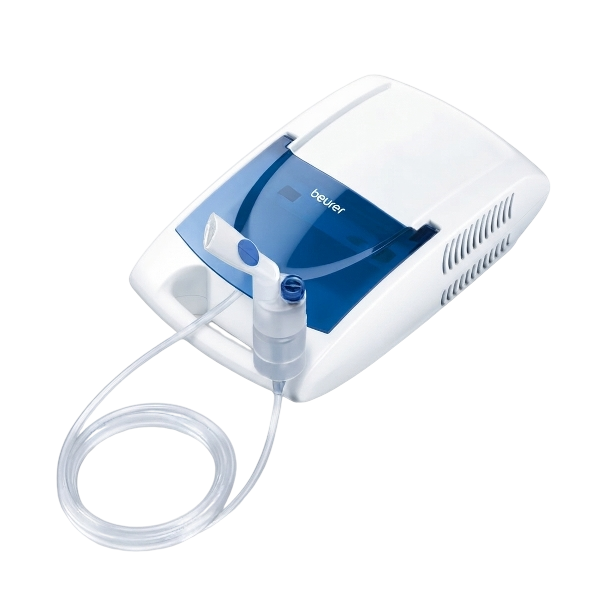
The beurer Nebuliser IH 21 is a compact, mains-powered compressor nebuliser designed to deliver aerosolised liquid medication to the upper and lower respiratory tract for conditions such as asthma, bronchitis, COPD and common colds (compressed‑air nebulisation technology). The device produces a high proportion of respirable particles with a typical nebulisation rate of approx. 0.3 ml/min and particle size in the respirable range, reducing inhalation time and improving deposition in the lungs. This makes the IH 21 suitable for both adults and children and for regular home therapy as prescribed by a clinician.
Key benefits and unique selling points:
- Efficient compressed‑air technology: Provides consistent aerosol generation and a nebulisation performance around 0.3 ml/min for shorter treatments.
- High respirable particle proportion: Particle size is engineered for lung deposition, improving therapeutic effect compared with larger-particle devices.
- Full accessory kit and storage: Typically includes adult/child masks, mouthpiece, nosepiece, tubing, filters, and onboard accessory storage for tidy home use.
- User-friendly and quiet: Designed for home use with modest noise levels and simple set-up; suitable for multi‑age households.
Target audience and common use cases: patients with asthma, COPD, chronic bronchitis, acute respiratory infections or anyone prescribed inhalation therapy by a healthcare professional; caregivers treating children or elderly patients will find the multiple mask sizes useful.
Estimated price range and availability: the beurer Nebuliser IH 21 is sold internationally through pharmacies and medical suppliers; typical retail prices vary by market — approximately the equivalent of low‑to‑mid consumer nebuliser pricing (examples from online retailers show prices in affordable ranges, e.g., regional retail listings around mid‑low hundreds in local currency) — and is commonly available with standard manufacturer warranty and replacement filters via distributors.
Specifications:
- Model: IH 21
- Type: IH 21/1
- Dimensions (W × H × D): 177 × 295 × 97 mm ± 0.2 mm
- Weight: 1.65 kg
- Operating Pressure: Approx. 0.8–1.45 bar
- Atomiser Fill Volume:
- Maximum: 8 ml
- Minimum: 2 ml
- Medicine Flow: Approx. 0.3 ml/min
- Sound Pressure: Approx. 52 dBA
- Mains Connection:
- Standard: 230 V~, 50 Hz, 230 VA
- UK: 240 V~, 50 Hz, 240 VA
- Saudi Arabia: 220 V~, 60 Hz, 220 VA
- Expected Service Life: 1000 hours
Operating Conditions:
- Temperature: +10°C to +40°C
- Relative Humidity: 10%–95%
- Atmospheric Pressure: 700–1060 hPa
Storage and Transport Conditions:
- Temperature: -25°C to +70°C
- Relative Humidity: 10%–95%
Aerosol Values:
Measured according to EN 27427:2019, based on adult breathing patterns using sodium fluoride (NaF).
- Aerosol Delivery: 0.11 ml
- Aerosol Delivery Rate: 0.07 ml/min
- Fill Volume Dispensed per Minute: 3.5%
- Residual Volume: 1.68 ml
- Particle Size (MMAD): 3.07 µm
- Geometrical Standard Deviation (GSD): 2.03
- Respirable Fraction (RF, <5 µm): 75%
- Large Particle Range (>5 µm): 25%
- Medium Particle Range (2–5 µm): 47.8%
- Small Particle Range (<2 µm): 27.2%
DESCRIPTION OF DEVICE AND ACCESSORIES
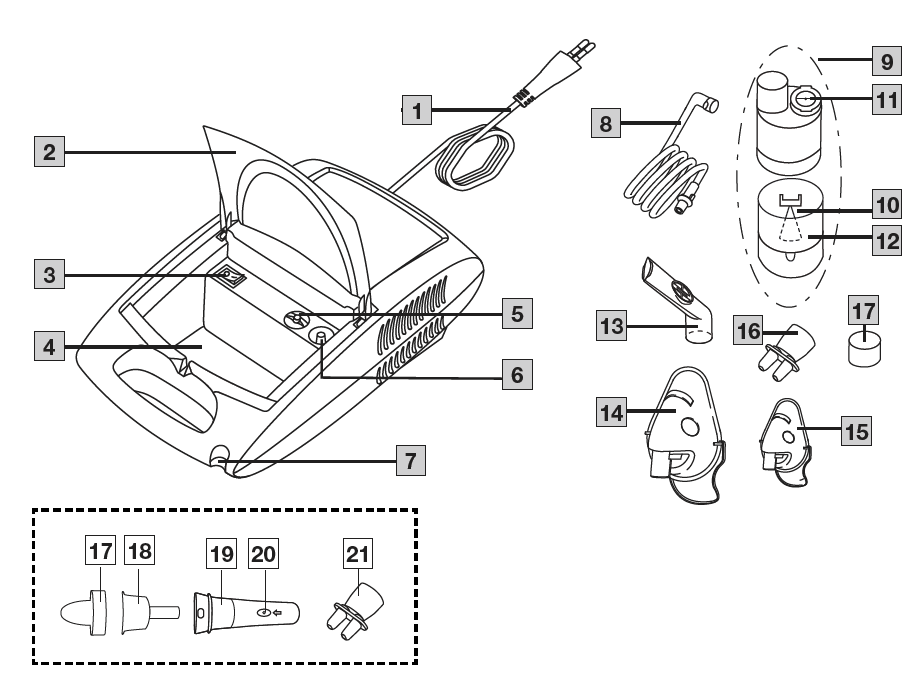
Overview of the Nebuliser
- Mains cable
- Lid
- On/off switch
- Compartment for accessories
- Filter cap with filter
- Hose connection
- Holder for atomiser
Overview of Atomiser and Accessories
- Compressed air hose
- Atomiser
- Atomiser insert
- Valve
- Medicine container
- Mouthpiece
- Adult mask
- Child mask
- Nosepiece with comfort attachment
Replacement filter
INITIAL USE
Setup
Remove the unit from the packaging. Place it on a flat surface. Ensure that the ventilation slits are free. Fold open the lid to access the accessories. Before Using the Unit for the First Time The atomiser and accessories must be cleaned and disinfected before they are used for the first time. For information about this, see “Cleaning and disinfection”.
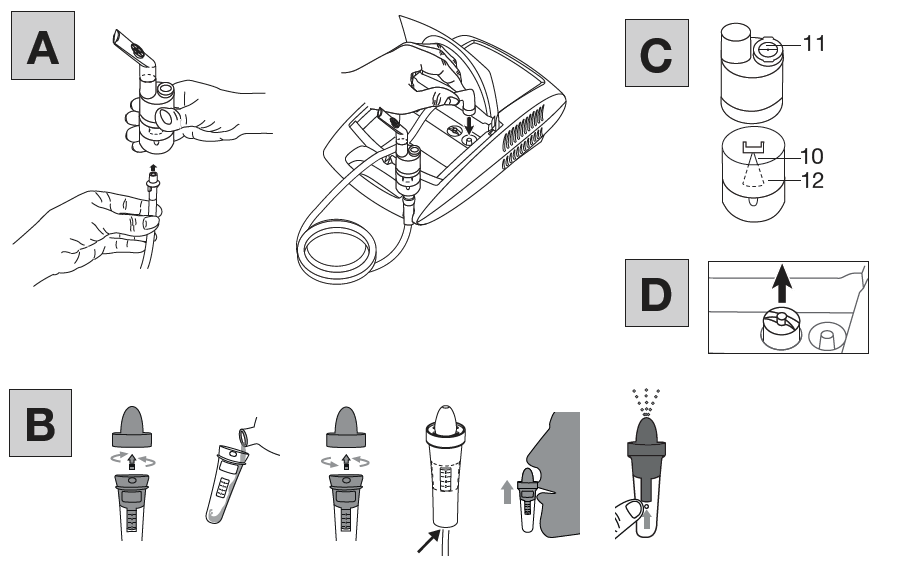
- Attach the compressed-air hose at the bottom of the medicine container.
- Connect the other end of the hose to the hose connector on the nebuliser by lightly turning it.
Mains Connection
Connect the unit only to the mains voltage listed on the type plate.
- Insert the mains cable plug into a suitable socket.
- Push the plug completely into the mains socket.
- Ensure that there is a socket near to where the unit will stand.
- Lay the mains cable in such a way that no one can trip over it.
- To disconnect the nebuliser from the mains after use, first switch off the device and then remove the plug from the socket.
OPERATION
CAUTION
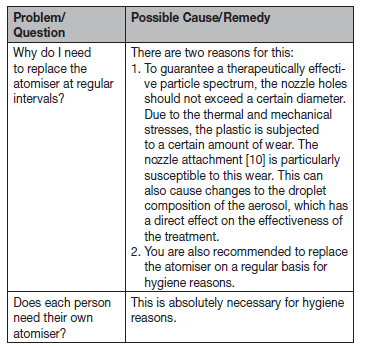
- For hygiene reasons, the atomiser and the accessories must be cleaned after each treatment and disinfected after the last treatment of the day.
- The accessories may be used only by one person; use by several people is not recommended.
If several different medicines are to be inhaled in succession during therapeutic use, the atomiser must be rinsed under warm tap water after each use. For information about this, see “Cleaning and disinfection” on page 16.
Inserting the Nozzle Attachment
- To open the atomiser, twist the upper section anti-clockwise against the medicine container. Place the nozzle attachment in the medicine container.
- Ensure that the cone for administering medication fits well on the cone for the air duct inside the atomiser.
Filling the Atomiser
- Pour an isotonic saline solution or the medicine directly into the medicine container. Do not overfill! The maximum recommended fill level is 8 ml!
- Use medication only on the advice of a physician, and check the appropriate inhalation duration and quantity for your needs.
- If the required volume of medication is less than 2 ml, top up this quantity to at least 4 ml using an isotonic saline solution. Viscous medicines may also require dilution. Always follow the instructions of your doctor.
Closing the Atomiser
- To close the atomiser, twist the upper section clockwise against the medicine container. Ensure the parts are connected correctly.
Inserting the Valve
- Press the blue valve into the opening intended for this purpose on the upper side of the atomiser. The valve system ensures better delivery of the medication to the lungs. Only use the valve with the mouthpiece, never with the masks or the nosepiece.
Connecting the Accessories to the Atomiser
- Connect the required accessory part (mouthpiece, adult mask, child mask or nosepiece) to the atomiser.
In addition to the accompanying adult and children's mask (from 2 years of age), you also have the option of using a baby mask (from ages 0–3 years) with your nebuliser. The baby mask is not included in delivery with the IH 21. You can find an overview of all replacement items in chapter Replacement parts and wearing parts”.
The most effective form of nebulisation is by using the mouthpiece. Nebulisation using a mask is only recommended if it is not possible to use a mouthpiece (e.g. for children who are not yet able to inhale medication using a mouthpiece).
When using a mask to inhale, take care to ensure the mask fits well and the eyes are unobstructed.
- Before commencing treatment, pull the atomiser upwards out of its holder.
- Start the nebuliser using the on/off switch.
Treatment
- When inhaling, sit upright and relaxed at a table and not in an armchair to avoid compressing the airways and therefore impairing the effectiveness of the treatment.
- Inhale the nebulised medicine deeply.
IMPORTANT
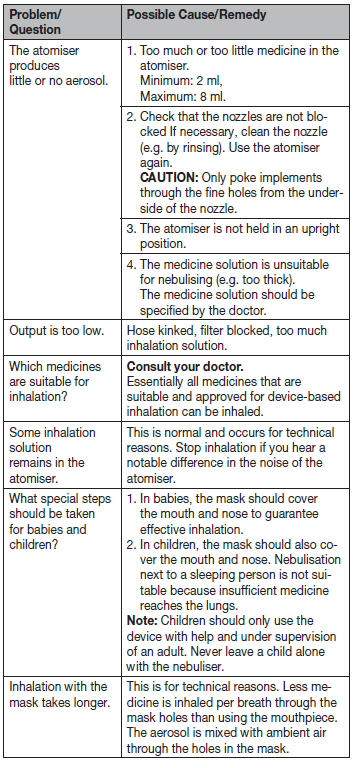
The device is not suitable for continuous operation; after 30 minutes of operation it must be switched off for 30 minutes. During treatment, hold the atomiser straight (vertical), otherwise, the atomisation does not work, and correct function cannot be guaranteed.
IMPORTANT
Essential oils, cough medicines, solutions designed for gargling, and drops for application to the skin or for use in steam baths are wholly unsuitable for inhalation using a nebuliser. These substances are often highly viscous and can impair the correct function of the device and hence affect the effectiveness of its application in the long term. In the case of oversensitivity of the bronchial system, medicines containing essential oils can sometimes cause acute bronchospasm (a sudden, cramp-like tightening of the bronchi accompanied by breathlessness). Always ask your doctor or pharmacist for advice!
End of Inhalation
If the spray is only output sporadically or if the noise changes during inhalation, you can end the treatment.
- Switch off the nebuliser after treatment using the on/off switch and disconnect it from the mains.
- After use, replace the atomiser in its holder.
Nasal Douche
The nasal douche is not included in delivery with the IH 21. You can order the nasal douche using the item number 601.37.
- Cover
- Collection container for nasal secretions
- Saline container
- Cover hole (starting the application)
You can use the nasal douche to clean your nasal cavities. The nasal douche creates a fine jet of liquid for treating respiratory tract problems or for moistening the nasal mucous membranes.
Using the Nasal Douche
To use the nasal douche correctly, proceed as follows:
- Twist the cover 90° anticlockwise and remove it in an upward direction.
- Lift the collection container out.
- Fill the saline container with saline solution.
- Place the collection container into the saline container.
- Place the cover on the saline container. Twist the cover in a clockwise direction until it clicks firmly into place.
- Connect the compressed air hose to the saline container from below.
- Position the cover carefully inside one of your nostrils. Breathe through the nose.
- Press the on/off switch on the back of the nebuliser. To start the application, place one finger over the cover hole on the container.
During the application, breathe slowly and evenly through the nose. Tilt your head slightly in the opposite direction to the nostril being treated so that the saline solution can flow deep into the nose.
- To pause or stop the application, take your finger off the cover hole on the saline container.
- Once your nose feels clear again, you can stop the application. The application should be stopped at the latest once the maximum filling quantity has been used.
Clean the Device
For information about this, see “Cleaning and disinfection”.
CHANGING THE FILTER
In normal operating conditions, the air filter must be replaced after approx. 500 operating hours or one year. Please check the air filter regularly (after 10–12 nebulisation procedures).
If the filter is very contaminated or blocked, replace the used filter. If the filter has become wet, it must also be replaced with a new one.
CAUTION
- Do not try to clean and re-use the used filter!
- Only use original filters supplied by the manufacturer. Otherwise, your nebuliser may become damaged or effective therapy can no longer be guaranteed.
- Do not repair or maintain the air filter while it is in use.
- Never operate the device without a filter.
CLEANING AND DISINFECTION
Atomiser and Accessories
WARNING
Observe the following hygiene instructions to avoid any health risks.
- The atomiser and accessories are intended for multiple use. Please note that cleaning requirements differ according to the different application areas.
- The atomiser and accessories must not be mechanically cleaned with brushes or similar as this can cause irreparable damage and the success of the treatment can no longer be guaranteed.
- For additional requirements regarding the necessary hygienic preparations (hand washing, handling of medicines or inhalation solutions) in high-risk groups (e.g. cystic fibrosis patients), contact your doctor.
- Ensure that all parts are properly dried following all cleaning and disinfection. Residual moisture or water droplets can result in an increased risk of bacterial growth.
Preparation
- Directly following each treatment, all parts of the atomiser and any accessories used must be cleaned of medicine residues and contamination.
- To do this, dismantle the atomiser into its component parts.
- Remove the mouthpiece, mask or nosepiece from the atomiser.
- Disassemble the nosepiece if you have used it with the comfort attachment.
- Dismantle the atomiser by twisting the upper section anticlockwise against the medicine container.
- Remove the nozzle attachment from the medicine container.
- Remove the valve by pulling it out of the atomiser.
- The nebuliser is later reassembled in the reverse order.
Cleaning
IMPORTANT
Before you clean the unit, always switch it off, unplug it, and let it cool off. The atomiser and the used accessories such as the mouthpiece, mask, nozzle attachment, nasal douche, etc. must be cleaned with hot but not boiling water after each use. Carefully dry all components using a soft cloth. Once all components are fully dry, reassemble the atomiser and place the components in a dry, sealed container or carry out disinfection. When cleaning, ensure that all residues are removed. Never use any substances that may be poisonous when in contact with the skin or mucous membranes, or when swallowed or inhaled.
Condensation, Care of the Hose
Depending on the environmental conditions, condensation may collect in the hose. To prevent bacterial growth and to ensure effective therapeutic use, this moisture must always be removed. To remove moisture from the hose, proceed as follows:
- Remove the hose [8] from the atomiser [9].
- Leave the hose plugged into the nebuliser [6].
- Run the nebuliser until all the moisture has been displaced by the flow of air.
- In the event of significant contamination, replace the hose.
Disinfection
Follow the steps listed below carefully to disinfect your atomiser and the accessories. It is advisable to disinfect the individual components after the last time they are used each day at the latest.
(All you need for this is a little vinegar essence (25% acidity) and distilled water.)
- First, clean the atomiser and the accessories as described under “Cleaning”.
- Place the disassembled atomiser, nasal douche, mouthpiece, and the disassembled nosepiece in boiling water for 5 minutes.
- For the remaining accessories, use a vinegar solution consisting of ½ vinegar essence (25%) and ½ distilled water. Make sure that the volume is sufficient to fully submerge the parts in the solution.
- Leave the components in the vinegar solution for 30 minutes.
- Rinse the parts with water and dry carefully with a soft cloth.
Drying
- Place the individual components on a dry, clean and absorbent surface and allow them to dry completely (for at least 4 hours).
Material Resistance
- As with all plastic components, frequent use and cleaning of the atomiser and the accessories can lead to a certain amount of wear. Over time, this can alter the aerosol properties and may eventually affect the efficiency of therapy. We therefore recommend that you replace the atomiser once a year.
- When choosing a cleaning or disinfecting agent, note the following: Only use mild cleaning or disinfectant agents in the quantities recommended by the manufacturer.
Storage
- Do not store the nebuliser in a damp atmosphere (e.g. in the bathroom) or transport it together with damp objects.
- Store and transport the nebuliser away from direct sunlight.
- The accessories can be safely stored in the accessories compartment [4]. Store the device in a dry place, if possible in its original packaging.
Troubleshooting — common problems, error indications, fixes and support
- Common problem: Device does not start. Check the mains connection and power supply (230 V in many markets) and ensure the on/off switch is in the correct position; inspect the power cable and fuse if present.
- Common problem: Little or no aerosol output. Confirm the medication chamber is correctly assembled, tubing is connected, and the nebuliser cup contains the prescribed liquid (not exceeding max fill volume, typically 8 ml). Clean or replace the air filter if clogged and ensure compressor vents are unobstructed; filters are user‑replaceable, and spares are included or available.
- Common problem: Excessive noise or vibration. Place the unit on a flat, stable surface and ensure tubing is not kinked; a worn or missing filter can increase noise—replace filters as recommended.
- Error codes and fixes: The IH 21 is a mechanical compressor nebuliser and usually does not display numeric error codes; instead, operational issues manifest as no power, poor aerosol output, or unusual noise—follow the checks above and consult the user manual provided with the product for model‑specific indicators.
- Preventive measures: Use distilled or sterile water/saline when directed; clean, disinfect, and dry nebuliser parts (mouthpiece, mask, medication cup) after each use per manufacturer instructions; replace disposable filters regularly and store accessories in the device’s storage compartment to avoid contamination.
- Warranty and support: The IH 21 is supplied with a manufacturer warranty (commonly 1 year; some retailers list extended guarantees—check your vendor). For repairs or replacement parts, contact your point of purchase or Beurer’s official after‑sales service; retailer support telephone numbers are typically listed on the supplier product page.
- Contact for help: Use the retailer’s customer service (example UK retailer number listed on some stockists) or Beurer’s local distributor contact details included in the product documentation; keep serial and purchase information ready when contacting support.
Pros & Cons — balanced assessment of the beurer Nebuliser IH 21
Pros — Efficient therapy and easy home use
- Reliable compressed‑air nebulisation with ~0.3 ml/min nebulisation rate speeds treatments compared with slower devices
- Includes multiple accessories (adult and child masks, mouthpiece, tubing and spare filters) and onboard storage for convenience and hygiene
- Designed for all ages — suitable for pediatric and adult inhalation therapy when using appropriate masks
Cons — size, power and alternatives
- Mains‑powered compressor is less portable than battery or handheld mesh nebulisers; not ideal for frequent travel without mains access
- Compressor nebulisers can be louder than ultrasonic or mesh units; noise under 60 dB is reported on some listings but may be noticeable during use.
- Some competitors (mesh/nebuliser inhalers) offer smaller footprints, quieter operation, and faster nebulisation for certain medications — evaluate based on therapy needs and budget
Value for money
- Offers strong value for home therapy due to robust compressor performance, comprehensive accessory set and availability of replacement filters; a practical mid‑range choice for regular inhalation therapy compared with low‑cost disposable nebulisers
Customer reviews, ratings and real user feedback for beurer Nebuliser IH 21
Average user feedback across retailers reports generally positive ratings for therapeutic effectiveness and build quality, with common praise for the accessory kit and storage compartment that keeps parts organised and clean.
Typical praises: “Solid performance — delivers a fine mist quickly,” “Good value for household use,” and “Includes masks for kids and adults, easy assembly.” Star ratings on commerce sites commonly range from 4 to 4.5 out of 5 for overall satisfaction in many listings.
Typical complaints: “A bit noisy compared with mesh nebulisers,” “Requires mains power so not as portable,” and occasional reports of reduced aerosol output when filters are clogged, or parts need cleaning—issues usually resolved by replacing filters or following the cleaning schedule .
Purchase recommendation: Recommended for households seeking a reliable, cost‑effective compressor nebuliser for regular home therapy; if portability or ultra‑quiet operation is a priority, consider comparing with mesh or ultrasonic alternatives before purchase.
SEO and keyword notes used in this manual
- Primary keyword usage: the primary keyword beurer Nebuliser IH 21 appears naturally throughout headings and body copy to support search visibility.
- Related and semantic keywords included: compressed air nebuliser, compressor nebuliser, inhalation therapy, particle size, nebulisation rate, home nebuliser for asthma, pediatric nebuliser, respiratory inhaler.
- Long‑tail headings used for featured‑snippet and voice‑search optimization (for example: “Troubleshooting — common problems, error indications, fixes and support”).
Faqs
How do I set up my beurer Nebuliser IH 21 for the first time?
What should I do if the beurer Nebuliser IH 21 produces little or no mist?
Can I use the beurer Nebuliser IH 21 with saline, prescribed drugs, or over‑the‑counter solutions?
How can I optimise the beurer Nebuliser IH 21 performance for faster, more effective treatments?
What routine maintenance and cleaning does the beurer Nebuliser IH 21 require?
Which parts of the beurer Nebuliser IH 21 are replaceable and where can I get spares?
Why does my beurer Nebuliser IH 21 make unusual noise or vibrate excessively during use?
Is the beurer Nebuliser IH 21 suitable for children and how should I adjust use for paediatric treatments?
More beurer manuals
Leave a Comment