
Setup: Beurer Upper Arm Blood Pressure Monitor BM-23 User Manual
Content
Introduction — beurer Upper Arm Blood Pressure Monitor BM 23 (Product Manual & Guide)
The beurer Upper Arm Blood Pressure Monitor BM 23 is a compact, user‑friendly, fully automatic upper‑arm blood pressure monitor designed for reliable home self‑measurement and simple digital tracking of results. It features one‑button operation, automatic pressure preselection with deflation technology for comfortable readings, and a clear colour risk indicator to quickly classify blood pressure stages. The device also includes cuff‑fit verification and arrhythmia detection to alert users to possible irregular heartbeats, and a convenient Scan & Save function for rapid digital recording of measurements in the beurer HealthManager Pro app with a smartphone camera.*
Key benefits and unique selling points include: immediate one‑touch operation for non‑technical users, comfortable automatic inflation/deflation technology, mobile-friendly Scan & Save data capture without mandatory Bluetooth pairing, and a USB‑C port for mains operation (adapter sold separately) for flexible power options. The product is positioned toward adults monitoring hypertension, hypotension, cardiac risk factors, or routine cardiovascular wellness checks, and is suitable for caregivers and seniors who need straightforward, repeatable measurements.
Estimated retail price commonly ranges in the mid‑to‑low consumer medical device bracket (typical market listings show prices in the approximately US$25–US$70 / regional equivalent range depending on retailer, limited editions and bundles).* Availability is broad—sold through official beurer channels, major e‑retailers, and health/consumer electronics stores worldwide.
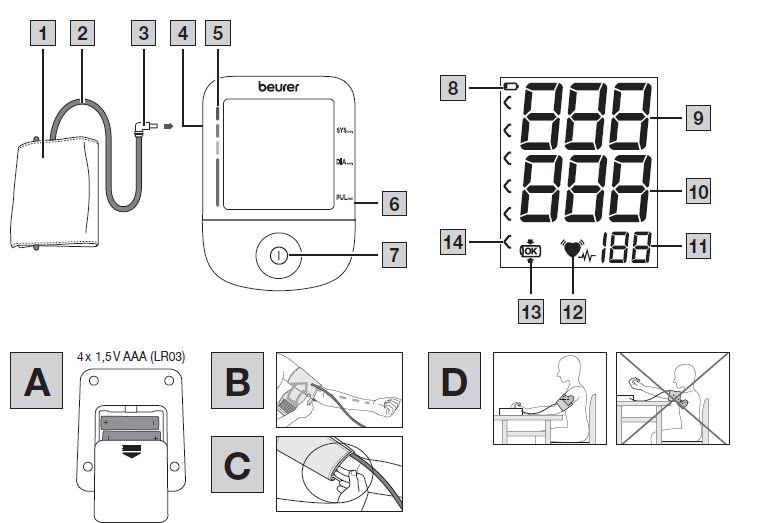
Device Description
- Cuff
- Cuff line
- Cuff connector
- Connection for cuff connector (left-hand side)
- Risk indicator
- Connection for mains adapter
- START/STOP button
Information on the Display
- Low battery indicator
- Systolic pressure
- Diastolic pressure
- Calculated pulse value
- Cardiac arrhythmia symbol / Pulse symbol
- Cuff position control
Risk indicator
Specifications — Technical Details & Key Features
The following technical specifications and capabilities summarize the beurer Upper Arm Blood Pressure Monitor BM 23 for quick reference.
- Measurement type: Automatic upper‑arm blood pressure and pulse measurement (oscillometric).
- Cuff size: Included cuff for upper arm circumference 22–42 cm (22–42 cm). [Fits most adults]
- Display: Clear, easy‑to‑read LCD with coloured risk indicator (green/yellow/orange) for immediate classification of results.
- Functions: One‑button operation, cuff fit check, arrhythmia detection, automatic pressure preselection and deflation technology, automatic switch‑off, low battery indicator.
- Connectivity: Scan & Save function — scan the on‑screen measurement with the beurer HealthManager Pro app to record results digitally (no Bluetooth required). [Scan & Save simplifies logging]
- Power: 4 × AAA batteries included; integrated USB‑C port for optional mains operation (mains adapter sold separately).
- Dimensions & weight: Approx. 120 × 90 × 40 mm; weight approx. 318 g (without batteries, with cuff).
- Certifications/classification: Medical device (compliant with applicable EU MDR 2017/745 where sold in EU markets).
- Warranty: Manufacturer warranty typically 5 years (check local documentation/retailer for region‑specific terms).
Performance notes and comparison: the BM 23 emphasizes ease of use and comfortable readings through deflation technology and cuff‑fit guidance, comparable to other mid‑range home upper‑arm monitors (for example, products from manufacturers such as Omron and A&D Healthcare). Its Scan & Save function is an advantage for users who prefer camera‑based digital logging rather than manual entry or Bluetooth sync.*
Intended Use
The blood pressure monitor (hereinafter referred to as the device) is intended for the fully automatic, non-invasive measurement of arterial blood pressure and pulse values on the upper arm. It is designed for self-measurement by adults in a domestic environment.
Intended Users
The blood pressure measurement is suitable for adult users whose upper arm circumference is within the range printed on the cuff.
Clinical Benefits
The user can record their blood pressure and pulse values quickly and easily using the device. The recorded values are classified according to internationally applicable guidelines and evaluated graphically. Furthermore, the device can detect any irregular heartbeats that occur during measurement and inform the user via a symbol on the display.
Indications
In the event of hypertension or hypotension, the user can independently monitor their blood pressure and pulse values at home. However, the user does not need to be suffering from hypertension or arrhythmia to use the device.
Contraindications
Warning:
- Do not use the blood pressure monitor on newborns, children or pets.
- Persons with reduced physical, sensory or mental capabilities should be supervised by a person responsible for their safety and receive instructions from that person on how to use the device.
- Do not use the device if you are using electrical implants (e.g. pacemakers).
- Do not use the device if you have metal implants.
- Do not use the cuff on people who have undergone a mastectomy or lymph node clearance.
- Do not place the cuff over wounds, as this may cause further injury.
- Make sure that the cuff is not placed on an arm whose arteries or veins are undergoing medical treatment, e.g. intravascular access or intravascular therapy, or an arteriovenous (AV) shunt.
- Do not use the device on people with allergies or sensitive skin.
Undesirable Side Effects
- Skin irritation.
- Negative influence on blood circulation.
Warnings and Safety Notes
Warning:
- The measurements you take are for your information only. They are not a substitute for a medical examination. Discuss your measured values with your doctor and never make your own medical decisions based on them (e.g. regarding medicine doses).
- The device is only intended for the purpose described in these instructions for use. The manufacturer is not liable for damage resulting from improper or incorrect use.
General Precautions
Caution:
- The blood pressure monitor is made from precision and electronic components. The accuracy of the measurements and service life of the device depend on its careful handling.
- Protect the device and its mains adapter from impacts, humidity, dirt, major temperature fluctuations and direct sunlight.
- Ensure the device is at room temperature before taking a measurement. If the measuring device has been stored close to the maximum or minimum storage and transport temperatures and is placed in an environment with a temperature of 20°C, it is recommended that you wait approximately 2 hours before using the measuring device.
- Do not use the device in the vicinity of strong electromagnetic fields and keep it away from radio systems or mobile telephones.
Notes on Handling Batteries
Warning:
- Risk of explosion and fire: Failure to comply with the following points can result in personal injury or cause overheating, leakage, venting, breakage, explosion or fire of the battery.
- This device contains non-rechargeable batteries which must not be charged.
- Do not throw batteries into a fire.
- Never charge, forcibly discharge, heat, disassemble, open, crush, deform, encapsulate or modify batteries.
- Never short-circuit batteries or battery compartment contacts.
- Protect the batteries from direct sunlight, rain, heat, and water.
- Exposure of batteries to an environment with extremely high temperatures or extremely low air pressure may result in explosion or leakage of flammable liquids and gases.
- Dispose of defective and discharged batteries immediately and properly (see the chapter on disposal).
- Do not use modified or damaged batteries.
Notes on Electromagnetic Compatibility
Caution:
- The device is suitable for use in all environments listed in these instructions for use, including domestic environments.
- The device may not be fully usable in the presence of electromagnetic disturbances. This could result in issues such as error messages or failure of the display or device.
- Avoid using this device directly next to other devices or stacked on top of other devices, as this could lead to faulty operation. If it is necessary to use the device in this manner, this device and the other devices must be monitored to ensure they are working properly.
- The use of accessories and/or replacement parts other than those specified or provided by the manufacturer of this device could lead to an increase in electromagnetic emissions or a decrease in the device's electromagnetic immunity. This can result in faulty operation.
Usage
Inserting the Batteries
- Remove the battery compartment cover on the back of the device (A).
- Insert the batteries (see the chapter "Technical Specifications"). Make sure the polarity is correct according to the label (A).
- Close the battery compartment cover.
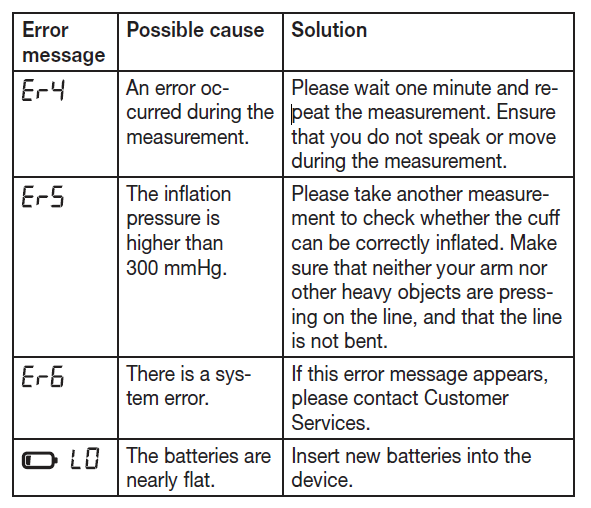
If the battery replacement symbol is displayed and does not disappear, measurement is no longer possible. Replace all the batteries.
Operation with the Mains Part
You can also operate this device with a mains part (not included in delivery). However, before connecting the device with the mains part, please ensure that you have removed the batteries from the device. During mains operation, there must not be any batteries in the battery compartment, as this could damage the device.
- To avoid any potential damage, the device may only be operated with a mains part that meets the specifications described in the chapter "Technical Specifications".
- Furthermore, the mains part must only be connected to the mains voltage specified on the type plate.
- Insert the mains adapter into the connection provided for this purpose on the blood pressure monitor.
- Then insert the mains plug of the mains part into the mains socket.
- After using the blood pressure monitor, unplug the mains part from the mains socket first and then disconnect it from the blood pressure monitor.
Before the Blood Pressure Measurement
General Rules When Measuring Your Own Blood Pressure
- In order to generate an informative profile of changes in your blood pressure that can be used for comparisons, you should measure your blood pressure regularly and always at the same time of day. Measure your blood pressure twice a day: once in the morning after getting up and once in the evening.
- Always perform the measurement when you are sufficiently physically rested. Avoid taking measurements at stressful times.
- Do not measure within 30 minutes of eating, drinking, smoking or exercising.
- Before the initial blood pressure measurement, always rest for about 5 minutes.
- If you want to take several measurements in succession, always make sure that you leave 5 minutes between each measurement.
- Repeat the measurement if you have doubts about the measured value.
Attaching the Cuff
You can measure your blood pressure on either arm. Some deviations between the values in the right and left arm are perfectly normal. Always measure the arm with the higher blood pressure values. Consult your doctor about this before starting self-measurement.
- Always measure your blood pressure on the same arm.
- Only use the device with the cuff supplied, based on your upper arm circumference.
Before taking the measurement, check the fit using the index mark described below.
- Expose your upper arm. The circulation of the arm must not be hindered by tight clothing or similar restrictions.
- The cuff must be placed on the upper arm so that the bottom edge is positioned 2–3 cm above the elbow and over the artery. The line should point to the centre of the palm (B).
- The cuff should be fastened so that two fingers fit under the cuff when it is closed (C).
- Now insert the cuff line into the connection for the cuff connector.
- The cuff is suitable for you if the index mark is within the OK range after fitting the cuff.
Adopting the Correct Posture
- Sit in a comfortable upright position when taking the blood pressure measurement. Lean back so that your back is supported.
- Place your arm on a surface (D).
- Place your feet flat on the ground next to one another.
- The cuff must be level with your heart.
- Stay as still as possible during the measurement and do not talk.
Taking a Blood Pressure Measurement
Requirement: Cuff attached.
Measurement
- Press the START/STOP button. All display elements are briefly displayed.
- The cuff inflates automatically, and the measurement process starts.
- The pulse symbol is displayed as soon as a pulse is detected.
- To cancel the measurement, press the START/STOP button.
- The systolic pressure, diastolic pressure and pulse measurements are displayed.
- The cuff position control symbol is displayed throughout the entire measurement.
- If the cuff is too loose, the relevant cuff position warning symbols will be displayed. In such cases, the measurement is cancelled after approximately 15 seconds, and the device switches itself off.
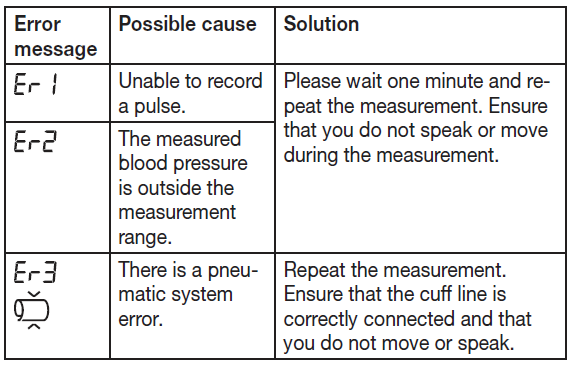
- An error indication is displayed if the measurement could not be performed properly. In this case, refer to the "Troubleshooting" section.
- If necessary, reattach the cuff after 1 minute.
- The device switches off automatically after approximately 1 minute.
Evaluating the Results
General Information About Blood Pressure
- Blood pressure is the force with which the bloodstream presses against the arterial walls. Arterial blood pressure constantly changes during a cardiac cycle.
- Blood pressure is always stated in the form of two values:
- Systolic Blood Pressure: The highest pressure. This occurs when the heart muscle contracts and blood is pumped into the blood vessels.
- Diastolic Blood Pressure: The lowest pressure. This occurs when the heart muscle has completely relaxed again and the heart is filling with blood.
- Fluctuations in blood pressure are normal. Even during repeat measurements, there may be considerable differences between the measured values. One-off or irregular measurements therefore do not provide reliable information about actual blood pressure. Reliable assessment is only possible when you perform the measurement regularly under comparable conditions.
Cardiac Arrhythmia
The device can identify heart rhythm abnormalities during the blood pressure measurement. If the cardiac arrhythmia symbol is displayed after the measurement, this indicates that an irregularity has been detected in your pulse. Repeat the measurement if the cardiac arrhythmia symbol is displayed. When assessing your blood pressure, only use the results that have been recorded without any irregularities in your pulse. Consult your doctor if the cardiac arrhythmia symbol is displayed frequently. Only a doctor can determine, through an examination, whether there is an abnormality.
Risk Indicator
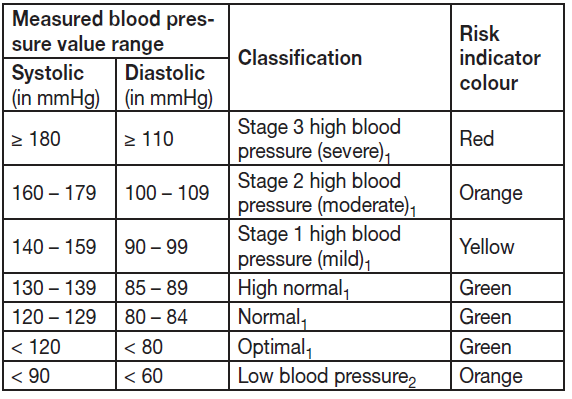
The risk indicator shows which category the recorded blood pressure values fall into. If the measured values are in two different categories (e.g. systolic pressure in the "high normal" range and diastolic pressure in the "normal" range), the risk indicator always indicates the higher range, which is "high normal" in this example. Note that these default values are for general guidance only, as individual blood pressures may vary. Please note that self-measurement at home usually results in values lower than those recorded at a doctor's surgery. Consult your doctor at regular intervals. Only a doctor can give you personal target values for controlled blood pressure, particularly if you are receiving medical therapy.
Low Blood Pressure
Warning:
Low blood pressure (hypotension) can be a health hazard and cause dizziness or fainting. Blood pressure is considered low if systolic pressure is below 90 mmHg or diastolic pressure is below 60 mmHg (source: National Health Service, 2023). Seek medical attention if you suddenly suffer from low blood pressure.
Cleaning and Maintenance
- Clean the device and cuff carefully using only a slightly damp cloth.
- Do not use any cleaning solutions or solvents.
- Under no circumstances hold the device or cuff under water, as this can cause liquid to enter and damage the device and cuff.
- If you store the device and cuff, do not place heavy objects on them. The cuff line should not be bent sharply.
Troubleshooting — Common Problems, Error Codes & Fixes
- No power / device won’t start: Ensure 4 × AAA batteries are correctly installed and have charge; replace batteries if low (low battery indicator displayed). Alternatively connect USB‑C power supply (mains adapter sold separately) and retry.
- Incorrect or unstable readings: Recheck cuff position and fit—use cuff fit check guidance on the display; sit upright with back supported, feet flat, arm at heart level and rest for 5 minutes before measuring; avoid talking, eating or smoking immediately before measurement.
- “Err” or measurement aborted: Movement or speaking during measurement can trigger abort; keep still and retry; if repeated errors occur, remove and reapply cuff and ensure cuff tubing is not kinked or pinched.
- Arrhythmia alert displayed: The unit indicates possible irregular heartbeat; repeat the measurement and consult a healthcare professional if the irregularity persists or symptoms occur.
- Scan & Save issues (camera scanning not recognized): Ensure app is the latest beurer HealthManager Pro version, good ambient lighting and steady camera alignment over the monitor display; enter values manually in the app if scanning fails.
- Preventive measures: Regularly check cuff for wear and contamination; store device in a dry place; avoid electromagnetic interference—keep portable RF transmitting devices (like mobile phones) at least 30 cm from the device during measurement.
- Support & warranty: The BM 23 typically carries a 5‑year manufacturer warranty; for repairs, warranty claims, or technical help contact beurer customer support through the regional beurer website or the retailer where purchased.*
Pros & Cons — Balanced Assessment
- Pros — Easy, comfortable operation: One‑button design and deflation technology provide comfortable, repeatable readings for non‑technical users; cuff fit guidance reduces user error.
- Pros — Digital logging made simple: Scan & Save lets users capture measurements into the beurer HealthManager Pro app with a smartphone camera without needing Bluetooth pairing, ideal for users who prefer minimal setup.
- Pros — Modern conveniences: USB‑C power option adds flexibility for mains operation; compact, lightweight design is travel‑friendly.
- Cons — Limited built‑in memory / connectivity: The BM 23 focuses on camera‑scan logging rather than integrated Bluetooth/Wi‑Fi cloud sync, which may be less convenient for users seeking automatic wireless sync to health platforms.
- Cons — Cuff size limits: Standard cuff fits 22–42 cm; users with larger or much smaller arms will need to purchase alternative cuff sizes where available.
- Value for money: Offers strong value as a mid‑range, medically classified home monitor with modern features (arrhythmia detection, cuff fit check and Scan & Save), competing well against similar models from other mainstream brands.
- Alternatives comparison: Compared to Bluetooth‑enabled models from competitors, the BM 23’s camera‑based Scan & Save is simpler but less automated; users wanting full cloud integration may prefer Bluetooth models, while users prioritizing simplicity and comfort will find BM 23 attractive.
Customer Reviews — What Users Say
Summary of common customer feedback (synthesised from retailer listings and product pages):
- Praises: Users frequently highlight the simple one‑button operation, comfortable inflation/deflation and clear colour risk indicator as convenient for seniors and caregivers.*
- Complaints: Some customers note preference for native Bluetooth syncing rather than Scan & Save camera capture; a few report occasional scanning difficulties under poor lighting conditions.*
- Ratings & testimonials: Review scores vary by retailer and region; many listings emphasize reliability and ease of use with multiple customers recommending the BM 23 for routine at‑home monitoring.
- Purchase recommendation: Recommended for users who want an accurate, easy‑to‑use upper arm monitor with simple digital logging via smartphone scan. For users requiring automatic wireless sync or specialized cuff sizes, compare alternative models before purchase.
SEO & Keywords (naturally included)
This manual includes the primary keyword beurer Upper Arm Blood Pressure Monitor BM 23 multiple times and uses related and long‑tail phrases such as *upper arm blood pressure monitor*, *Scan & Save beurer HealthManager Pro*, *deflation technology blood pressure monitor*, *cuff fit guidance 22–42 cm*, and *arrhythmia detection home monitor* to aid discoverability and featured snippet chances.
Help & Contact Information
For product registration, warranty claims or technical support, consult the documentation included with your BM 23 or visit the regional beurer support page and contact beurer customer service or the retailer where the unit was purchased.*
Faqs
How do I set up the beurer Upper Arm Blood Pressure Monitor BM 23 for the first time?
What should I do if the beurer Upper Arm Blood Pressure Monitor BM 23 shows an error or irregular readings?
How does the Scan & Save feature work on the beurer Upper Arm Blood Pressure Monitor BM 23?
Is the beurer Upper Arm Blood Pressure Monitor BM 23 compatible with the beurer HealthManager Pro app?
What cuff size is required for the beurer Upper Arm Blood Pressure Monitor BM 23 and how to ensure accurate fit?
How can I optimize blood pressure readings with the beurer Upper Arm Blood Pressure Monitor BM 23?
How do I maintain and clean the beurer Upper Arm Blood Pressure Monitor BM 23 properly?
What makes the arrhythmia detection feature on the beurer Upper Arm Blood Pressure Monitor BM 23 useful?
More beurer manuals
- Setup: Beurer Upper Arm Blood Pressure Monitor BM-54 User Manual
- Setup: Beurer Blood Pressure Monitor BM-51 easyClip User Manual
- Setup: Beurer Blood Pressure Monitor BC-27 User Manual
- Setup: Beurer Wrist Blood Pressure Monitor BC-51 User Manual
- Setup: Beurer Upper Arm Blood Pressure Monitor BM-48 User Manual
- Setup: Beurer Blood Pressure Monitor BM-26 User Manual
Leave a Comment