
How to Use: Fitbit Charge 5 Fitness Tracker User Manual
Content
Fitbit Charge 5 Fitness Tracker
Introduction
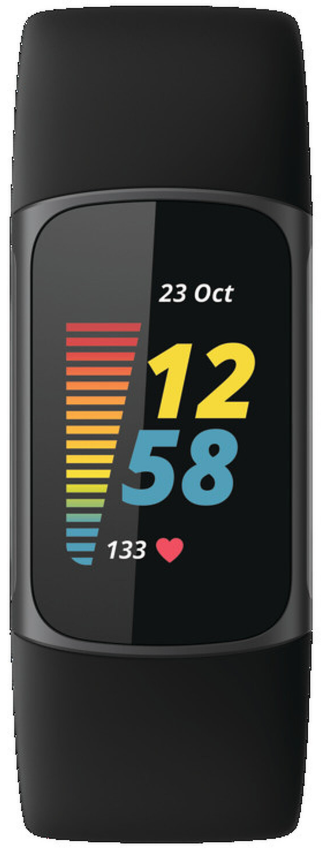
The Fitbit Charge 5 Fitness Tracker is a sleek, advanced wearable designed to empower users in managing their health and fitness with precision. Featuring a vibrant AMOLED color touchscreen, it delivers real-time insights into critical health metrics such as heart rate, SpO2 (blood oxygen levels), sleep quality, and stress via an innovative EDA (electrodermal activity) sensor. This device is ideal for fitness enthusiasts, health-conscious individuals, and those seeking detailed wellness tracking in a compact form factor.
Uniquely, the Charge 5 integrates an onboard GPS for accurate outdoor exercise mapping, alongside an ECG app that monitors heart rhythms and can potentially detect atrial fibrillation (AFib), enhancing heart health awareness. Additionally, it provides a Daily Readiness Score to optimize workout routines and recovery, ideal for users balancing active and rest days. The tracker is water-resistant up to 50 meters, making it suitable for swimming and various outdoor activities.
Priced approximately between $130 to $180, depending on the retailer and promotions, the Fitbit Charge 5 is widely available online and in major electronics stores. It includes a six-month Fitbit Premium membership, offering advanced analytics, guided workouts, mindfulness tools, and personalized health insights. Whether you are tracking daily steps, managing stress, or seeking in-depth sleep analysis, the Fitbit Charge 5 delivers comprehensive data to support healthier lifestyle decisions.
Get started
What's in the box
Your Charge 5 box includes:
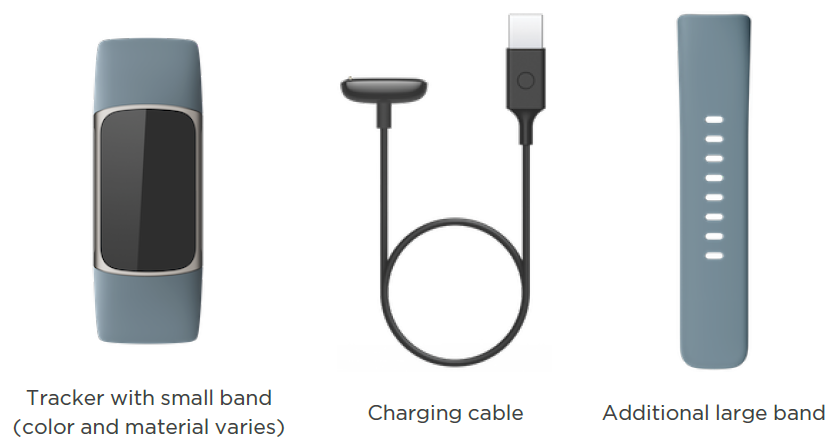
The detachable bands on Charge 5 come in a variety of colors and materials, sold separately.
Charge your tracker
A fully-charged Charge 5 has a battery life of up to 7 days. Battery life and charge cycles vary with use and other factors; actual results will vary.
To charge Charge 5:
- Plug the charging cable into the USB port on your computer, a UL-certified USB wall charger, or another low-energy charging device.
- Hold the other end of the charging cable near the port on the back of the tracker until it attaches magnetically. Make sure the pins on the charging cable align with the port on the back of your tracker.
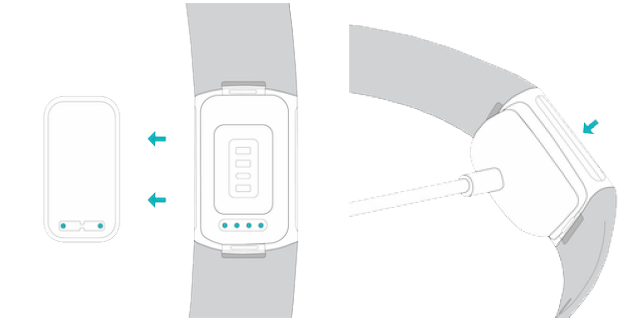
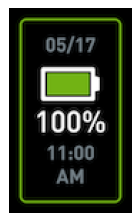
Charging fully takes about 1-2 hours. While Charge 5 charges, double-tap the screen to turn it on and check the battery level. Swipe right on the battery screen to use Charge 5. A fully charged tracker shows a solid battery icon.
Set up Charge 5
Set up Charge 5 with the Fitbit app for iPhones and iPads or Android phones. The Fitbit app is compatible with most popular phones.
To get started:
- Download the Fitbit app:
Apple App Store for iPhones
Google Play Store for Android phones - Install the app, and open it.
- Tap Sign in with Google, and follow the on-screen instructions to set up your device.
When you're done with setup, read through the guide to learn more about your new tracker and then explore the Fitbit app.
For more information, see the related help article.
See your data in the Fitbit app.p
Open the Fitbit app on your phone to see your health metrics, activity, type, and sleep data, choose a workout or mindfulness session, and more.
Unlock Fitbit Premium
- Fitbit Premium is your personalized resource in the Fitbit app that helps you stay active, sleep well, and manage stress. A Premium subscription includes programs tailored to your health and fitness goals, personalized insights, hundreds of workouts from fitness brands, guided meditations, and more.
- Customers can redeem a Fitbit Premium trial subscription in the Fitbit app.
- For more information, see the related help article.
Wear Charge 5
- Wear Charge 5 around your wrist. If you need to attach a different size band, or if you purchased another band, see the instructions in "Change the band" on page 13.
- Placement for all-day wear vs. exercise
- When you're not exercising, wear Charge 5 a finger's width above your wrist bone.
- In general, it's always important to give your wrist a regular check-up by removing your tracker for around an hour after extended wear. We recommend removing your tracker while you shower. Although you can shower while wearing your tracker, not doing so reduces the potential for exposure to soaps, shampoos, and conditioners, which can cause long-term damage to your tracker and may cause skin irritation.
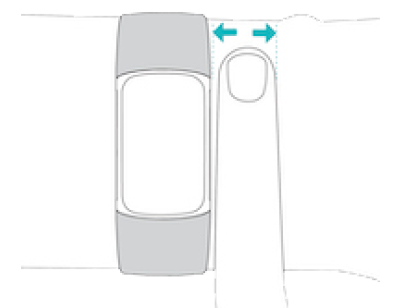
For optimized heart-rate tracking while exercising:
- During a workout, experiment with wearing your tracker a bit higher on your wrist for an improved fit. Many exercises, such as bike riding or weight lifting, cause you to bend your wrist frequently, which could interfere with the heart-rate signal if the tracker is lower on your wrist.
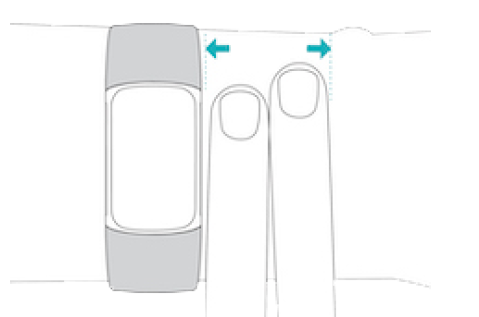
- Wear your tracker on top of your wrist, and make sure the back of the device is in contact with your skin.
- Consider tightening your band before a workout and loosening it when you’re done. The band should be snug but not constricting (a tight band restricts blood flow, potentially affecting the heart-rate signal).
- Note: If you have trouble connecting to GPS on Charge 5, see the related help article.
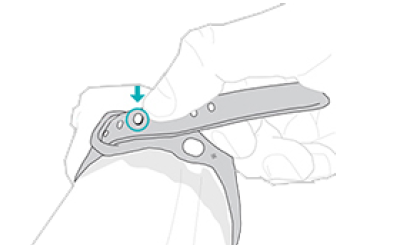
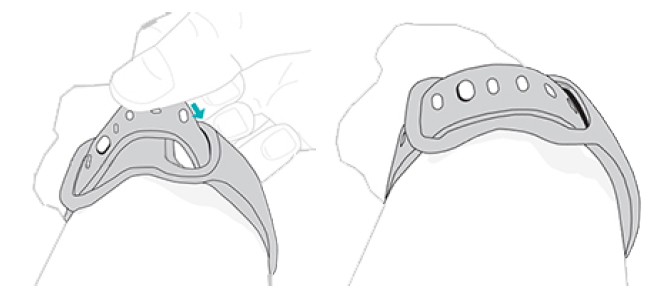
Fasten the band
- Place Charge 5 around your wrist.
- Slide the bottom band through the first loop in the top band.
- Tighten the band until it fits comfortably, and press the peg through one of the holes in the band.
- Slide the loose end of the band through the second loop until it lies flat on your wrist. Make sure the band isn’t too tight. Wear the band loosely enough that it can move back and forth on your wrist.
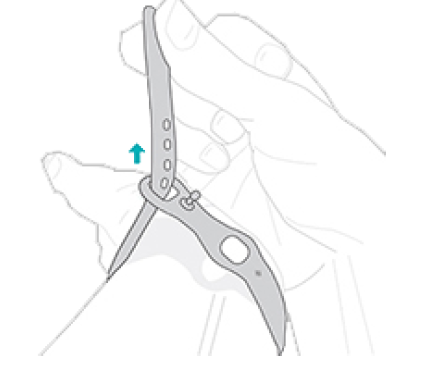
Handedness
For greater accuracy, you must specify whether you wear Charge 5 on your dominant or non-dominant hand. Your dominant hand is the one you use for writing and eating. To start, the Wrist setting is set to non-dominant. If you wear Charge 5 on your dominant hand, change the Wrist setting in the Fitbit app:
From the Today tab in the Fitbit app, tap  the icon in the top left >Charge 5 tile> Wrist> Dominant.
Wear and care tips
- Clean your band and wrist regularly with a soap-free cleanser.
- If your tracker gets wet, remove it and dry it completely after your activity.
- Take your tracker off from time to time.
- For more information, visit the Fitbit Wear & Care page.
Change the band
Charge 5 comes with a small band attached and an additional large, bottom band in the box. Both the top and bottom bands can be swapped with accessory bands, sold separately . For band measurements, see "Band size" on page 54.
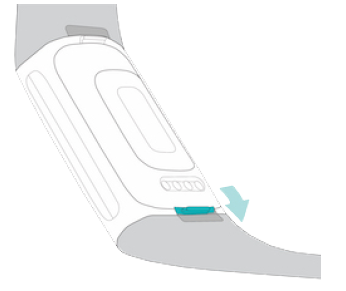
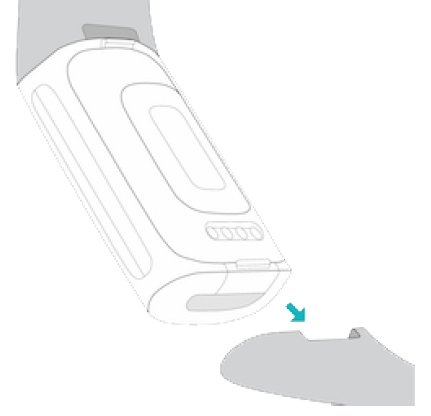
Remove a band
- Turn over Charge 5 and find the band latches.
- To release the latch, use your fingernail to press the flat button toward the band.
- Gently pull the band away from the tracker to release it.
- Repeat on the other side.
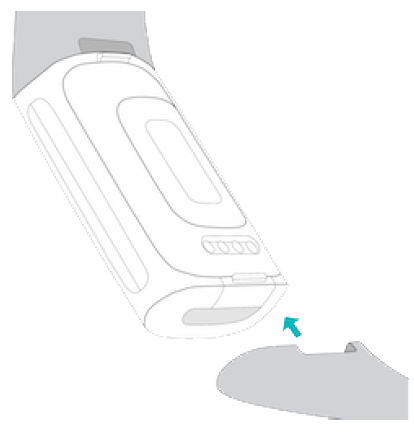
Attach a band
To attach a band, press it into the end of the tracker until you hear a click, and it snaps into place. The band with the loops and peg attaches to the top of the tracker.
Troubleshooting
If Charge 5 isn't working properly, see our troubleshooting steps below.
Heart-rate signal missing
Charge 5 continuously tracks your heart rate while you're exercising and throughout the day. If the heart-rate sensor on your tracker has difficulty detecting a signal, dashed lines appear.

If your tracker doesn't detect a heart-rate signal, first make sure heart-rate tracking is turned on in the Settings app on your tracker. Next, make sure you're wearing your tracker correctly, either by moving it higher or lower on your wrist or by tightening or loosening the band. Charge 5 should be in contact with your skin. After holding your arm still and straight for a short time, you should see your heart rate again.
For more information, see the related help article.
GPS signal missing
Environmental factors, rs including tall buildings, dense forest, steep hills, and thick cloud co, ver can interfere with your tracker's ability to connect to GPS satellites. If your tracker is searching for a GPS signal during an exercise, you’ll see “
GPS connecting ” appear at the top of the screen. If Charge 5 can't connect to a GPS satellite, the tracker stops trying to connect until the next time you start a GPS exercise.
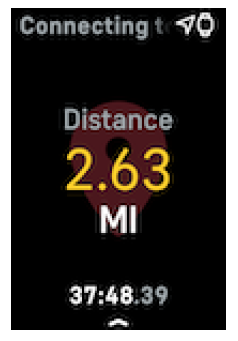
For best results, wait for Charge 5 to find the signal before you start your workout.
If you still have trouble connecting to GPS or notice that your distance traveled seems inaccurate, try the following tips to allow your device to connect to GPS satellites:
- Follow the recommendations for wearing your device for exercise. For more information, see "Wear Charge 5" on page 10.
- Try loosening the band 1 notch.
- Make sure your device doesn't touch your wrist bone.
- Avoid bending your wrist backwards.
- To more quickly establish a GPS connection, point your device toward open sky (clear of heavy tree coverage and away from tall buildings).
- Establish a GPS connection before beginning your exercise.
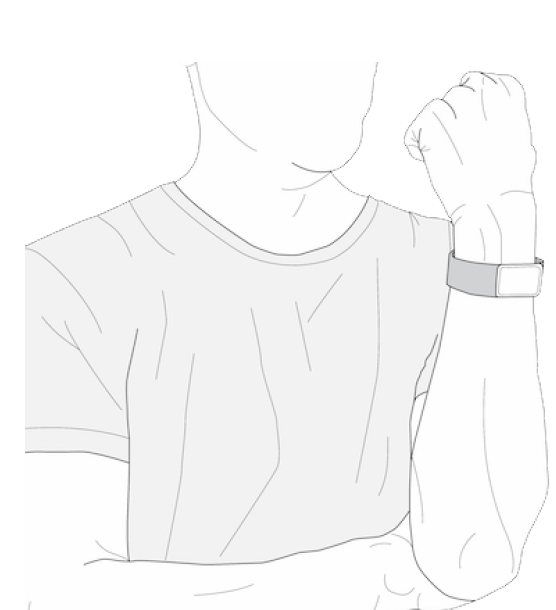
- Hold your arm parallel to your body near your head and at least 2 inches away.
For more information, see the related help article.
Other issues
If you experience any of the following issues, restart your tracker:
- Won't sync
- Won't respond to taps or swipes
- Won't track steps or other data
- Won't show notifications
General Info and Specifications
Sensors and Components
Fitbit Charge 5 contains the following sensors and motors:
- Optical heart-rate tracker
- 3-axis accelerometer, which tracks motion patterns, Ambient light sensor
- Built-in GPS receiver + GLONASS, which tracks your location during a workout
- Multipurpose electrical sensors compatible with the EDA Scan app
- Vibration motor
- Materials
The housing on Charge 5 is made of anodized aluminum and surgical-grade stainless steel. The band that comes with Charge 5 is made of a flexible, durable silicone similar to that used in many sports watches. While all stainless steel and anodized aluminum can contain traces of nickel, which can cause an allergic reaction in someone with nickel sensitivity, the amount of nickel in all Fitbit products meets the European Union's stringent Nickel Directive. - Wireless technology
Charge 5 contains a Bluetooth 5.0 radio transceiver and NFC chip. - Haptic feedback
Charge 5 contains a vibration motor for alarms, goals, notifications, reminders, and apps. - Battery
Charge 5 contains a rechargeable lithium-polymer battery. - Memory
Charge 5 stores your data, including daily stats, sleep information, and exercise history, for 7 days. See your historical data in the Fitbit app. - Display
Charge 5 has a color AMOLED display. - Band size
Band sizes are shown below. Note that accessory bands sold separately may vary slightly.- Small band
Fits a wrist between 5.5 - 7.1 inches (140 mm - 180 mm) in circumference - Large band
Fits a wrist between 7.1 - 8.7 inches (180 mm - 220 mm) in circumference
- Small band
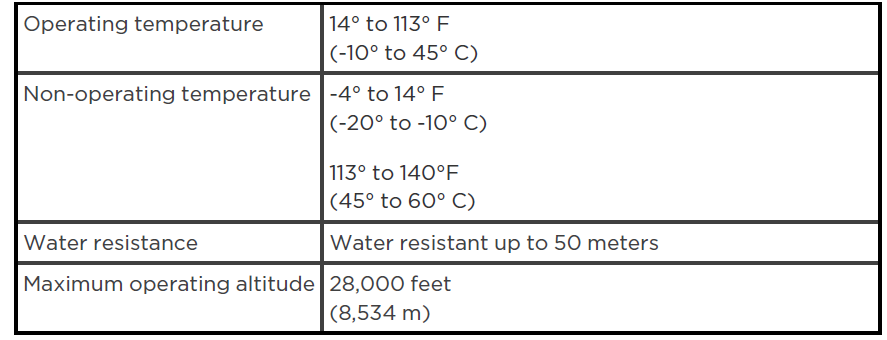
Environmental conditions
Return policy and warranty
Find warranty information and the return policy on our website.
Pros & Cons of the Fitbit Charge 5 Fitness Tracker
Pros
- Comprehensive Health Monitoring: Includes ECG, EDA stress scans, SpO2, skin temperature, and heart rate variability for multifaceted wellness tracking.
- Bright AMOLED Touchscreen: Offers a sharp, responsive display that is twice as bright as previous models, enhancing outdoor visibility.
- Built-in GPS: Enables precise tracking of distance and pace during runs or bike rides without needing a phone.
- Daily Readiness & Stress Management: Unique scores and mindfulness sessions help tailor workouts and recovery.
- Water Resistance: Rated up to 50 meters, suitable for swimming and water sports.
- Good Battery Life: Advertised up to 7 days, though real-world use with GPS and sensors tends to reduce this to about 3-5 days.
Cons
- ECG Feature Limited: ECG tracing and full AFib notifications are coming soon,oon but not fully functional at launch.
- Premium Subscription Required: Many advanced features, including detailed sleep analysis and Daily Readiness Scores, require a Fitbit Premium membership.
- No Music Controls: Unlike some competitors, the Charge 5 lacks onboard music playback or control capabilities.
- Battery Life Variability: Intensive use of GPS and sensors can significantly reduce battery life compared to the advertised maximum.
- Charging Cable Differences: The proprietary charger is not compatible with earlier Fitbit models, which may inconvenience some users.
Compared to alternatives like the Garmin Vivosmart or Xiaomi Mi Band, the Fitbit Charge 5 excels in health metric variety and display quality but falls short in music and battery endurance.
Customer Reviews of the Fitbit Charge 5 Fitness Tracker
Users generally praise the Fitbit Charge 5 Fitness Tracker for its accurate health tracking and user-friendly app integration. Many highlight the clarity of the AMOLED display and the utility of the Daily Readiness Score in managing exercise intensity. The inclusion of stress tracking and sleep insights receives frequent positive mentions, especially when paired with the Fitbit Premium membership.
Common complaints focus on the limited ECG functionality, which users expect to improve with future software updates. Some reviewers express dissatisfaction with the battery life under heavy GPS and sensor use, noting that it often falls short of the advertised 7 days. Additionally, a few users find the mandatory subscription for advanced features costly, which can affect the overall value perception.
Star ratings typically range between 4 to 4.5 out of 5, with testimonials recommending the device for those seeking a balance between fitness tracking and health monitoring. Purchase recommendations frequently include consideration of the Fitbit Premium subscription to unlock the full potential of the tracker’s insights.
Faqs
How do I set up my fitbit Charge 5 Fitness Tracker for the first time?
What should I do if my fitbit Charge 5 Fitness Tracker is not syncing data with the app?
How do I use the built-in GPS feature on the fitbit Charge 5 Fitness Tracker for outdoor workouts?
Can I use my fitbit Charge 5 Fitness Tracker with both Android and iOS devices?
How do I optimize battery life on my fitbit Charge 5 Fitness Tracker?
What are the best ways to troubleshoot if my fitbit Charge 5 Fitness Tracker freezes or becomes unresponsive?
How do I maintain and clean my fitbit Charge 5 Fitness Tracker to ensure longevity?
What unique features does the fitbit Charge 5 Fitness Tracker offer for stress and health monitoring?
More fitbit manuals
- How to Use: Fitbit Flex Wireless Activity + Sleep Wristband User Manual
- Setup: Fitbit Charge 4 Fitness Tracker Instruction Manual
- Setup: Fitbit Flex 2 Wristband User Guide
- How to Use: Fitbit Charge 3 User Manual
- How to Pair: Fitbit Flyer Headphones Instruction Guide
- How to Use: Fitbit Charge 3 Fitness Tracker User Manual
Leave a Comment